SKT CEO Jung Jae-heon Takes the Podium at Seoul National University: "Overcome Discomfort to Rise Along the J-Curve in AX"
- Input
- 2026-09-02 13:15:15
- Updated
- 2026-09-02 13:15:15
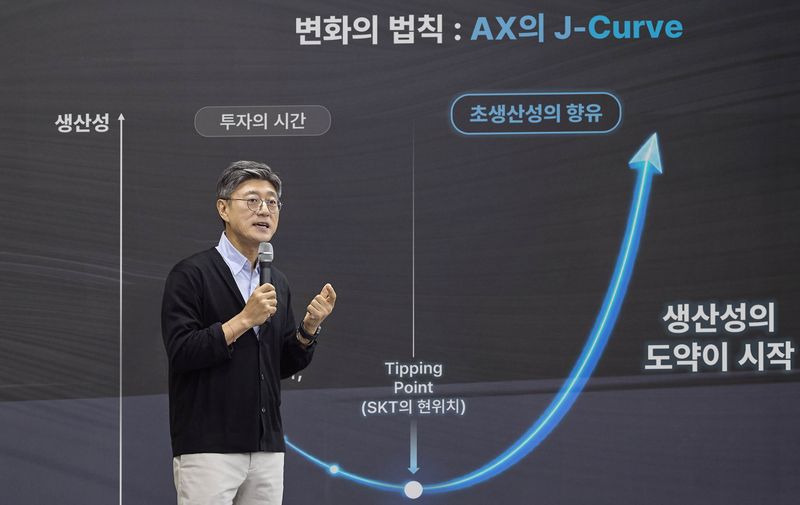
[Financial News]"Only when we move beyond familiar inefficiencies and confront extremes at the edge of a cliff can we reach the hyper-productivity innovation of the J-curve."Jung Jae-heon, CEO of SKT, emphasized in a special lecture for Seoul National University students that organizations must endure the initial decline in productivity during AI transformation (AX) before they can achieve a sharp increase in productivity.
Jung delivered the lecture, titled "Choices and Opportunities in the AI Era," to more than 300 undergraduate and graduate students at Seoul National University's Building 1 of the College of Engineering on the 1st. The lecture was part of the SKT–Seoul National University AI joint program, which SKT and Seoul National University have operated for 10 years. It also marked Jung's return to his alma mater's podium nearly 40 years after he entered Seoul National University's Department of Public Law in 1987.
Jung explained the purpose of the lecture, saying, "I did not come here to teach technology. I came to share what one company at the forefront of AI transformation is thinking about today."
Cars took 100 years, mobile phones 10 years... AI became mainstream in one month
He observed that the value and density of time are changing with the emergence of AI. He cited the fact that it took more than 60 years for cars to become widespread and more than 10 years for mobile phones to spread, while ChatGPT gained 50 million users just one month after its launch.
Jung also stressed that the AI race has expanded beyond competition among companies to competition among nations. Just as oil and semiconductors once determined national competitiveness, AI is now becoming a key strategic asset. He explained the importance of Sovereign AI, warning that countries and companies without their own AI capabilities will find it difficult to determine prices and terms for themselves if they depend on technologies from other countries or companies.
"How to work in the AX era: see the familiar anew, confront extremes, and embrace discomfort"
The lecture centered on the "J-curve of AX," a pattern Jung derived firsthand while leading SKT's AX efforts over the past year, along with three methodologies for working in the AX era: seeing the familiar anew, confronting extremes, and embracing discomfort.
The J-curve is an economic theory originally used to explain the relationship between exchange rates and the trade balance. When the exchange rate rises, the trade balance may appear likely to improve immediately, but it initially worsens because of the time lag before import and export volumes adjust. The term comes from the shape's resemblance to the letter "J."
Jung applied this concept to AI transformation. Although adopting AI may seem likely to improve efficiency immediately, productivity can actually decline because of a time lag between technological innovation and productivity gains. His view is that only organizations that endure this downturn can achieve a steep rise in productivity.
He said, "If you turn back at the valley of discomfort, you will remain on the left side of the curve forever. But organizations that endure it eventually bend upward in the shape of a J," adding, "Seeing the familiar anew, confronting extremes, and embracing discomfort are the ways to cross this valley."
"Seeing the familiar anew" means questioning assumptions that have long been taken for granted to discover new possibilities. Jung said SKT places the question, "If we assume AI from the outset, how should we redesign this work?" before every task.
"Confronting extremes" means challenging oneself by pushing into extreme situations. Setting goals that cannot be reached through existing methods can instead provide momentum. SKT's development of its own ultra-large AI model, A.X K2, with 688 billion parameters using limited GPU resources is one example.
"Embracing discomfort" means overcoming the difficulties that arise during the early stages of AI transformation. One SKT developer had been spending 50 hours processing system modifications requested by customers. When the developer tried to perform the work with AI, it initially took more than 500 hours because an AI agent had to be newly created and modified, followed by hundreds of rounds of verification. The same task now takes only one hour.
Insight and empathy are the keys to competitiveness in the AI era
Jung emphasized, "We are living in an era when it may seem that AI will decide everything, but I do not think that is the case. Insight to set one's own direction with initiative and empathy are the sources of competitiveness."
Citing SK Group Chairman Chey Tae-won's "four conditions for talent in the AI era," he explained that people need the "thinking muscle" to see into the essence, the "adaptability muscle" to adjust to change and learn again after failure, the "empathy muscle" that AI will ultimately struggle to possess, and "physical intelligence" that turns embodied experience into value.
Jung concluded the lecture by saying, "Ten years ago, we asked whether AI could surpass humans. Today, we are asking what we will create with AI. I sincerely look forward to meeting you again as colleagues on the dynamic front lines of AI innovation, where you will be the ones to create the answer to this question 10 years from now."
[email protected] Yoon Hong-jip Reporter