September Mock CSAT Korean Section Harder Than June Test but Slightly Easier Than Last Year’s CSAT
- Input
- 2026-09-02 10:40:21
- Updated
- 2026-09-02 10:40:21
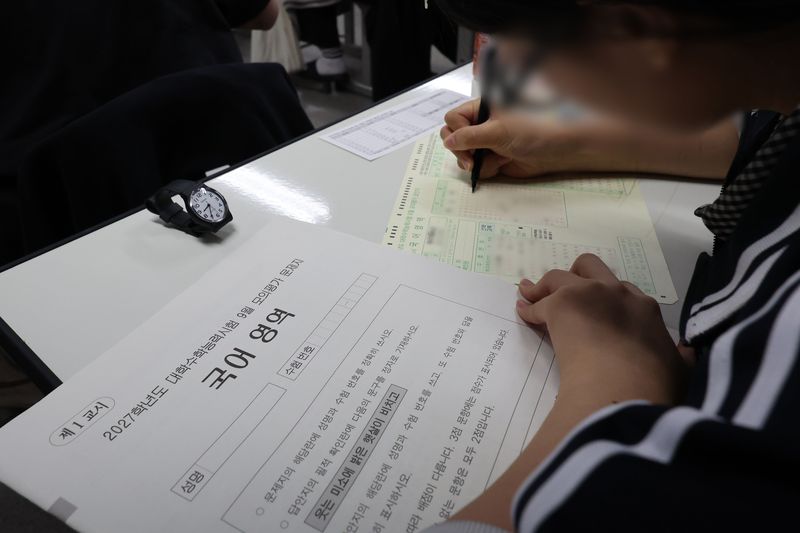
According to education and admissions experts on September 2, the Korean section of the September mock test for the 2027 CSAT focused on addressing concerns over weakened differentiation in the June mock test while maintaining an appropriate level of difficulty.
Han Byung-hoon, who briefed reporters on behalf of the EBS field teacher panel, stated, "The test was more difficult than this June’s mock test and was similar in difficulty to last September’s mock test." He added, "There were definitely no questions requiring excessive inference beyond the curriculum," explaining that "the test ensured differentiation through inferential thinking that allowed students to draw conclusions sufficiently grounded in the passages."
Admissions experts also agreed that the Korean section was designed with an appropriate level of differentiation. The June mock test had a top standard score of only 132 in Language and Media, while the cutoff for the top grade reached 95 points. Compared with that test, experts expected students to perceive this exam as more difficult.
Nam Yungon, head of the admissions strategy research institute at MegaStudyEdu, assessed, "This September mock test’s Korean section was easier than last year’s CSAT but somewhat more difficult than this June’s test." He added, "Questions 8 and 13 in the common reading section were difficult, and students likely found them challenging to solve. Question 33 in literature and Question 40 in Speech and Writing probably also took some time to answer." Nam analyzed that although the humanities, social sciences, and technology passages in the reading section were all linked to the EBS CSAT Special Lecture, the perceived level of linkage was not high. In particular, he said the technology passage had a low degree of linkage and was the most challenging passage on the test.
Lim Seong Ho, head of Jongro Academy, likewise analyzed, "The test was set at an appropriate level of difficulty to ensure differentiation," adding, "It appears to have been more difficult than the easily administered June mock test, while being similar to or somewhat easier than last year’s actual CSAT." The top standard score in Language and Media on last year’s CSAT was 147. Lim noted, "Students spent relatively more time on the literature section than on reading, and the appearance of question types somewhat different from the established style may have placed a burden on them." He added, "Questions 7 and 8, which dealt with humanities and philosophy, and Question 13 on technology are likely to be key questions separating students in the upper grade bands."
Looking at the key questions, both MegaStudyEdu and Jongro Academy identified Question 8 from an integrated humanities passage dealing with artificial intelligence and the concept of personhood, as well as Question 13 from a technology passage asking about how an adapter’s switching mechanism operates, as difficult. Nam additionally singled out Question 33 in literature and Question 40 in Speech and Writing, while Lim identified Question 7 in reading as another challenging question. Question 26 in literature was a new type that required students to understand one work and use that understanding to interpret another, rather than relying on the external criteria provided in the reference. However, Han Byung-hoon and MegaStudyEdu analyzed that the question was unlikely to have significantly increased the test’s perceived difficulty.
Experts advised students not to overreact to the mock test results with only about two months remaining before the CSAT, but instead to use them as an opportunity to quickly address their weaknesses. Han Byung-hoon urged students to "identify the flow of reasoning emphasized in the linked materials and past questions and focus on improving areas where they are lacking," noting that "the degree of scene matching with EBS-linked CSAT preparation materials is high, particularly for literary works." Nam also stressed the need for reading practice that involves "reading passages and answer choices in segments and finding clear evidence within the passage," while emphasizing thorough review of the EBS-linked materials.
[email protected] Kim Man-gi Reporter