Korea and Australia’s Business Communities Strengthen Strategic Partnership, Expand Cooperation in Critical Minerals, AI and Defense
- Input
- 2026-09-02 11:03:38
- Updated
- 2026-09-02 11:03:38
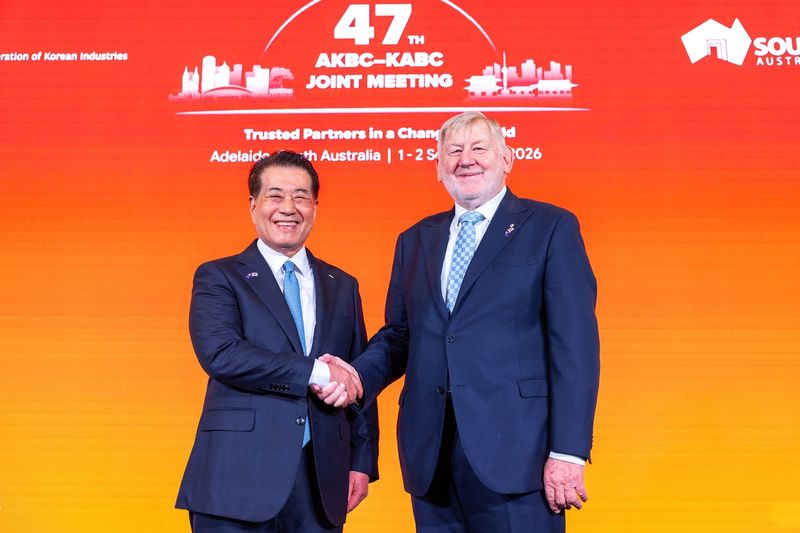
[Financial News] The Federation of Korean Industries (FKI) issued a joint statement marking the 65th anniversary of diplomatic relations between Korea and Australia, calling for stronger cooperation in future-oriented advanced industries beyond resource- and trade-centered collaboration. The statement focused on strengthening the two countries’ strategic partnership across the board in response to geopolitical uncertainty.
On the 2nd, FKI held a joint meeting of the 47th Korea–Australia Economic Cooperation Committee with the Australia–Korea Business Council (AKBC) at Adelaide Oval and adopted the joint statement.
In particular, the two sides agreed to integrate their critical-mineral and battery-material value chains and strengthen financial support from export credit agencies (ECAs); expand cooperation in advanced defense industries linked to artificial intelligence (AI), data centers, space, and AUKUS (Australia-United Kingdom-United States security partnership) Pillar II; and diversify cooperation in clean energy, including renewable energy, hydrogen and carbon capture and storage (CCS). They also agreed on the need to strengthen regional economic integration through Korea’s accession to the Comprehensive and Progressive Agreement for Trans-Pacific Partnership (CPTPP), and confirmed Australia’s active support.
About 200 business leaders and senior government officials from both countries attended the meeting, including Chang In-hwa, chairman of the Korea–Australia Economic Cooperation Committee and chairman of POSCO Group; Kim Chang-beom, executive vice chairman of FKI; Kim Ji-min, minister-counsellor at the Embassy of the Republic of Korea in Australia; Yong Jun Choi, consul general in Sydney; Yoon Young-mi, president of the Korea Importers Association; Martin Ferguson, chairman of the Australia–Korea Business Council; Foreign Minister Penny Wong; and Trade and Tourism Minister Don Farrell.
In his opening remarks, Chang In-hwa presented three key areas of cooperation to help the two countries jointly lead future industries: upgrading critical-mineral supply chains, creating a clean-energy ecosystem, and expanding cooperation in defense, shipbuilding, space and advanced research and development (R&D).
Park Jung-sung, head of the Ministry of Trade’s trade negotiations office, emphasized in a video congratulatory address that solidarity among trusted partners is more important than ever as the global trade environment undergoes rapid change. For Korea–Australia cooperation, he proposed energy and resource security cooperation, collaboration on critical-mineral supply chains, expanded trade and investment, and stronger coordination on multilateral trade through the World Trade Organization (WTO) and Asia-Pacific Economic Cooperation (APEC).
Kim Chang-beom, executive vice chairman of FKI, who participated in the panel session, emphasized, "We must expand the partnership beyond existing resource-supply cooperation to the full range of future advanced industries, including critical-mineral supply chains, AI, space and defense."
Participants also presented a vision of advancing bilateral cooperation to the level of a technology partnership through the development of critical-mineral technologies. They further called for a mutually beneficial model that combines Korean companies’ manufacturing capabilities with Australia’s infrastructure needs amid a global shortage of power equipment.
[email protected] Park So-hyun Reporter