What Are the Corporate Response Strategies for Tax Audits? Lee & Ko Tax Forum Concludes Successfully [Law Firm News]
- Input
- 2026-09-02 10:40:00
- Updated
- 2026-09-02 10:40:00
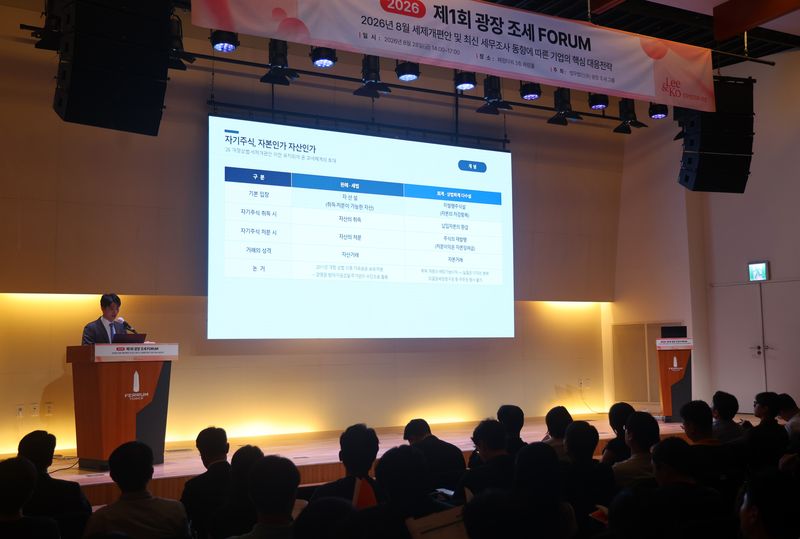
[Financial News] Lee & Ko reviewed this year’s tax reform proposals and recent tax audit trends, presenting response strategies that companies can apply in their day-to-day operations. The forum covered a wide range of issues of keen interest to businesses, including changes to the taxation system for treasury shares, methods for valuing listed shares in response to so-called “stock price suppression,” tax deferral for overseas subsidiary restructurings, and reforms to the business succession system.
Lee & Ko announced on the 2nd that it had held the 2026 Lee & Ko Tax Forum at Ferum Hall in Ferum Tower, Jung-gu, Seoul, on the 28th of last month. The forum was organized to analyze the key points of the recently announced 2026 tax reform proposals and share recent tax audit trends and company-specific response measures.
About 200 corporate representatives attended the forum to examine how tax changes could affect capital transactions, international taxation, business succession, and the practical handling of tax audits.
Before the forum, Choi Jin-gyu, director of the Tax Policy Division at the Ministry of Economy and Finance, personally explained the main directions and rationale behind this year’s tax reforms under the theme “Key Points and Policy Implications of the August 2026 Tax Reform Proposals.” The program was structured so that a government official overseeing the practical implementation of the tax reforms first explained the policy background, followed by Lee & Ko tax experts’ analysis of the issues from a corporate practice perspective.
In the first session, Lee & Ko attorney Lim Han-sol gave a presentation titled “Capital Transactions, Share Valuation, and the Domestic Production Tax Credit.” Regarding the overhaul of the treasury-share taxation system, Lim explained, “This represents a fundamental change under which transactions involving treasury shares will be regulated as capital transactions regardless of the purpose of acquisition.” Lim added, “Because two different tax systems will coexist around the implementation date of January 1 next year, companies must pay close attention to their tax treatment.”
Regarding the newly introduced method for valuing listed shares in response to “stock price suppression,” Lim advised companies to review their price-to-book ratio (PBR) position within their industry every six months and to accumulate in advance the grounds for their management decisions so they can demonstrate that they had no intention of avoiding taxes.
Regarding the domestic production tax credit, Lim analyzed that companies should first confirm the standard credit amounts by item, which will be finalized early next year, and then compare them with the existing integrated investment tax credit to select the more advantageous system for each company.
Lee & Ko attorney Kim Min-gu then explained the “Key Amendments to International Taxation and Business Succession.” He emphasized that companies considering the restructuring of overseas subsidiaries should plan their transaction schedules in light of the system’s implementation timeline, as tax deferral or exclusion from taxable income may become available when an overseas subsidiary undergoes a qualifying restructuring, such as a spin-off.
In the final session, tax accountant Kim Tae-woo, who previously served as head of Investigation Division 1 at the Seoul Regional Tax Office, reviewed the main areas examined in tax audits of large companies and changes in tax audit administration under the theme “2026 Tax Audit Trends and Risk Management.” He also presented ways to use attorney-client privilege (ACP) during tax audits, an issue that has drawn attention following recent Supreme Court rulings and amendments to the Attorney-at-Law Act.
Kim Sang-hoon, co-head of Lee & Ko’s Tax Group and a 36th-class attorney, said, “These reform proposals contain institutional changes that go beyond simple amendments to statutory provisions and could directly affect companies’ capital transactions, corporate governance, investment, and succession strategies.” He added, “Rather than responding after the system takes effect, companies need to proactively assess its impact before the provisions are finalized.”
[email protected] Yoo Sun-jun Reporter