"The government will directly buy 200 units"—Which robot stocks will benefit from increased spending starting next year?
- Input
- 2026-09-02 13:30:47
- Updated
- 2026-09-02 13:30:47
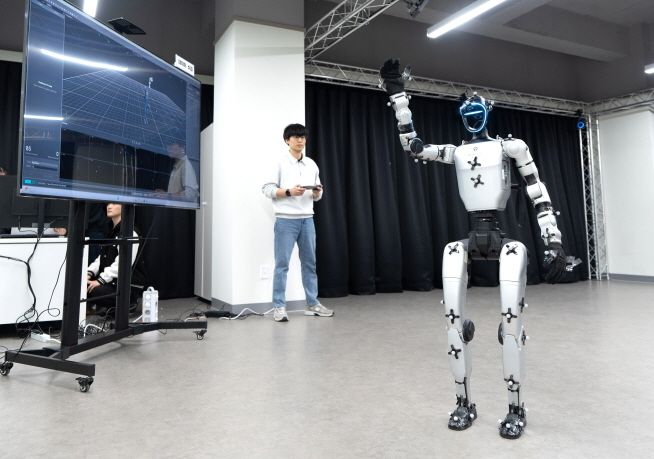
[Financial News] The government’s robot-support policy is expanding beyond research and development (R&D) to include purchases, field demonstrations, and mass-production support. As the government takes on the role of an initial customer for domestically produced robots, domestic companies are expected to secure sales and business references.
According to Eugene Investment & Securities on the 2nd, the government’s 2027 budget proposal includes substantial funding for the robotics industry, led by the Ministry of Trade, Industry and Energy (MOTIE) and the Ministry of Science and ICT. MOTIE allocated 37 billion won for R&D to advance the K-Robot Industry Ecosystem and 80.7 billion won for the deployment and expansion of intelligent robots. It also newly allocated 45 billion won for the Robot Data Factory and 30 billion won for the public deployment of domestically produced humanoids.
The budget for the deployment and expansion of intelligent robots will rise by 24 billion won, or 42.3%, from 56.7 billion won this year to 80.7 billion won next year. The focus is on introducing manufacturing and service robots into actual workplaces to help domestic companies build usage records and a foundation for commercialization.
A project will also be launched to create an initial market for domestically produced humanoids. With 30 billion won allocated to the public deployment program, 200 research humanoids are scheduled to be supplied to engineering colleges and government-funded research institutes.
The feasibility of using humanoids in manufacturing environments will also be tested. The plan is to invest 30 billion won to deploy 200 domestically produced humanoids at production sites, assess their task performance and economic viability, and then connect the results to mass production and expansion into the private sector.
The government will also promote the localization of key components. Through the K-Robot Industry Ecosystem Advancement project, it will support the development of key components, including actuators, reducers, and sensors, as well as the construction of a domestic supply chain. The Robot Data Factory will build 50 robot-process datasets across 10 industry sectors.
Yang Seung-yoon, a researcher at Eugene Investment & Securities, said, "The selection itself as a national flagship platform is meaningful because it can serve as a reference demonstrating technological capabilities to customers at home and abroad." He added, "Through government support, domestic companies can secure initial sales, references, and training data at the same time. Products that pass field demonstrations are also expected to have an advantage in entering the private sector and overseas markets." He continued, "In the short term, platform companies with finished products ready for supply may be likely to benefit."
[email protected] Choi Doo-sun Reporter