Local Gift Certificates to Expand to 25.6 Trillion Won Next Year; MOIS Draws Up 84.7 Trillion-Won Budget
- Input
- 2026-09-02 10:40:39
- Updated
- 2026-09-02 10:40:39
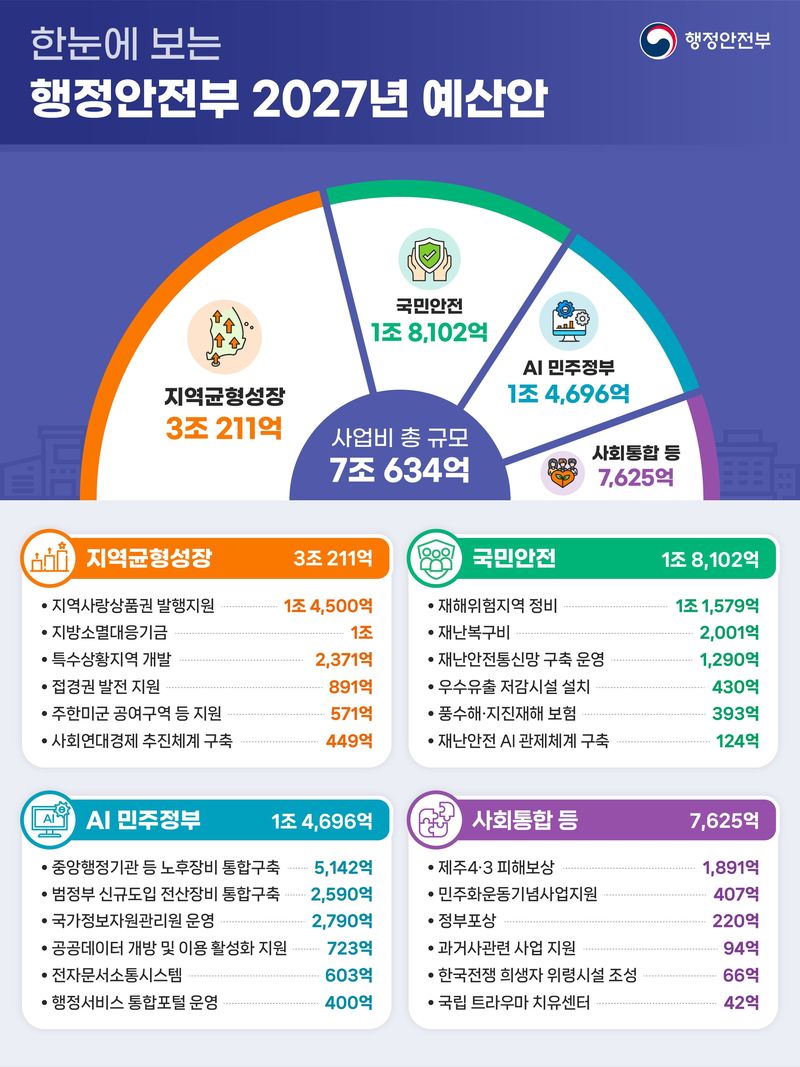
[Financial News] The Ministry of the Interior and Safety (MOIS) will expand next year's issuance of Local Love Gift Certificates to 25.6 trillion won. To support this, it will increase national funding from 1.15 trillion won this year to 1.45 trillion won next year, an increase of 300 billion won, and inject 1 trillion won into the Local Extinction Response Fund. It will also invest 20.3 billion won in building an Integrated AI Civil Complaint Platform to handle civil complaints using artificial intelligence (AI), while increasing the budget for improving disaster-risk areas by about 90 billion won from this year to respond to abnormal weather.
MOIS announced its 2027 budget proposal on the 2nd. The total budget for next year is 84.7036 trillion won, up 10.1% from this year. Local allocation tax accounts for 77.1899 trillion won, or 91.1% of the total. Program expenses amount to 7.0634 trillion won, while personnel and basic operating expenses total 450.3 billion won.
Excluding local allocation tax, MOIS program spending will fall from 7.1196 trillion won this year to 7.0634 trillion won next year, a decrease of 56.2 billion won. Budgets for the AI Democratic Government and balanced regional growth will each rise by more than 200 billion won and 400 billion won, respectively. However, spending on public safety will decline by 724.9 billion won. This is largely due to a base effect: the 810 billion won allocated this year for recovery from damage caused by the previous year's torrential rains will be removed next year.
Local Allocation Tax to Rise More Slowly Even as Domestic Tax Revenue Grows
Next year's local allocation tax is the first to be budgeted since the calculation criteria were changed. The government will maintain the statutory rate that allocates 19.24% of domestic tax revenue to local allocation tax. However, it will first exclude additional tax revenue transferred to the Future Response Fund from the domestic tax revenue used to calculate the allocation tax.
Previously, local allocation tax rose alongside domestic tax revenue according to the statutory rate. Going forward, additional tax revenue transferred to the Future Response Fund will be deducted first, and the allocation tax will then be calculated based on the remaining domestic tax revenue. The allocation tax itself will increase, but growth in tax revenue will no longer translate directly into an equivalent increase in the allocation tax.
The government plans to transfer 162.3 trillion won of next year's additional tax revenue to the Future Response Fund. Although the statutory local allocation tax rate will remain at 19.24%, the smaller base to which the rate is applied will reduce the increase in local allocation tax compared with the previous system. Instead, the government plans to establish a local account within the Future Response Fund and use the money to create regional growth hubs and improve living conditions.
Local Gift Certificate Issuance to Reach 25.6 Trillion Won; 1.45 Trillion Won in National Funding
The government allocated 3.0211 trillion won to balanced regional growth. Next year's issuance of Local Love Gift Certificates will expand to 25.6 trillion won. National funding to support the program will increase by 300 billion won, from 1.15 trillion won this year to 1.45 trillion won next year. The government will also inject 1 trillion won into the Local Extinction Response Fund.
A new budget of 44.9 billion won was allocated to establish a social solidarity economy framework. Funding for a program to strengthen communities' self-sustaining creative capacity will increase from 23.8 billion won to 32 billion won. The government will also newly allocate 1.2 billion won to the Half-Price Island Travel program, which aims to attract tourists and other members of the living population to island regions.
The public safety sector was allocated 1.8102 trillion won. Although the overall amount is lower than this year, investment in disaster prevention programs will increase. The budget for improving disaster-risk areas will rise by 89.1 billion won, from 1.0688 trillion won this year to 1.1579 trillion won next year. The funds will be used to reduce in advance the risks of disasters such as torrential rain and flooding caused by abnormal weather.
The government will invest 43 billion won in stormwater runoff reduction facilities that temporarily store rainwater in low-lying urban areas during torrential rains. A program to share drone footage of disaster sites between central and local government situation rooms will also expand from 3.4 billion won this year to 6 billion won next year.
20.3 Billion Won for Integrated AI Civil Complaint Platform
Investment in administrative services using AI will also increase. The government will invest 20.3 billion won to build an Integrated AI Civil Complaint Platform, allowing citizens to receive guidance and complete procedures through a single AI civil complaint channel. This is more than ten times the 1.8 billion won allocated this year. The Subsidy 24 service, which provides advance notifications about government benefits, will add more than 1,000 types of benefits.
The government will invest 271.6 billion won to establish dual operating systems for major public information systems. A new budget of 54.8 billion won was allocated to move public information systems to private clouds. Spending on applying AI to administrative work, including On AI, which enables public officials to use AI in their duties, will nearly triple from 18.7 billion won this year to 54.2 billion won next year.
In the social integration sector, funding for trauma-healing programs for victims of the Yeosu–Suncheon rebellion and others will increase from 600 million won to 1 billion won. A new budget of 1.9 billion won was allocated for events marking the 40th anniversary of the 6·10 Democracy Movement. Another 1.3 billion won was newly allocated to promote public-participation policies that reflect citizens' views in government policy.
Minister of the Interior and Safety Yun Ho-jung said, "We drew up the 2027 budget proposal around programs that citizens can directly feel in areas closely connected to their daily lives, including an AI Democratic Government, public safety, balanced regional growth and social integration."
[email protected] Lee Bo-mi Reporter