Jeju Governor Wi Seong-gon and Superintendent Ko Ui-suk Face First Questioning; Council Conducts Five-Day Review
- Input
- 2026-09-02 10:26:02
- Updated
- 2026-09-02 10:26:02
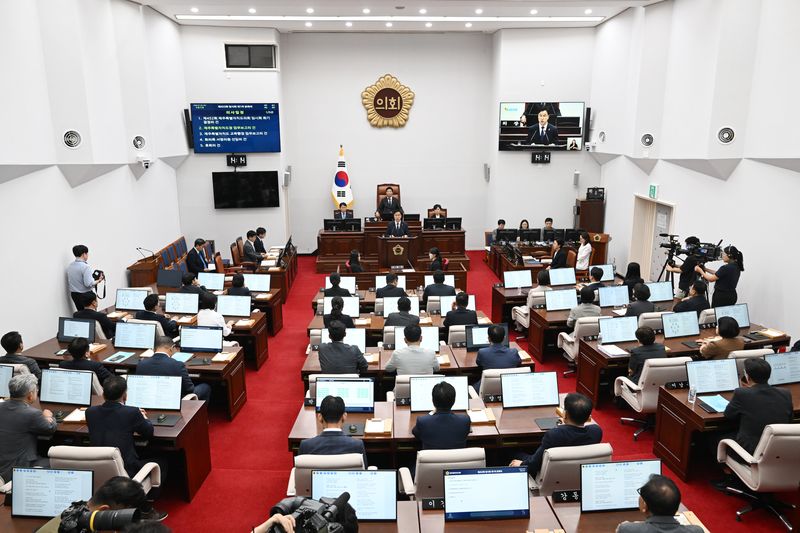
【Financial News Jeju = Reporter Jeong Yong-bok】 Jeju Governor Wi Seong-gon and Superintendent Ko Ui-suk will appear before the Jeju Special Self-Governing Province Council for questions on provincial and educational administration for the first time since taking office. Governor Wi will answer questions in the plenary chamber for three days, while Superintendent Ko will do so for two days. This marks the first full-scale review of the new provincial and educational administrations’ policy implementation plans and fiscal management.
According to the Jeju Special Self-Governing Province Council on the 2nd, the council will hold the first plenary session of the 454th First Regular Session at 2 p.m. that day, beginning a 21-day session that runs through the 22nd.
The first major test of the regular session will be the questions on provincial and educational administration beginning on the 3rd.
The council will hold the second through fourth plenary sessions at 10 a.m. on the 3rd, 4th and 7th to question Governor Wi on provincial administration. The sessions are expected to focus on the policy direction and major issues of the ninth popularly elected provincial administration, as well as detailed implementation plans for projects announced since he took office.
Questions on educational administration directed at Superintendent Ko will be held over two days, during the fifth and sixth plenary sessions on the 8th and 9th. The new administration’s education policies, school-related issues and management of education finances will be examined.
After five days of questioning, the council will turn its attention to the actual execution of last year’s finances.
Beginning on the 10th, each standing committee will review Jeju Special Self-Governing Province’s 2025 fiscal-year settlement of accounts, reserve-fund expenditures and the settlement of fund operations. The review will assess not merely how much funding was secured, but whether it was spent as planned and produced results.
The Special Committee on Budget and Accounts will conduct an integrated review of the province’s settlement of accounts, reserve-fund expenditures and settlement of fund operations on the 16th and 17th. The settlement of accounts and fund settlement of the Jeju Special Self-Governing Province Office of Education will be reviewed and voted on separately on the 21st.
Jeju’s energy-policy framework will also come before the council during this session. On the 11th, the Future Economy and Industry Committee will review a comprehensive revision of the ordinance on permits for wind-power generation projects and the designation of wind-power districts in Jeju Special Self-Governing Province.
The committee will also consider a consent motion to change the designated area for the expansion of the Dongbok–Bukchon Wind Power Complex, along with a consent motion to construct permanent facilities on public property for the Gapado Island RE100 Village Development Project.
Other agenda items include a resolution urging expanded national funding to promote electric-vehicle adoption, a change in the 2026 issuance amount of Tamna-jeon, and revised plans for the third and fourth phases of the Shining Jeju Listed Companies Development Fund.
In urban planning, proposed changes to the height districts of Jeju City and Seogwipo City are a key issue. On the 11th, the Environment and Urban Affairs Committee will present its opinion on changes to the decisions designating height districts in the urban management plans of Jeju City and Seogwipo City. Because the matter affects building heights and development density, attention is focused on discussions over the areas subject to change and the applicable standards.
The committee will also consider on the same day the national pilot district plan for the Tapdong Urban Regeneration Innovation District in Jeju City, as well as changes to the maintenance plan and designation of the maintenance area for the housing-redevelopment project at Ido Jugong 1 Complex.
A consent motion on the details of consultations for the environmental impact assessment of the livestock-manure joint resource-recovery and energy-generation project by Jeju Seonjin Agricultural Cooperative is also subject to review. The Environment and Urban Affairs Committee will inspect the site in person on the 10th, ahead of the review.
A personnel review for a local public corporation is also scheduled. On the 2nd, the Environment and Urban Affairs Committee will adopt a plan to hold a personnel hearing for the nominee to head the Jeju Special Self-Governing Province Development Corporation, with the hearing set for the 15th. The committee is also scheduled to adopt a report on the hearing’s proceedings later that day.
The Jeju Special Self-Governing Province Development Corporation is a key local public corporation responsible for producing and selling Jeju Samdasoo, as well as for public-housing projects. The nominee’s management capabilities, approach to organizational operations, and policy judgment on major projects—including Jeju Samdasoo’s competitiveness and public housing—are expected to be examined.
Discussions on forming new special committees will also begin within the council. On the 2nd, the Council Operations Committee will review the 2026 administrative audit plan, along with resolutions to establish the Jeju 4·3 Special Committee and the Special Committee on Regulatory Reform. If the resolutions pass the plenary session, separate council-level bodies dedicated to Jeju 4·3 issues and regulatory reform will begin operating.
On the 14th, the Education Committee will review the Jeju Special Self-Governing Province Office of Education’s settlement of accounts, along with amendments to ordinances promoting Jeju 4·3 peace and human-rights education at schools of all levels, an ordinance on operating and supporting an orchestra for people with disabilities, and ordinances related to the Integrated Fiscal Stabilization Fund.
Numerous consent motions for outsourcing education programs to private operators have also been submitted, including programs to train artificial-intelligence talent, operate a drone academy, and support students affected by school violence and students at risk due to maladjustment to school.
The regular session will conclude at 2 p.m. on the 22nd with the seventh plenary session.
The session is structured to begin with the first plenary review of Governor Wi Seong-gon and Superintendent Ko Ui-suk, then move to an assessment of last year’s fiscal execution, reforms to energy and urban-planning systems, and a personnel review for a local public corporation. Over the 21-day legislative session, the council is expected to focus on how concretely the policy directions announced since their inauguration have been translated into projects, budgets and institutional measures.
[email protected] Reporter Jeong Yong-bok Reporter