Korea Forest Service Allocates 3.1582 Trillion Won Budget for 2027... Strengthening Forest Disaster Response and Forestry Support
- Input
- 2026-09-02 10:00:08
- Updated
- 2026-09-02 10:00:08
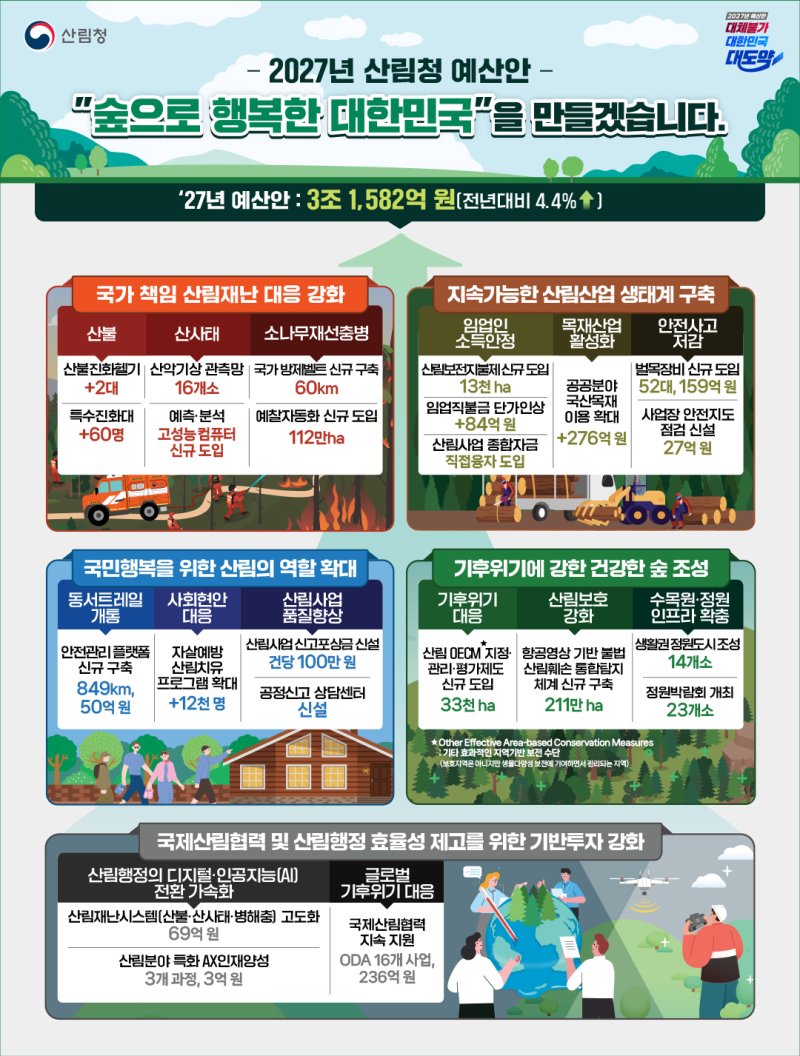
On the 2nd, the Korea Forest Service announced a budget plan centered on four key areas: state-response to forest disasters, establishment of a sustainable forest industry ecosystem, realization of a green era of happiness for the people, and response to the climate crisis.
First, a budget will be allocated to the field of forest disaster prevention and response to enhance public safety. The expansion of the mountain weather observation network (16 locations) and the introduction of high-performance computers (4 billion won) will be promoted to improve landslide prediction capabilities, and aerial firefighting capabilities will be boosted through the introduction of two new forest fire fighting helicopters and the securing of spare parts (11.9 billion won).
To improve on-site response, the number of personnel in the Special Wildfire Disaster Suppression Unit will be increased to 615, and support will be provided for the replacement of 56 new wildfire fighting vehicles (2.1 billion won) that resolve winter engine stalling issues and improve climbing ability by 51%. The establishment of a national disease control belt to prevent pine wilt disease (15 billion won), AI and drone-based surveillance automation (10.7 billion won), and the expansion of fumigation-treated wood collection (+36 billion won) will also be implemented.
Various support measures have also been prepared to stabilize the income of forest owners and foresters. A new 'Forest Public Value Conservation Payment System' worth 1.7 billion won will be introduced to compensate for the public value within forest protection areas, and the unit price for forestry and forest public benefit direct payments will be increased from the existing 53.2 billion won to 61.6 billion won. To revitalize the timber industry, plans include expanding the use of domestic timber in the public sector (66.9 billion won), promoting the construction of eco-friendly wooden observatories and wood-friendly cities, and reducing on-site safety accidents through the introduction of specialized timber harvesting equipment for mountainous areas (15.9 billion won).
Infrastructure closely related to the daily lives of citizens, such as forest welfare and climate crisis response, will also be strengthened. A safety management system (5 billion won) will be established for the East-West Trail (849 km), the nation's first long-distance forest trail, and forest healing programs for those at risk of suicide will be expanded (+900 million won). In addition, the opening and operation of the National Saemangeum Arboretum (25.6 billion won) and the construction of the National Warm Temperate Arboretum (27.5 billion won) will proceed without setbacks, and the creation of urban garden cities (+3.8 billion won) and
We also plan to expand our leadership in international forest cooperation, including the project utilizing international climate finance based on the Asian Forest Cooperation Organization (AFoCO) (1 billion KRW).
With localized torrential rains and large-scale forest fires becoming more frequent due to recent climate change, the Korea Forest Service's recent budget allocation is interpreted as reflecting a shift from simple forest tending to a forest management system at the level of national security. In particular, as the establishment of a real-time data sharing system with related agencies, such as local governments, the police, and fire departments, begins in earnest, it is expected to play a decisive role in securing the "golden time" for initial response in the event of a disaster.
Along with this, the full opening of the East-West Trail and the expansion of arboretum infrastructure are expected to breathe new vitality into the local economy, which is on the verge of collapse, by going beyond mere recreation to increase the floating population in mountain villages and create related jobs.
Park Eun-sik, Minister of the Korea Forest Service, stated, "We will provide forest services that can be tangibly experienced by 2.2 million forest owners, 200,000 forestry workers nationwide, and all citizens," adding, "Through next year's budget proposal, we will build forests resilient to the climate crisis and realize a forest powerhouse where the people are happy." This budget proposal will be finalized after deliberation and approval by the National Assembly.
[email protected] Kim Won-jun Reporter