“30,000 Atlas Units Would Mean 1.4 Trillion Won” — Hyundai Mobis Poised to Be First to See Robot Revenue
- Input
- 2026-09-02 08:45:18
- Updated
- 2026-09-02 08:45:18
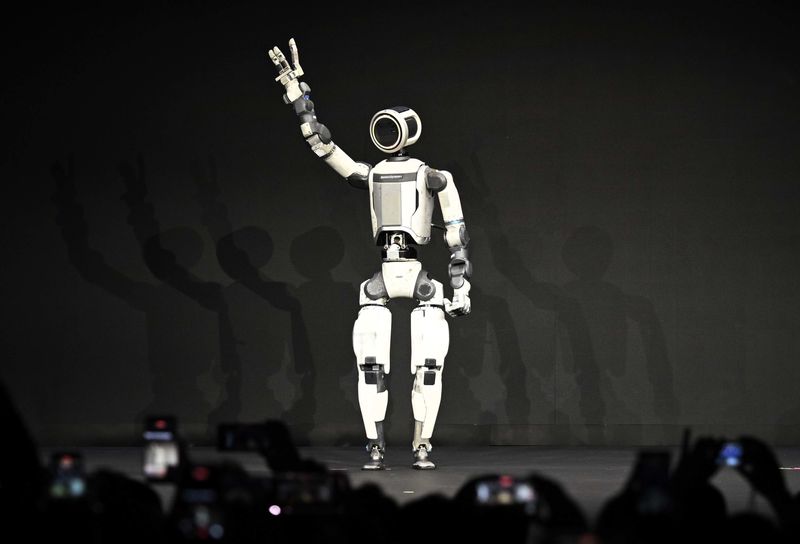
[Financial News] Hyundai Mobis has been identified as the Hyundai Motor Group affiliate most likely to see the benefits of the group’s expanded investment in physical artificial intelligence (AI) reflected in its earnings first. The company has won the entire order for the actuators used in the humanoid robot Atlas, with related revenue potentially beginning in 2027.
On the 2nd, LS Securities maintained its “Buy” rating and target price of 750,000 won for Hyundai Mobis, naming it the top pick in Korea’s physical-AI value chain.
Hyundai Mobis is attracting attention because the Hyundai Motor Group’s expansion of mass robot production could translate directly into component revenue. The group has begun operating the Robot Metaplant Application Center (RMAC) in the United States and plans to expand the facility tenfold by the end of the year. It aims to establish an annual robot production system capable of producing 30,000 units by 2028. The Atlas robots produced will initially be deployed in the parts-sequencing process at Hyundai Motor Group Metaplant America (HMGMA). From 2030, their use is expected to expand to assembly operations.
Hyundai Mobis won the entire order for the actuators installed in Boston Dynamics’ Atlas. Each Atlas unit contains 31 body actuators. Assuming a mass-production price of $800–$1,100 per actuator, LS Securities estimated that each robot would generate approximately 35 million–50 million won in revenue for Hyundai Mobis.
As Atlas production ramps up in earnest, related revenue is also expected to grow rapidly. According to the report, actuator revenue is estimated at 173.6 billion–238.7 billion won based on production of 5,000 Atlas units. If production rises to 10,000 units, revenue would increase to 347.2 billion–477.4 billion won, and at 20,000 units, it would reach 694.4 billion–954.8 billion won.
If the annual production system targeted by Hyundai Motor Group reaches 30,000 units, revenue is expected to total 1.0416 trillion–1.4322 trillion won. These figures assume an exchange rate of 1,400 won per U.S. dollar. Revenue could increase further if the supply scope is expanded to include after-sales service (AS) and grippers.
Robot components could also become a new source of revenue in the short term. LS Securities estimated the potential revenue from a U.S. actuator plant scheduled to begin construction at approximately 250 billion–400 billion won. If Atlas production subsequently expands to 30,000 units, actuator-related revenue would rise to the trillion-won range.
The report particularly noted that Hyundai Mobis is expected to see the benefits reflected in its earnings sooner than other Hyundai Motor Group affiliates involved in physical AI. Hyundai AutoEver is expected to benefit more as Atlas moves from demonstrations on individual processes to deployment across large-scale factories. Hyundai Motor Company and Kia are also expected to achieve manufacturing-cost savings from robot adoption over the medium to long term.
“Hyundai Mobis could begin generating robot-component revenue in 2027, making it the earliest beneficiary,” said Lee Byung-geun, a researcher at LS Securities. “Given that its hardware position within the group’s robotics business is strengthening, it deserves a premium over traditional auto-parts companies.”
Profitability recovery in the existing automotive-parts business is also expected to provide support. Although higher prices for memory semiconductors, printed circuit boards (PCBs), and copper-clad laminates (CCLs) are continuing to raise costs this year, the company is expected to gradually offset the increase from the second half through price adjustments with customers and a larger share of high-value-added products.
“The current share price is in an undervalued range, at about 9.1 times the 12-month forward price-to-earnings ratio (PER),” Lee said. “Given that its hardware position within the group’s robotics business is strengthening, it should receive a premium over traditional auto-parts companies.”
[email protected] Choi Doo-sun Reporter