“The National Pension System Must First Address Intergenerational Fairness”: KEF Proposes Reform Measures
- Input
- 2026-09-02 12:00:00
- Updated
- 2026-09-02 12:00:00
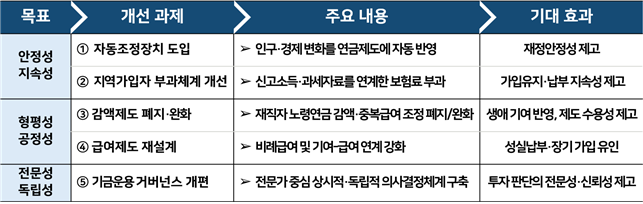
On the 2nd, the Korea Enterprises Federation (KEF) released a report titled “Measures to Reform the National Pension System to Enhance Public Trust.” It presented structural improvement tasks covering the system as a whole, including its finances, contribution and collection framework, benefits, and fund management.
KEF pointed out that although the National Pension Act was amended last April to include parametric reform and codify the state’s guarantee of payments, 55.7% of respondents in a public perception survey conducted last November said they did not trust the National Pension system. The factors undermining public trust, it said, include a financial foundation that fails to reflect demographic changes; contribution assessment and collection systems that differ by type of enrollee; pension reduction rules that do not match social and economic changes; a benefit structure overly focused on income redistribution; and insufficient expertise and independence in fund management governance.
KEF first proposed introducing an automatic adjustment mechanism that reflects not only inflation but also demographic and economic variables, such as rising life expectancy and a decline in the number of contributors, to improve fiscal sustainability and intergenerational fairness. According to an OECD report on pensions, 24 of the 38 member countries already operate such mechanisms.
The contribution assessment and collection system for individually insured persons was also identified as an area requiring improvement. Unlike workplace-based insured persons, individually insured persons must report their income directly, making underreporting and arrears more likely. KEF said the system should be reorganized into a “hybrid assessment system” that maintains the principle of reported income while strengthening links with and verification against tax data from the National Tax Service (NTS).
KEF also said the pension reduction system needs to be improved. The reduction of old-age pension benefits for working beneficiaries and the reduction applied when old-age and survivors’ pensions overlap do not sufficiently reflect changed social and economic conditions or enrollees’ lifetime contributions. It therefore argued that the relevant rules should be abolished or substantially eased.
KEF also proposed redesigning the benefit structure. Under the current National Pension system, flat-rate and earnings-related benefits each account for 50%, causing large differences in income replacement rates by income level. The organization said the flat-rate share should be reduced and the earnings-related share increased to strengthen the link between contributions and benefits.
The need to reform fund management governance was also raised. KEF said the Fund Management Committee, currently composed mainly of stakeholders such as government officials and representatives of contributors, should be transformed into a permanent body centered on investment and financial experts. This would establish a system capable of managing the fund professionally and responsibly.
Lee Sang-cheol, head of KEF’s Employment and Social Policy Division, said, “The fact that public trust in the National Pension system remains low despite parametric reform shows that the system’s basic principles and overall operating framework need to be reassessed.”
He emphasized, “The system must be improved to enhance fairness in the burden borne by different generations and to ensure that enrollees’ contributions are fairly reflected in their benefits. At the same time, the expertise and independence of fund management must be strengthened so that the National Pension system can become one that all generations can trust and rely on.”
[email protected] Kim Dong-chan Reporter