Incheon Airport T1 Looks Fine on the Outside, The Reason for Renewal... "To Defend World No. 1 Ranking"
- Input
- 2026-09-02 10:30:00
- Updated
- 2026-09-02 10:30:00
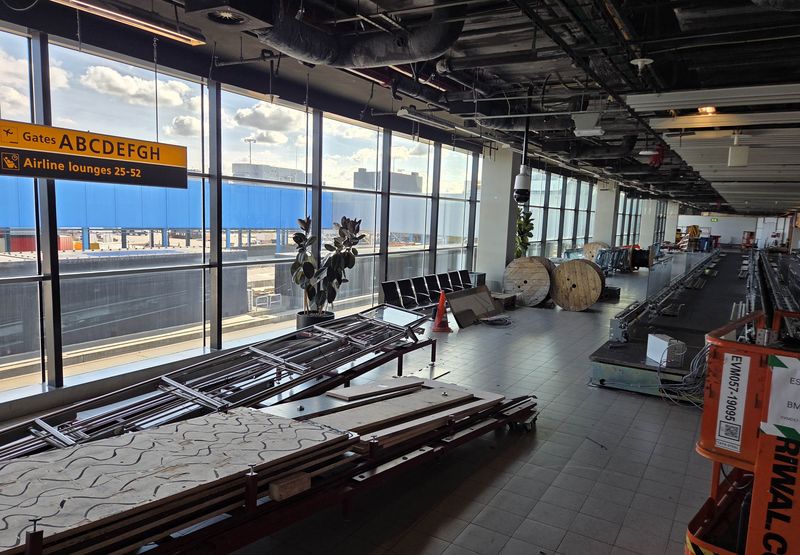
【Amsterdam (Netherlands) = Reporter Kim Dong-hoAlthough it still maintains a modern and imposing appearance, Incheon International Airport Terminal 1 (T1), which has operated continuously for 25 years since its opening in 2001, is set to undergo its largest-scale renovation since its inception. The plan goes beyond simple exterior improvements to overhaul the underground piping and power grids that have reached their limits, and to completely reorganize security and passenger flow systems, with the aim of maintaining the top position in the fierce global competition for aviation supremacy. Based on the premise of "uninterrupted operation" that keeps the flow of 54 million passengers from passing through annually, a total of 1.8 trillion won will be invested to transform the terminal into a state-of-the-art smart terminal by 2035.
Cho Seong-mi, Head of the Management Strategy Team at Incheon International Airport Corporation, explained the 'Incheon Airport Terminal 1 Comprehensive Improvement Project' on the 1st (local time) ahead of a visit to Amsterdam Schiphol Airport in the Netherlands. This project is a preemptive measure to respond to the global aviation demand growth (an annual average of 3.4% until 2043) projected by Airports Council International (ACI), while also countering the large-scale infrastructure expansion offensive by airports in neighboring countries, such as Narita International Airport in Japan and Shanghai and Hong Kong in China.
With the completion of its Phase 4 expansion, Incheon International Airport is equipped with the hardware to handle 106 million passengers annually; however, the aging facilities and spatial structure of Terminal 1 (total floor area 505,939 m2), which is 25 years old, are revealing physical limitations in accommodating the latest safety standards and smart technologies. According to airport officials, while the exterior still appears intact, some areas are experiencing leaks and problems due to aging pipes.
A bigger problem is the aging facilities that cannot keep up with global aviation demand, which is expected to grow at an annual average rate of 3.4% until 2043. Over the course of 25 years, they have revealed their physical limitations in accommodating the latest energy efficiency standards, strengthened fire and safety regulations, and rapidly changing smart technologies.
Incheon International Airport Corporation adopted the renovation method of Amsterdam Schiphol Airport in the Netherlands, a representative European hub, as its core model.
Schiphol Airport, where site expansion is impossible, is investing approximately 10 billion euros (about 16 trillion won) to secure a new boarding area called 'Pier A' in advance, and is proceeding with uninterrupted modernization through night work and phased construction.
Incheon Airport has also decided to proceed with sequential construction in three phases using alternative facilities and conduct night work, as the complete closure of T1 would cause passenger capacity to plummet to between 30 and 40 million, resulting in massive operational disruptions. Consultations with the Ministry of Land, Infrastructure and Transport (MOLIT) regarding specific measures, such as securing an alternative terminal, are ongoing.
The core direction is based on three pillars: the complete replacement of mechanical, electrical, telecommunications, and firefighting (MEPF) facilities and their transition to eco-friendly practices; the modernization of baggage handling and security screening; and the creation of an integrated immigration hall and optimization of passenger flow. Aging utilities, which serve as the building's arteries, will be replaced to meet the latest safety standards, and carbon emissions will be reduced by introducing high-efficiency HVAC and smart energy management systems.
The security screening process will also undergo significant changes. Moving away from the existing method of screening only suspicious baggage after 2D X-ray scanning, a comprehensive high-speed screening system will be established where all checked baggage passes through a 3D Explosive Detection System (EDS) immediately upon check-in. Dispersed departure halls will be expanded and integrated on a large scale to reduce waiting times, and commercial facilities such as duty-free shops will be relocated to align with the flow of departing passengers.
The total project cost was estimated at approximately 1.8 trillion won, reflecting the increase in construction costs and the scope of the introduction of the latest smart technologies.
"Team Leader Cho stated, 'Incheon International Airport Corporation plans to complete the design by September 2027, begin construction in 2028, and complete the project in 2035,' adding, 'Once the project is finished, Incheon Airport will complete a global 'dual mega-hub' system featuring a balance between the expanded KLIA2 (T2) and the fully modernized Terminal 1.'"
[email protected] Kim Dong-ho Reporter