"I've lived here for 20 years, and you're telling me to leave?"... The 'Public Housing Exit War' Begins as Housing Prices Rise [Which 'Public' Is For Whom? 3]
- Input
- 2026-09-03 06:32:54
- Updated
- 2026-09-03 06:32:54
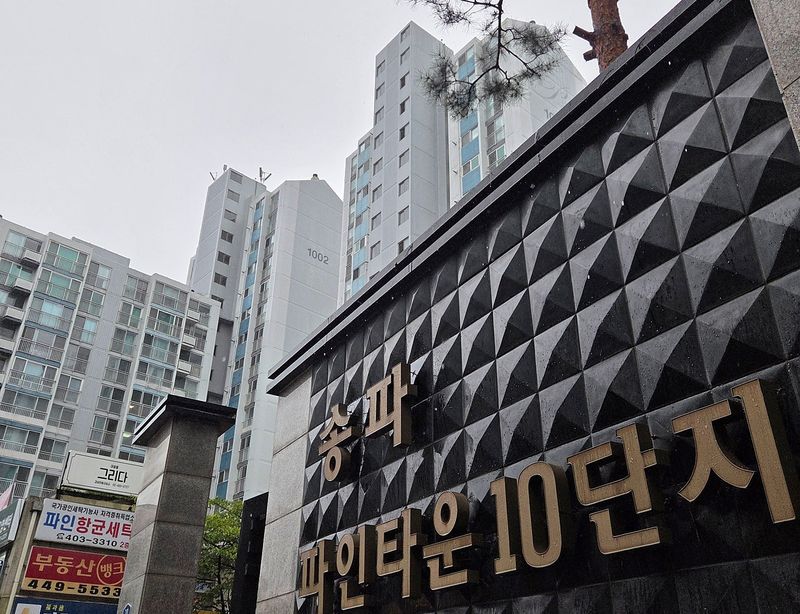
[Financial News] On the 1st, after walking about three minutes from Jangji Station on Seoul Subway Line 8, Songpa Pine Town Complex 10 in Songpa-gu, Seoul came into view. On a rainy weekday morning, the complex was quiet, but the voices of the residents who had moved into Long-term Jeonse Housing I (SHIFT) within the complex were growing louder.
A tenants' association composed of long-term lease tenants held an information session attended by approximately 200 people on July 11 and demanded contract renewals and phased conversion to ownership. Their demands include guaranteed contract renewals for non-homeowning actual buyers, priority conversion opportunities for 20-year long-term residents, and resident participation in the policy-making process.
Public housing, established to provide stable housing opportunities at costs lower than market rates, is broadly categorized into public rental housing and public sale housing and is offered in various forms. However, contrary to its original intent, controversies continue to arise.
Tenants of long-term lease housing are asking, "Why do I have to leave after living here for 20 years?" while owners of land-lease housing are raising their voices, asking, "Why is the public taking the land of the apartment where I live?"
More than half of the 2007 contract holders have lived there for nearly 20 years.
SHIFT is a public rental housing program established by the Seoul Metropolitan Government that allows residents to live for up to 20 years with a security deposit lower than surrounding market Jeonse rates. It is a system that enables non-homeowning middle-class families to reside stably for up to 20 years at approximately 80% of the surrounding market rate. With the first tenant recruitment announcement made in 2007, the first group of tenants whose leases are set to expire will emerge in 2027.
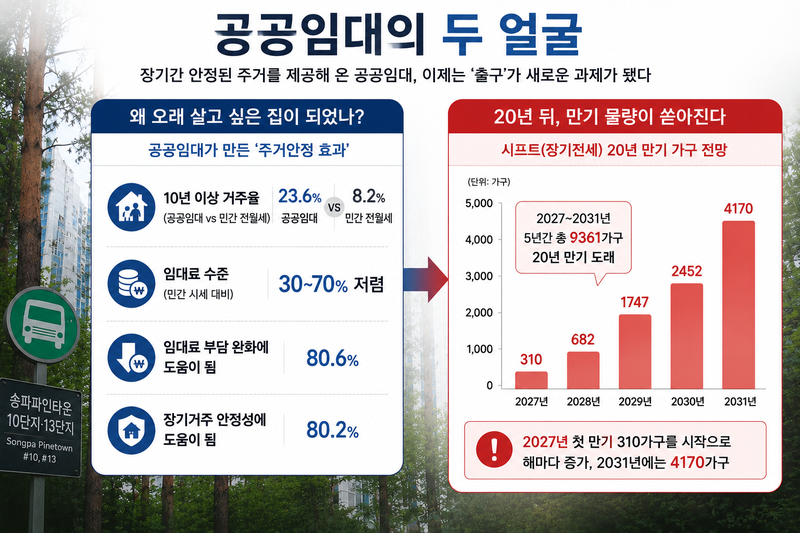
An official from the Seoul Metropolitan Government's Housing Supply Planning Team stated in a phone call with the Financial News, "567 households signed contracts in the first year following the recruitment announcement in 2007. Some households have moved elsewhere, and 310 households will reach the end of their 20-year contracts next year." This means that approximately 54.7% of the initial contract holders have continued to reside there for nearly 20 years.
Among them, 38 households in Songpa Pine Town Complex 10 and 51 households in Complex 12 will reach maturity next year. Although there are households residing in public rental housing within the complexes, their contracts will mature sequentially starting in 2028 due to differing contract timings.
The scale of maturing households is expected to grow further. The Seoul Metropolitan Government estimates that starting with 310 households next year, the number of maturing households will nearly double thereafter, with approximately 9,000 households reaching the 20-year maturity date over the next four to five years.
The 'housing ladder' was very effective, but... coming down is the problem.
Public rental housing, such as the Seoul Housing & Urban Development Corporation (SH Corporation)'s Shift, is operated in various forms depending on the managing entity. The strengths of public rental housing are considered to be the possibility of long-term residency along with affordable rent.
According to a survey of 10,156 public rental housing households nationwide conducted by the LH Land and Housing Research Institute, the proportion of residents who have lived in the five core types of public rental housing for 10 years or more was 23.6%, which is about three times higher than the 8.2% rate for private rental housing. Public rental housing rents were 30–70% cheaper than similar private rental housing, and the rent savings effect by type was estimated to be between 110,000 and 380,000 won per month.
Regarding responses indicating that moving in was helpful, 80.6% cited the alleviation of rent burden, and 80.2% cited residential stability due to long-term residency. Notably, in the LH survey, approximately 70% of all public rental households had no plans to move.
High satisfaction with public rental housing is escalating into conflict with the operating authorities. This is the reason why residents who moved into Songpa Pine Town through the Shift program are protesting.
Lee Kwang-hoon, Chairman of the Seoul Metropolitan Government's Committee for the Promotion of Tenants' Rights in Public Rental Housing, argued in a recent interview with the media that "existing tenants should be allowed to continue residing, and new public rental housing should be expanded separately."
The Seoul Metropolitan Government maintains a firm stance. An official from the Seoul Metropolitan Government stated, "The long-term jeonse housing project itself is a system that limits the maximum period of residence to 20 years," adding, "The actual period of residence is up to 20 years, and the contract was signed that way."
He added, "Long-term Jeonse provided time to live stably for an extended period and then move to another home. It is difficult to view the right to continue residing there after the contract ends simply because it is a public property."
A plan has also been established for the use of the units recovered upon maturity. Some will be converted into Mirinae House public housing program units, with a plan to supply an average of over 400 units annually from 2027 to 2031. Mirinae House public housing program is Long-term Jeonse Housing II, which was introduced in 2024 by redesigning the long-term jeonse housing program to address the low birth rate.
A Seoul City official emphasized, "We are not supplying all expiring units as Mirinae House public housing program units. We will decide whether to supply them as existing long-term leases or Mirinae House public housing program units by taking into account the new long-term lease units secured through redevelopment and reconstruction that year," adding that "if existing residents do not vacate, it could lead to an infringement of the rights of the next tenants."
Conflicts are also emerging in public housing sales. This concerns some residents of LH Gangnam Breeze Hill in Jagok-dong, Gangnam-gu, Seoul. They purchased the housing units under a land lease system. A land lease refers to a housing unit where the resident owns the building, while LH retains ownership of the land. Since the cost of the land is excluded from the sale price, the initial purchase cost is lower.
Residents who recently received housing under a land lease system are demanding that LH sell them the land it owns.
Such voices grew louder after a unit with an exclusive area of 84.98m2 at Gangnam Breeze Hill was traded for 1.385 billion won in May of this year. With a unit of similar size at the nearby Gangnam Jagok IPARK selling for 2.32 billion won, residents raised concerns that they could not keep the increase in land value and made these demands.
On the other hand, demand for land-lease housing remains high. In 2023, approximately 20,000 people flocked to pre-reservations for 500 units at Godeok Gangil Complex 3. At the time, the estimated sale price for a unit with an exclusive area of 59m2 was about 355 million won, and the land lease fee was around 400,000 won per month.
Increased Public Housing... Will Conflicts Also Rise?
The possibility that the conflict could escalate further has also been raised, as the number of public housing units has increased significantly.
According to the 2026 report by the Korea Center for City and Environment Research (KOCER), the stock of long-term public rental housing in Seoul increased 2.35-fold from 127,863 units in 2007 to 300,846 units in 2024. Its share of total housing in Seoul also rose from 4.0% to 7.7% during the same period.
Long-term public rental housing nationwide also accounts for 6.2% of total housing in 2024 with 1,433,000 units.
There are also calls to devise an exit strategy.
The point is that while public housing policies have previously focused on "who to provide homes to and at what affordable prices," going forward, we must consider "when to end benefits and how to resolve the issue of housing rights and asset values."
Choi Eun-young, Director of the Urban Research Institute, stated, "Among those who have lived there for 20 years, there may be some who still have nowhere to go except public rental housing, while conversely, there may be those who reside there despite having financial means," adding, "It is necessary to formulate policies that differentiate based on income and assets."
[email protected] Kim Hee-sun Seo Yoon-kyung Reporter