"Is a 1 billion won property worth buying?"... The growing 'public' sector, the complicated calculations for owning a home [Which 'public' for whom 2]
- Input
- 2026-09-02 16:31:01
- Updated
- 2026-09-02 16:31:01
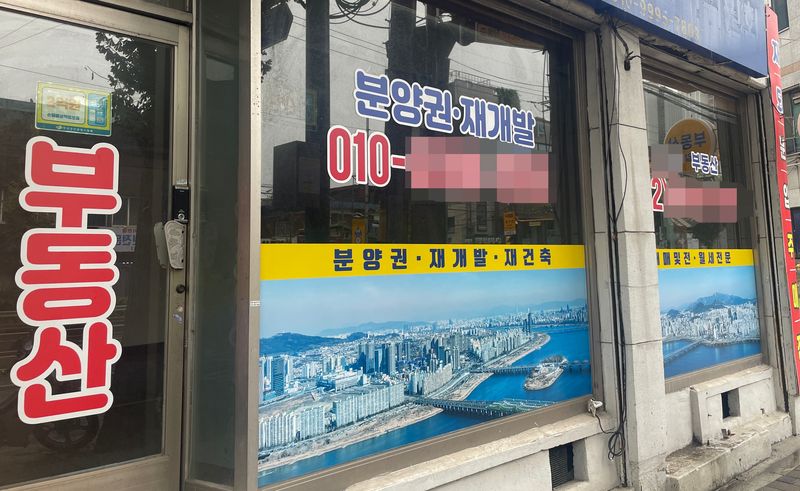
[Financial News]It is too late for Singil 2, but here the application for approval of the complex development plan has been completed and is awaiting approval, so if you buy now, you can receive a presale to rights holders. We have one priced at 1 billion won; would you like to take a look?When I inquired about redevelopment at Real Estate Agency A in Singil-dong, Yeongdeungpo District, Seoul, on the 31st of last month, the agent displayed a map of the Singil area on a monitor connected to a laptop. Private redevelopment, public redevelopment, and urban public housing complex projects were all mixed together within just a few blocks.
Public Housing Calculations Encountered in Singil-dong, the 'Public Housing Department Store'
The place the real estate agent pointed to was a house in Singil District 15, which the Korea Land and Housing Corporation (LH) plans to redevelop as an urban public housing complex project. "Since the project is still underway, if you meet the conditions to purchase it, there is a chance to receive a new apartment in the future," he emphasized. "As transactions will be suspended next year, prices could rise as time goes by."
At the same time, they mentioned that it is not subject to the two-year actual residency requirement. Although Yeongdeungpo District, where Singil District 15 is located, is designated as a land transaction permit zone, the target areas are apartments and some row houses and multi-family homes, meaning that the two-year actual residency requirement under the land permit system does not apply to the multi-family homes in question.
It is reported that the burden of premiums is rising as various forms of redevelopment projects are recently underway in the Singil area.
The representative of Real Estate Agency B near Yeongdeungpo Station explained, "In Zone 4, properties were listed at a higher price per pyeong compared to nearby homes. It appears that premiums are rising as expectations for redevelopment are being reflected."
Here, the premium refers to the amount paid to the current seller to obtain future value. For example, if the price of a house purchased to receive a right holder's allocation is 1.5 billion won, but the appraised value of the house for reconstruction is 700 million won, the premium becomes the additional 800 million won paid. If the appraised value is lower than the price of the house agreed upon for in-kind compensation, the shortfall must also be paid additionally.
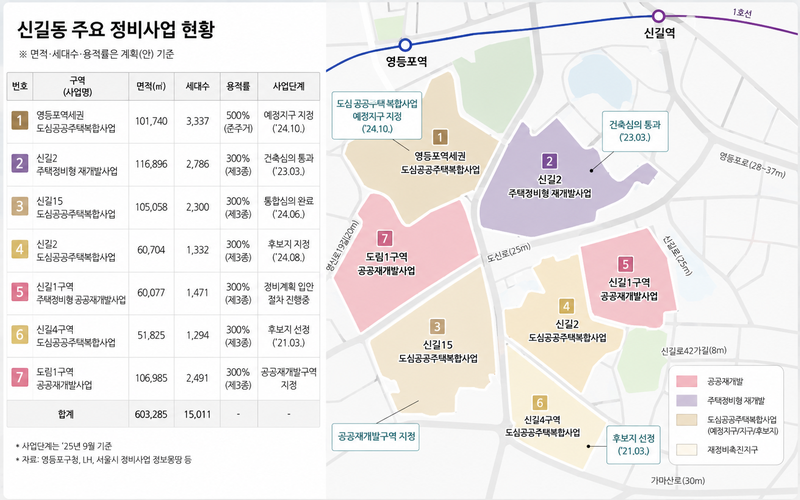
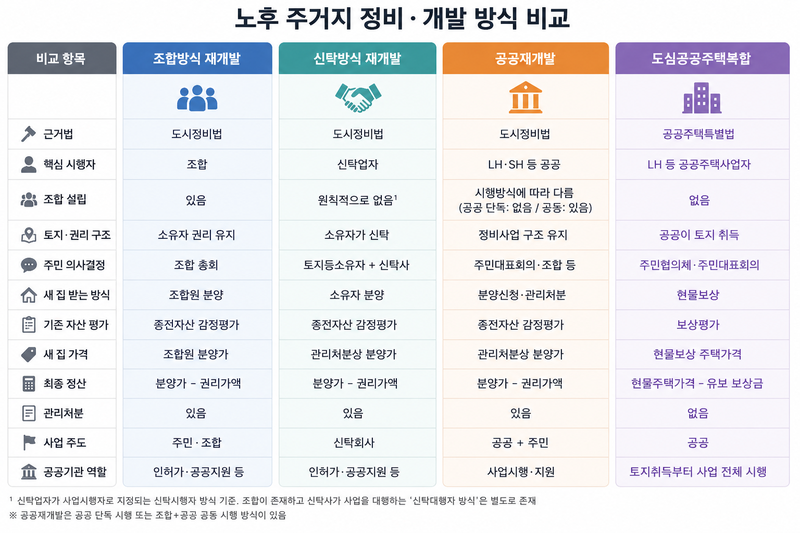
However, even within the same redevelopment project, premiums varied depending on the specific form. This difference can be clearly seen through the aforementioned Singil 2. These include the Singil District 2 Housing Redevelopment Project, driven by a private association, and the Singil 2 Urban Public Housing Complex Project, implemented by LH near Wooshin Elementary School.
According to the Actual Transaction Price Disclosure System of the Ministry of Land, Infrastructure and Transport, since last year, transaction prices in Singil Zone 2 have ranged from 40 million to 51 million won per pyeong, while Singil 2 has traded at around 32 million to 35 million won. Considering that the officially assessed price is set at 69% of the market price, the market expects the premium for Singil Zone 2 to be formed at 700 million to 800 million won.
There are also areas where premiums have skyrocketed following news of private redevelopment. One such example is Seongsu District 2 in Seongdong District. Like Singil District 2, this is a 'housing improvement type redevelopment,' a private redevelopment project conducted through a cooperative method. Since properties expected to be appraised at around 800 to 900 million won are selling for approximately 3 billion won, this inevitably becomes a burden for buyers.
"A real estate agent stated, 'While the burden is heavy due to the high premiums and land prices in the private Singil 2 project, progress is fast because it is being handled by the private sector. Expectations for future price increases are also higher than for the public sector.' Conversely, the LH project site has the advantage of relatively lower initial purchase costs due to the lower premium burden, but the speed of redevelopment is slow and the effect of price increases is minimal."
From public rental housing to public development... The name 'public' only increases confusion
The complexity observed in Singil-dong is not limited to a single region. Whenever the administration changed or the issues in the housing market shifted, new housing policies bearing the label "public" were added.
Under the current Special Act on Public Housing, the basic legal structure of public housing is relatively simple. Public housing providers, such as the state, local governments, LH, and local corporations, supply housing through construction, purchase, or lease with financial support or the Housing and Urban Fund, and it is broadly divided into public rental housing and public sale housing.
When it comes to actual policies, it is subdivided into permanent rental, national rental, Bus House, integrated public rental, long-term Jeonse, purchased rental, and Public Rental Housing on a Deposit Basis.
In addition to the public sector directly supplying housing, methods involving participation in private redevelopment projects and urban development have been added. Public redevelopment and public reconstruction emerged in 2020, and urban public housing complex projects were introduced in the February 4 Measures of 2021. Since then, new types have been added whenever new policies and housing demands emerge.
As a result, there are more than a few things to scrutinize.
The representative of a real estate agency specializing in reconstruction said, "It varies depending on whether it is done by the private sector or LH, and also depending on whether it is public redevelopment or urban mixed-use development," adding, "Since there are conditions regarding land transaction permits and the succession of rights, real estate agents must also verify them on a case-by-case basis."
The real estate agents I met in Singil-dong also gave different information regarding the same property, such as the two-year residency requirement and the premium. However, there was one thing they all consistently added: "It could be different next year."
Choi Eun-young, Director of the Korea Center for City and Environment Research (KOCER), pointed out, "There are significant difficulties even in compiling data related to public housing," adding that "the current complex system is the result of past administrations creating new types of public rental housing."
"The public sector is the first step of the housing ladder... it should not replace the private sector"
The fact that the system has become more complex does not mean that the need for public housing has disappeared.
Shin Bo-yeon, a professor in the Department of Real Estate AI Convergence at Sejong University, explained that the primary role of public housing is to lower initial entry barriers that the private housing market fails to address.
"Professor Shin said, 'Public housing that is cheaper than market rates helps secure a starting point for saving and asset formation by allowing people to live stably without the burden of excessive loans or rent.'"
However, it is pointed out that the role of the public sector should not be expanded indefinitely into the private sector.
"It is correct to view public housing not as a means to replace the private sector, but as a selective and complementary mechanism that supplements areas where the market fails to supply efficiently," said Professor Shin. "It is desirable for the public sector to provide a safety net while the private sector handles the basic total supply volume and product diversity, thereby dividing roles."
Director Choi also raised the issue of eligibility criteria. He stated, "Since the Happy Housing program, young people and newlyweds have become key targets in public housing policy," but added, "We must also look after other vulnerable groups, such as households already raising children in poor living conditions, in addition to young people and newlyweds."
[email protected] Seo Yoon-kyung Kim Hee-sun Reporter