Detectives with expertise in searching for missing persons, but the legal framework is still in its infancy
- Input
- 2026-09-01 18:24:36
- Updated
- 2026-09-01 18:24:36
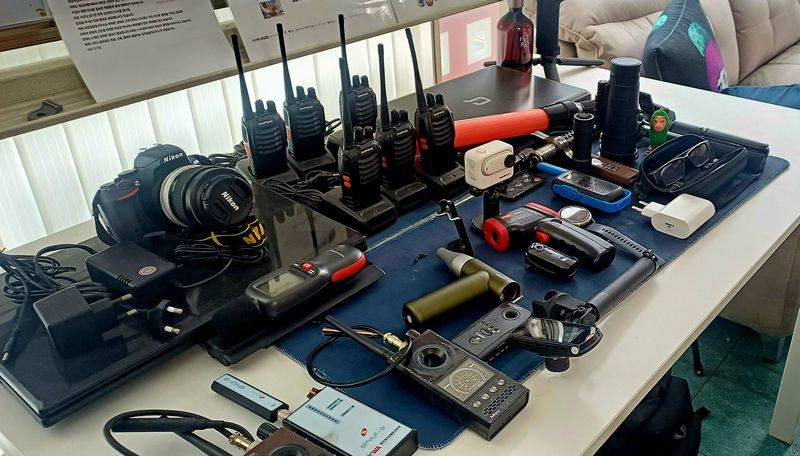
Inside Kim Jeon-il Detective Office near Busan District Court in Yeonje District, Busan, on the 1st, there were items needed for investigations, including a telephoto camera, a walkie-talkie, glasses with a built-in camera, and a pen camera, all of which looked like props from a movie. Work clothes and delivery vests used for disguises were also hanging on coat racks.
Ahn Duk-geun's communication
Minister Ahn Duk-geun of the Ministry of Trade, Industry and Energy speaking with executives of petrochemical companies
Private detective Jeong Gi-won, 36, showed a collapsible baton he said had been used in the past as a precaution against emergencies. "The items you see here are no longer used for investigations," he said. "These days, smartphone performance is so good that we can handle a client's case with just one mobile phone."
The detective office, headquartered in Busan, has branches in Seoul, Changwon, and Jeju Province. Jeong said inquiries from people wanting to find someone increased noticeably at the Jeju branch after the case of Mr. Jang, a missing person whose disappearance was falsely closed by a police officer and who was later found dead, came to light.
He said clients usually call after seeing the office number posted on portal sites. "Because detective work is unfamiliar to the general public, we deliberately invite people to the office to present a more professional image," he said. "In the past, we could not even use the word 'detective,' so we were called things like a private investigation agency. Now, our professionalism is gradually being recognized."
As public trust in the police has fallen sharply following the Jeju missing-person case, interest in private detectives has grown. A revision to the current law in 2008 made it possible to use the term 'detective,' but the field remains limited to private qualifications. With no detailed legal framework in place, industry players complain that they operate in a vague gray area between legality and illegality.
Still, detectives' investigative skills are no less than those of the police. Jeong's office found the older sister in Korea of a female client who had been adopted to the United States 30 years ago, and the two were reunited. It has also helped locate separated family members of refugees who were split apart during the Korean War.
Detectives also obtain a range of certifications. The Korean Private Detective Association, or PIA, issues credentials such as special security and wiretap detection certificates. Their investigative methods are also systematic. According to the PIA website, when investigating runaway cases, detectives should work closely with police or social welfare officials, and if the person is a foreign national, they should cooperate with immigration authorities.
As perceptions of the detective industry change, the number of workers is also rising. According to KOSIS, the number of people employed in the 'detective and investigation services' sector increased from 179 in 2020 to 289 in 2021, 362 in 2022, 360 in 2023, and 539 in 2024. KRIVET's private qualification information service shows that there are as many as 135 private detective-related certifications in South Korea. Against this backdrop, voices are growing louder that a legal foundation for the detective industry should be established as soon as possible. A bill on the management of the detective industry, introduced last year by People Power Party lawmaker Yoon Jae-ok of Daegu's Dalseo District, is still pending in the Security and Public Administration Committee. The bill would create a national qualification system for detectives. It also includes provisions for oversight of the detective industry and penalties for illegal activity. However, according to the bill, South Korea is the only OECD member country that does not allow the detective industry.
[email protected] Baek Chang-hoon Reporter