"Inspection Before the 200 Trillion Won MASGA Orders" U.S. Navy Department Visits Domestic Shipyards
- Input
- 2026-09-01 18:19:24
- Updated
- 2026-09-01 18:19:24
■ U.S. Navy visit to South Korea led by DAPA: "Assessing capabilities for future orders"
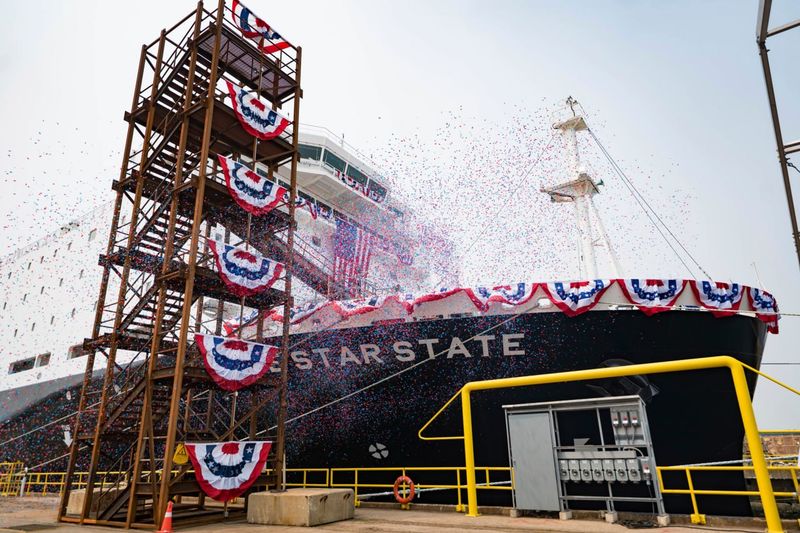
According to industry sources and government and ruling party officials on the 1st, a delegation led by Richard Breckenridge, the Navy's chief aide in charge of shipbuilding, toured the facilities of shipbuilders including Hanwha Ocean, HD Hyundai Heavy Industries, and SK Oceanplant. A ruling party source told this paper, "There have been several previous closed-door visits by the U.S. Navy," adding, "This trip is meant to assess the capabilities of Korean shipbuilders for warship construction and MRO, or maintenance, repair, and overhaul, orders under the MASGA project."
Breckenridge is known to report directly to the Secretary of the Navy and oversee practical matters such as streamlining U.S. Navy ship construction and procurement procedures and rebuilding shipbuilding infrastructure. The closed-door inspection was reportedly organized by DAPA. With Trump announcing an executive order on rebuilding the U.S. Navy and shipbuilding base, the industry and ruling party view it as a de facto pre-order inspection.
The executive order includes a special provision for foreign shipbuilders that invest in U.S. shipyards and create local jobs: the first two vessels must be built in their home country, while additional ships must be built locally. The targets include surface combatants for anti-submarine and surface warfare, cargo replenishment tankers, and cargo ships. Korean shipbuilders are also in full preparation mode for the MASGA project.
Hanwha acquired Philly Shipyard and won an order for the U.S. Navy's Missile Range Instrumentation Vessel (MRIV). It is also seeking to acquire Austal USA, which builds small U.S. Navy surface ships and logistics support vessels. HD Hyundai Heavy Industries has set up a local subsidiary, HD Hyundai USA, to pursue the acquisition of a U.S. shipyard, and it is developing unmanned surface vessel technology with Samsung Heavy Industries and U.S. defense firms Anduril Industries and Saronic. HD Korea Shipbuilding & Offshore Engineering Co., Ltd. (HDKSOE) has agreed to jointly build digital solutions for ship design with Siemens AG. SK Oceanplant has signed the Maintenance and Ship Repair Agreement (MSRA), which qualifies it to participate in U.S. Navy vessel MRO projects.
■ Once the MASGA agreement is finalized, National Assembly review of support bills will begin
The key tasks for the MASGA project to get on track are finalizing the Korea-U.S. agreement and enacting support legislation that reflects it. First, drafting the MASGA agreement faces obstacles, including uncertainty over approval and budget allocation in the U.S. Congress and pushback from the local shipbuilding industry. The extent of supply chain cooperation and joint research and development outcomes at the Korea-U.S. Shipbuilding Partnership Center (KUSPC), established by Korean shipbuilders and local companies, is expected to be the key to resolving the issue.
Once the agreement is completed, the National Assembly will finally be able to review the MASGA support bills. Democratic Party of Korea lawmakers Lee Un-ju and Heo Seong-mu introduced the bills in July last year and again in March this year, but they have not advanced because the Ministry of Trade, Industry and Energy said during the review process that they would only be effective if they reflected a more concrete agreement.
In a review report by the Trade, Industry, Energy, SMEs, and Startups Committee, which oversees the bill, MOTIE said, "It would be appropriate to discuss whether to designate special industrial complexes and what support to provide after a treaty or agreement has been concluded between the two countries, based on the specific terms of the agreement." It added, "As discussions on establishing a Korea-U.S. shipbuilding cooperation fund are still ongoing, legislation at this stage should be approached cautiously."
A Democratic Party of Korea lawmaker on the committee said, "We can begin full-scale review only after the Korea-U.S. agreement is made concrete." The lawmaker added, "Taking that into account, the pending bills are also supposed to follow the treaty or agreement if its provisions differ from domestic law."
[email protected] Kim Yun-ho Reporter