Real Estate and Leverage Accountability Debate Leads to Kim Yong-beom's Resignation as Cheong Wa Dae Policy Chief [Economic Line Reshuffle]
- Input
- 2026-09-01 18:16:17
- Updated
- 2026-09-01 18:16:17
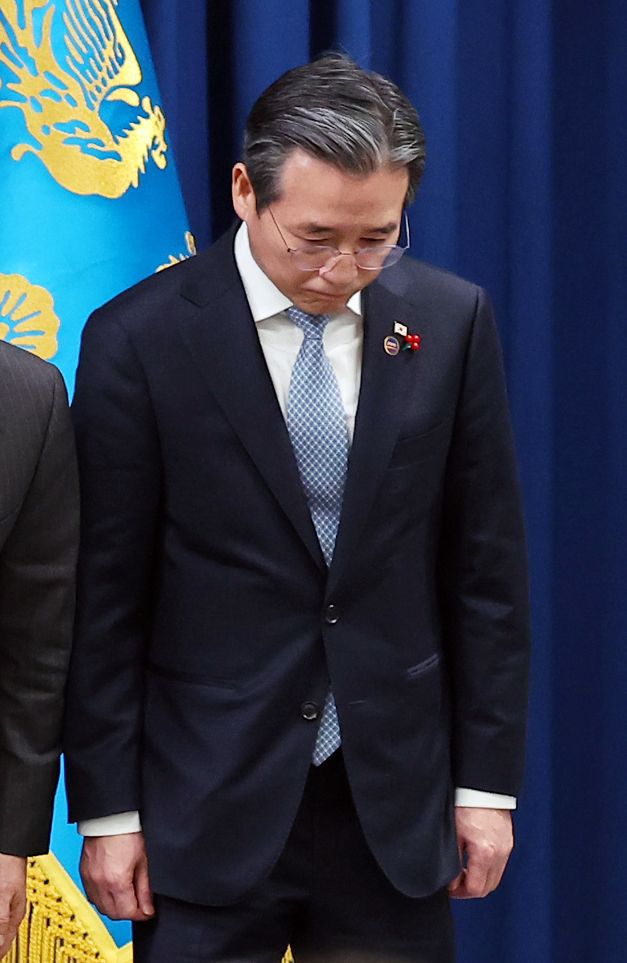
After a recent mid-sized Cabinet reshuffle that replaced the deputy prime minister for economic affairs and the minister of land, infrastructure and transport, the resignation of the policy chief, who had served as the government's economic control tower, has effectively put the administration's economic and policy team on track for a full overhaul. Attention is now turning to whether the Lee administration, which has entered its second term, will shift its economic policy direction.
At a briefing on current issues at the Chunchugwan Press Center at the Blue House, senior presidential spokesperson Kang Yoo-jung said, "Kim Yong-beom, Chief Secretary for Policy at Cheong Wa Dae, expressed his intention to resign yesterday, and President Lee accepted his resignation today." In effect, the resignation was accepted just one day after he offered to step down.
On the 30th of last month, President Lee carried out a mid-sized Cabinet reshuffle, replacing six ministers and reorganizing the Cheong Wa Dae staff. At the time, however, Kim remained in his post.
A Cheong Wa Dae official explained that "the average tenure for Cheong Wa Dae aides is about one year and two months to one year and six months," adding that "staff changes are made to ensure smooth momentum in policy implementation." Still, after the reshuffle, criticism grew over the introduction of single-stock leveraged ETFs and real estate issues, and Kim appears to have decided to step down.
Kim had served as the control tower coordinating the Lee administration's overall economic policy. He was also involved in designing and pushing major policies, including the Three Mega-Projects, support measures for advanced industries such as Artificial Intelligence (AI) and semiconductors, and key policies on real estate and taxation. He also led major economic issues such as the United States–Korea Tariff Negotiations and was credited with a relatively solid performance.
More recently, however, criticism of Kim has intensified. As instability in the Seoul and Capital Region housing markets continued, controversy over the introduction of single-stock leveraged ETFs fueled calls from the opposition for his resignation.
It has also been reported that some within the ruling bloc argued that changes to the policy team were needed as approval ratings for both the president and the party were falling at the same time.
With Kim's abrupt resignation, attention is now focused on who will replace him. Possible candidates include Kim Jung-kwan, the Minister of Trade and Industry, Lee Eok-won, Chairperson of the Financial Services Commission, and Joo Byung-ki, Chairperson of the Korea Fair Trade Commission. Other names being mentioned include Lee Ho-seung, former Chief Secretary for Policy at the Moon Jae-in administration, and Yoon Chang-ryeol, former Minister for Government Policy Coordination.
[email protected] Choi Jong-geun Reporter