Fiscal spending to top 1,000 trillion won by 2030; national debt to reach 1,700 trillion won, or 49% of GDP [2027 budget bill]
- Input
- 2026-09-01 18:12:13
- Updated
- 2026-09-01 18:12:13
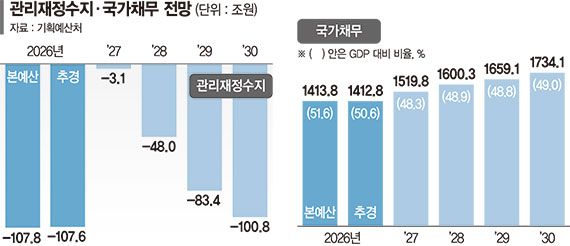
The government is making an optimistic assumption that the semiconductor supercycle will continue for another one to two years, driving a substantial increase in tax revenue. It also expects the debt-to-GDP ratio to stay below 50% at 49.0% in 2030 as the economy expands. However, if the semiconductor boom ends earlier than expected and tax revenue drops sharply, the government could face a heavy burden in covering its ballooning spending.
On the 1st, the Ministry of Planning and Budget presented the National Fiscal Management Plan for 2026-2030 at the State Council of South Korea. Minister Park Hong-keun said, "We will review all fiscal programs, including mandatory spending, and reinvest the savings into key priorities such as strengthening growth engines and easing polarization."
The fiscal plan shows that both revenue and spending will surge over the next four years. Total fiscal revenue is projected to grow by an average of 9.9% annually from 2026 to 2030, supported by the semiconductor boom, continued economic growth, and strong national tax revenue. National tax revenue, the core source of tax income, is estimated to rise by an average of 13.4% a year over the same period. Compared with total revenue of 700.6 trillion won, including this year's supplementary budget, fiscal revenue will increase by more than 180 trillion won next year and by more than 380 trillion won in 2030. The tax burden ratio on citizens will also rise, climbing to 29.8% next year from 25% this year before staying in the 29% range.
Spending will also hit record levels. The country is expected to enter the era of more than 1,000 trillion won in fiscal spending by 2030. With an average annual growth rate of 8.4%, spending is projected to reach 894.6 trillion won in 2028, up 9.0% from the previous year, then 957.4 trillion won in 2029, up 7.0%, and 1,005.2 trillion won in 2030, up 5.0%. More than half of total spending will be mandatory expenditures, including basic pensions, basic allowances and social welfare costs. The government expects mandatory spending to grow by an average of 8.5% a year through 2030, with its share rising to as much as 53.5%.
The fiscal balance will also change significantly. National debt in 2030 is projected to reach 1,734 trillion won, up more than 300 trillion won from this year's 1,412 trillion won. The Managed Fiscal Balance, a key indicator of the country's finances that excludes social security funds from the Integrated Fiscal Balance, is expected to plunge from 107 trillion won this year to 3 trillion won next year on the back of surging tax revenue, before rising again to 100 trillion won in 2030. As a share of GDP, the Managed Fiscal Balance is forecast to remain at minus 2.9% in 2030, staying below 3%.
Experts agree that the temporary surge in tax revenue from the semiconductor boom has improved fiscal conditions, but they also say it is not sustainable. In particular, the large-scale introduction and expansion of universal "basic income"-style mandatory spending, such as child allowances for ages 0 to 12, basic pensions for those 65 and older, youth allowances and rural allowances, means fiscal pressure will inevitably keep rising.
The biggest problem with such mandatory spending is that once it is paid out, it is difficult to reduce. Government mandatory contributions to the four major public pension funds, including NPS and the Public Officials Pension, are also expected to exceed 100 trillion won.
Lee Young-sook, a research fellow at KIHASA, said, "As late-stage aging, or people aged 75 and older, deepens, income gaps and long-term care needs will grow exponentially. That will change both the scale and nature of fiscal demand and increase the burden."
Fiscal soundness is directly tied to national creditworthiness. Even if the government pours in hundreds of trillions of won in tax money, the effect of fiscal spending will be limited unless it is accompanied by structural reforms in industry, labor and pensions. International organizations such as the IMF and the OECD have called for stronger, credible medium-term fiscal frameworks, including fiscal benchmarks, to advance fiscal consolidation.
[email protected] Jung Sang-kyun Reporter