After the abolition of the prosecution, a three-tier structure emerges... law firms will change how they handle cartel cases
- Input
- 2026-09-01 18:11:35
- Updated
- 2026-09-01 18:11:35
According to the legal community on the 1st, cartel cases had until now followed a linear process in which the KFTC investigated and reviewed the case, imposed fines, and only if it filed a complaint did the matter proceed to a prosecution investigation and criminal trial. Going forward, the KFTC will handle administrative investigations and sanctions such as fines, the Serious Crime Investigation Agency's antitrust unit will conduct criminal investigations including raids and suspect questioning, and the Public Prosecution Office will decide whether to indict and will manage the prosecution.
■A three-way system of the KFTC, the Serious Crime Investigation Agency, and the Public Prosecution Office
Kim Yong-ha, a lawyer at Barun Law LLC, said, "Beyond the past structure of KFTC investigations and prosecution indictments based on KFTC complaints, it is essential to operate an integrated dedicated response team that centralizes the facts and evidence to be submitted to all three agencies from the earliest stage."
In particular, the old formula of 'KFTC complaint first, prosecution investigation later' has recently been breaking down, and cases in which the prosecution conducts preemptive investigations before requesting a KFTC complaint are increasing. In February this year, the flour and sugar cartel case, the starch syrup cartel case, and the cases involving refiners and petrochemical companies were all investigated by prosecutors before the KFTC took action.
Jin Ho-sik, a lawyer at YK Law Firm, said, "The old practice of waiting for the KFTC's investigation and review results before setting a response strategy is no longer sufficient."
He said the reorganization of investigative agencies makes it necessary to respond through a dedicated team under an integrated task force. Kim Hong-ki, a lawyer at Bae, Kim & Lee LLC (BKL), said, "If the cartel response system is divided into the KFTC's administrative investigations, the Serious Crime Investigation Agency's criminal investigations, and the Public Prosecution Office's indictment and prosecution management, companies must be prepared for the possibility that procedures at multiple agencies will proceed simultaneously or sequentially on the same facts."
The most sensitive issue in practice is evidence law. KFTC administrative investigations are, in principle, voluntary, but refusal or obstruction can lead to fines or criminal punishment. By contrast, Serious Crime Investigation Agency probes are subject to the warrant principle and the constitutional right to remain silent. Jeong Hwan, a lawyer at Lee & Ko, explained, "It is necessary to manage the materials submitted to each agency and the statements of executives and employees so that they do not conflict with one another, and to prepare with the possibility of later criminal proceedings in mind from the KFTC investigation stage."
■"Concerns over a three-tier leniency reporting structure"
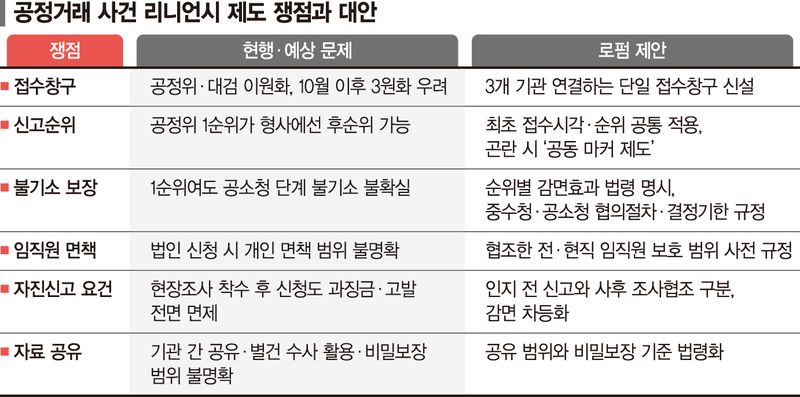
The biggest uncertainty is the leniency program for voluntary reporting. Even now, it is split between the KFTC's administrative leniency program and the Supreme Prosecutors' Office of the Republic of Korea (SPO)'s criminal leniency program, and it could become even more complex under a three-tier structure.
At present, the KFTC's leniency program offers exemptions from fines, corrective orders, and complaints, while the criminal leniency program offers incentives such as non-indictment or reduced sentencing recommendations. The problem is that the two agencies separately determine the order of filing and whether leniency applies. A company that is first in line at the KFTC could be lower in priority at the prosecution. From October, the prosecution's criminal leniency function will also be split between the Serious Crime Investigation Agency's investigations and the Public Prosecution Office's indictments.
Jeon Sang-oh, a lawyer at Hwawoo, said, "Even before, there were conflicts over differences in leniency rankings between the KFTC and the prosecution." He added, "Going forward, the procedures for accepting leniency applications and determining rankings should be clarified. Referring to overseas cases, one option would be for the Serious Crime Investigation Agency, as the investigative body, to receive the filing and immediately notify the Public Prosecution Office, while the Public Prosecution Office decides whether to grant final exemption from indictment." Jin Ho-sik said, "A single filing window connecting the KFTC, the Serious Crime Investigation Agency, and the Public Prosecution Office could be established, and one filing time and reporting order could be applied consistently to both administrative and criminal procedures." He added, "If a single window is difficult to create, then at least a 'joint marker system' should be introduced so that the time and order of the first filing at one agency are recognized equally by the others."
[email protected] Lee Hwan-ju Reporter