53 Trillion Won for Youth Housing and Regional Growth; the Remaining 109 Trillion Won to Serve as a 'Rainy-Day Fund' [2027 Budget Plan]
- Input
- 2026-09-01 18:11:11
- Updated
- 2026-09-01 18:11:11
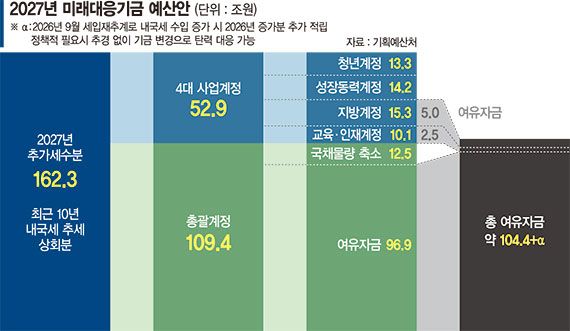
The government reviewed and approved the '2027 Budget Plan' at a State Council of South Korea meeting on the 1st. The Future Response Fund will be created at a scale of 162.3 trillion won.
The fund will be built by setting aside additional tax revenue that exceeds the 10-year trend line for internal taxes. It will also separately reserve savings from the education grant reform, specifically the portion of savings that falls below the 10-year trend line for internal taxes, in an education and talent account.
Next year, the Future Response Fund will invest 45.4 trillion won in four key areas aimed at lifting potential growth: youth, growth engines, regional development, and education and talent. Including 7.5 trillion won in reserve funds, a total of 52.9 trillion won will be allocated to the four program accounts.
The youth account will receive 13.3 trillion won. New programs include 400 billion won for youth first-job support, 1.4 trillion won for universal public rental housing, and 100 billion won for youth opportunity funds. The 14.2 trillion won growth-engine account will launch projects including 4.7 trillion won for frontier-level artificial intelligence development, 250 billion won for AI for All, 300 billion won for the Manufacturing Tacit Knowledge-Based AI Model Development Project, 300 billion won for the AIDC ecosystem, 500 billion won for a project-financing site normalization fund, 500 billion won for a KEPCO equity investment, and 100 billion won for water supply at the semiconductor industrial complex in the southwest region.
The regional account will receive 15.3 trillion won, with new initiatives including 3.5 trillion won for regional future growth support grants, 1.5 trillion won for multipurpose centers for everyday convenience, 20 billion won for agricultural AI transformation demonstrations, 10 billion won for distribution improvements for agricultural and fishery products, and 15 billion won for hotel construction support in regional areas. The 10.1 trillion won education and talent account will also introduce new support measures, including 700 billion won for future talent growth funds, 200 billion won for full scholarships at regional national universities, and 500 billion won for the Ministry of Education internship semester program.
Minister of Planning and Budget Park Hong-keun explained, "The general account and other funds already cover welfare, administration, and defense, among other areas," adding, "The Future Response Fund is designed to concentrate investment in four areas."
The remaining 109.4 trillion won in the Future Response Fund will be managed as reserve funds to ease and absorb sharp fluctuations in tax revenue or to promptly reinforce fiscal capacity when tax shortfalls occur. As a result, the government plans to reduce new government bond issuance for 2027 by 12.5 trillion won through the fund next year.
In addition to the bond-reduction funds, the remaining 96.9 trillion won will function as a fiscal reserve and be used without a supplementary budget when policy needs arise. To do this, the government will select a dedicated agency to manage the fund's reserve resources. Vice Minister of Economy and Finance Jo Yong-beom said, "The creation of the Future Response Fund came from the basic idea of overcoming the limits of annual budgetism," adding, "When money enters the general account, it has to be spent within the year. Since the general account cannot function as a fiscal stabilization device, we created a fund that can serve as a 'dam.'"
Along with the creation of the Future Response Fund, education grant reform will also move forward. At present, the local education grant is set at 20.79% of internal taxes, but going forward the amount will be calculated by reflecting 35% of the three-year average economic growth rate and 35% of the three-year average change in school-age population.
As a result, the education grant's internal tax linkage system, which began in 1972, will come to an end, and the surge in tax revenue driven by the semiconductor boom will no longer be automatically reflected in the grant. However, the total amount of the education grant and the grant per student will continue to rise. If the grant amount falls from the previous year, the government plans to cover the difference so that the total does not decline.
[email protected] Reporter Seo Young-jun Reporter