Up to 75 million won per child: New three-part package for marriage, childbirth and child-rearing introduced [2027 budget proposal]
- Input
- 2026-09-01 18:09:54
- Updated
- 2026-09-01 18:09:54
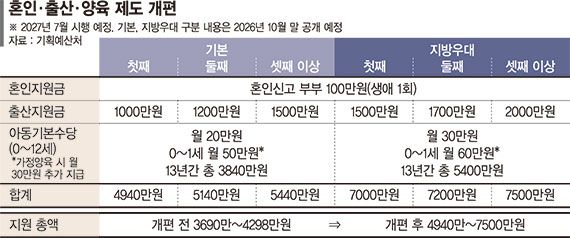
The government approved the 2027 budget proposal containing these measures at a State Council of South Korea meeting on the 1st.
To respond to the low birthrate, the government will first launch a 6.1 trillion won marriage, childbirth and child-rearing package. The core of the plan is to combine support at each stage, from marriage to child-rearing, and provide up to 75 million won per child.
If a newlywed couple who married in the second half of next year has a baby, they will receive a 1 million won marriage grant. After childbirth, they can receive a Birth Grant of 10 million to 20 million won and a monthly child basic allowance of 200,000 to 300,000 won. The aim is to integrate support that had previously been divided into separate programs, such as the Marriage Tax Credit, First Meeting Voucher and Parent Allowance, while also expanding the overall scale of assistance.
The government will also launch the Children's Asset-Building Fund to help children build assets from birth. It will provide up to 1.2 million won a year from birth until age 18, with the fund designed to pay out as much as 60 million to 100 million won at maturity. The government has allocated 2.3 trillion won for the related program.
A budget of 1.9 trillion won has been set aside for Youth Future Savings, which is intended to support young people in building assets. Previously, applicants had to meet income requirements, such as annual earnings of 75 million won or less, but from now on all young people will be eligible to join. The government contribution rate will rise from the previous 12 percent to 15 percent for the preferred tier and 25 percent for young workers at small and medium-sized companies in regional areas.
Park Chang-hwan, budget director-general at the Ministry of Planning and Budget, explained, "We designed a policy that does not discriminate in terms of eligibility, but differentiates the amount of support, so that low-income young people in regional areas receive more than twice the benefit."
Housing support will also be greatly expanded. Next year's budget for public rental housing for young people will rise to 18.1 trillion won, nearly double this year's 9.4 trillion won. The government plans to supply 106,000 public rental units for young people next year. In particular, it will newly provide larger, standard public rental homes in locations preferred by young people, such as areas near subway stations.
The government will also expand the training of talent for advanced industries. The number of people receiving vocational training in leading sectors, including the corporate-led K-New Deal Academy, will double from 60,000 to 120,000. The number of people trained through AI advanced boot camps will also increase from 13,000 to 25,000.
A budget of 1.3 trillion won has been allocated for support for youth entrepreneurship. To reduce the management burden on young founders, the government will introduce startup safety insurance and subsidize up to 80 percent of the premium.
Support to ease education costs and encourage young people to settle in regional areas will also be expanded. Starting next year, 60,000 freshmen entering local national universities will receive full tuition support. The government will spend 213 billion won on the program. However, medical, dental, pharmacy and veterinary schools will be excluded.
The government will also newly provide 691 billion won in Future Talent Growth Fund support to 21 local national universities, including flagship national universities. The funding will be provided as a lump sum so that universities can invest autonomously in education and research according to their mid- to long-term development plans. Flagship national universities will receive an average of 50 billion won each, while other local national universities will receive an average of 20 billion won each. Investment in regional private universities will also expand. The government will newly inject 600 billion won into the construction of experimental, practical training and research facilities at about 40 private universities and about 10 junior colleges that operate science and engineering departments linked to regional strategic industries.
Park Hong-keun, Minister of Planning and Budget, said, "Support for young people is a strategic investment in building the capabilities of the next generation, which will lead future national growth." He added, "We will provide seamless support across the entire life cycle of young people, from education, jobs and entrepreneurship to assets, housing, marriage, childbirth, child-rearing, and daily life and culture."
[email protected] Kim Chan-mi Reporter