Jeonnam-Gwangju Integrated Metropolitan City Wins First National Project Since Merger, Secures Quantum Cluster
- Input
- 2026-09-01 17:46:31
- Updated
- 2026-09-01 17:46:31
[Financial News Jeonnam-Gwangju = Reporter Hwang Tae-jong] Jeonnam-Gwangju Integrated Metropolitan City (Gwangju Metropolitan City) has been selected for the Ministry of Science and ICT’s Quantum Cluster Designation Project.
With this, the integrated metropolitan city has achieved its first national project win since its launch and is set to emerge as a national base for quantum communication, a field expected to transform the future industrial landscape, while securing a key growth engine that goes beyond the AI era.
According to Gwangju Metropolitan City on the 1st, the Quantum Cluster Designation Project is a key national initiative that supports the creation of an industrial ecosystem in quantum computing, quantum communication, and quantum sensing in connection with regionally specialized industries.
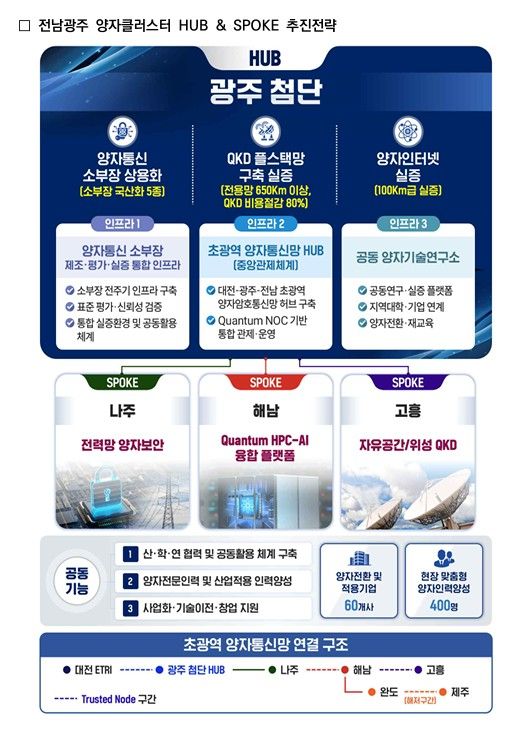
Following its selection, Gwangju Metropolitan City will invest a total of 140 billion won, including 100 billion won in state funding, from 2027 to 2030 over four years to build the Jeonnam-Gwangju Quantum Cluster.
In particular, it plans to build a complete quantum communication ecosystem through the Jeonnam-Gwangju Quantum Cluster, linking the Gwangju Advanced Science Industrial Complex as the technology hub and Naju, Haenam, and Goheung County as demand hubs.
Gwangju will serve as the center for manufacturing, evaluation, and demonstration of quantum communication materials, parts, and equipment. Naju will be linked to power grid and energy security, Haenam to AI, high-performance computing (HPC), and data, and Goheung County to space and satellite communications, broadening the industrial application base for quantum technology.
Mayor Min Hyung-bae said, "Jeonnam-Gwangju is the only region in the country equipped with all the infrastructure needed for AI, energy, and photonics convergence, giving it the ideal environment to complete quantum technology," adding, "With this selection for the quantum cluster, we will work closely with industry, academia, and research institutes to develop Jeonnam-Gwangju into the world's first quantum innovation city that will seize the leadership of new industries."
The project will involve research and support institutions and universities such as Gwangju Techno Park, JEONNAM TECHNOPARK, the Korea Photonics Technology Institute, the Electronics and Telecommunications Research Institute (ETRI), the Gwangju Institute of Science and Technology (GIST), and Chonnam National University (CNU), as well as a number of companies including SK Broadband, KEPCO KDN, ID Quantique (IDQ), WOORIRO, Korea Advanced Materials, and OE Solutions.
Based on this, Gwangju Metropolitan City plans to foster 60 quantum transformation and application companies and establish a self-sustaining industrial ecosystem that spans technology development, manufacturing, and commercialization.
It also plans to train 400 quantum specialists and practical professionals by establishing specialized degree programs and master's and doctoral courses at universities. In addition, it will operate quantum transformation programs that connect education, hands-on training, and employment for workers in adjacent fields such as photonics, semiconductors, and AI, while actively supporting the quantum transformation (QX) of existing industrial workers.
Meanwhile, Jeonnam-Gwangju’s top evaluation in the competition is seen as reflecting the country’s only photonics convergence infrastructure, built over the past 25 years. This is because the technology for controlling light, or photons, which is central to quantum technology, is directly linked to Gwangju’s optical communications and photonics materials infrastructure. Analysts also say that its ability to demonstrate next-generation security systems by linking energy, space, and aviation infrastructure in the Jeonnam region was a decisive factor.
[email protected] Hwang Tae-jong Reporter