Pusan National University, Chonnam National University, and Chungnam National University selected for first round of support under 'Creating 10 Seoul National Universities'
- Input
- 2026-09-01 17:00:00
- Updated
- 2026-09-01 17:00:00

[Financial News] Pusan National University, Chonnam National University, and Chungnam National University have been selected as the first universities to receive package support under the government's "Creating 10 Seoul National Universities" project. From 2026 to 2030, the government will invest about 100 billion won per year in each university to support talent development and strengthen research capabilities in regional strategic industries and artificial intelligence.
The Ministry of Education said on the 1st that the three universities were finalized as the 2026 package support recipients under the "Pan-Government Council for a Great Spatial Transformation of the National Territory," which was held at Government Complex Seoul and chaired by the Prime Minister.
At a briefing that day, Minister of Education Choi Kyo-jin said, "Through continued cooperation with related ministries, we will create a successful model of regional growth driven by local universities and deliver results that the public can feel," adding, "The Ministry of Education will spare no administrative or financial support so that national universities can fulfill their mission of achieving balanced national growth."
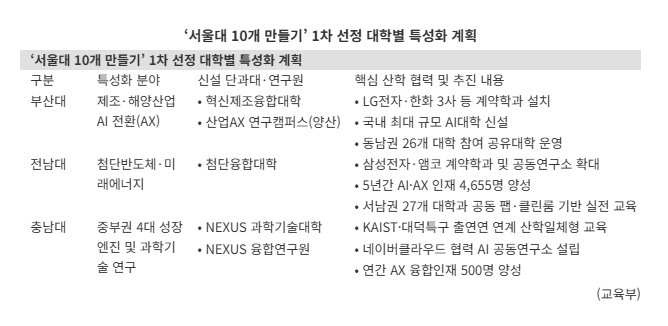
Branded colleges and convergence research institutes are designed to support integrated industry-academia-research undergraduate, graduate, and research programs in the 5 Poles 3 Special Growth Engine sectors. AI hub universities will train AI specialists and converged talent while supporting the AI transformation of regional strategic industries. Shared universities under the 5 Poles 3 Special Growth Engine will share resources and infrastructure from leading national universities with local universities to promote joint education, joint R&D, and startups.■ Three universities to specialize according to regional industriesEach university's specialization strategy will be tailored to its regional industrial base.
Pusan National University plans to establish an Innovation Manufacturing Convergence College that covers growth-engine industries in the southeastern region, including shipbuilding and marine engineering, mechanical systems, and aerospace. It will also set up new contract departments with three companies, including LG Electronics and Hanwha. The university will create the country's largest AI college and turn its Yangsan Campus into a research campus for industrial AI transformation. Through a shared university network involving 26 universities in the southeastern region, it will jointly use infrastructure and also operate a marine capital convergence major together.
Chonnam National University will establish an Advanced Convergence College focused on cutting-edge semiconductors and future energy. It plans to expand company-participation courses and scale up the Amkor semiconductor packaging joint research institute model to Samsung Group, KEPCO, and others. Over the next five years, it aims to train 4,655 AI and AX specialists and will also promote hands-on joint education using shared fabs and clean rooms with 27 universities in the southwest region.
Chungnam National University will build a joint cooperation framework with KAIST to establish the NEXUS College of Science and Technology, and it will create an industry-academia integrated education system in which leading companies and KAIST jointly design and operate the curriculum. Using regional research infrastructure such as the Daedeok R&D Special Zone and government-funded research institutes, it will pursue research aimed at solving industrial bottlenecks, and it will also establish a joint AI research center with NAVER Cloud. The university aims to train 500 AI convergence specialists each year.
The Ministry of Education plans to separately form a performance management committee for the large-scale investments in the selected universities and set shared key performance indicators involving universities, local governments, and the private sector. It will review annual results and manage project performance in connection with differentiated financial support.
[email protected] Kim Man-gi Reporter