Jeju to redesign its transition model for residents' autonomy councils after eight pilot sites
- Input
- 2026-09-01 16:07:07
- Updated
- 2026-09-01 16:07:07
[Financial News Jeju = Reporter Jung Yong-bok] In line with the legalization of residents' autonomy councils, Jeju Island is starting work on a new design that would turn its existing eight pilot eup, myeon and dong districts into a system that can be applied across the island. Key issues include how much authority to give residents' general meetings and autonomy plans, and how to reflect the different conditions of eup, myeon and dong areas in the system.
According to Jeju Special Self-Governing Province on the 1st, the province will hold the first plenary meeting of the Policy Working Group on the Transition of the Residents’ Autonomy System at 2 p.m. on the 2nd in Halla Hall at the Jeju Provincial Government Office, formally beginning discussions on the transition to a Jeju-style Residents’ Autonomy Council.
The working group consists of 27 members in total, including five experts, 14 resident representatives and eight officials. Rather than the administration designing the system first and then explaining it to residents, the structure brings together local autonomy officials, experts and the administration from the system-design stage.
Resident representatives include officials from the Jeju Island Residents’ Autonomy Committee Council and the Village and Neighborhood Leaders’ Council, as well as the heads of the residents' autonomy councils in eight pilot districts: Hallim-eup, Ido 2-dong, Yongdam-2-dong, Hwabuk-dong, Seongsan-eup, Andeok-myeon, Hyodon-dong and Donghong-dong.
The experts are Choi Ji-min, head of the Local Autonomy and Decentralization Research Center at the Korea Research Institute for Local Administration; Kang Chang-min, vice president of the Jeju Research Institute; Yoon Won-soo, a research fellow at the Jeju Research Institute; Kim Heung-ju, a senior research fellow at the Sejong Institute; and Kang Ho-jin, a member of the Jeju Island Regional Era Committee.
On the administrative side, Byun Young-geun, director of the Special Self-Governing Administration Bureau of Jeju Island, will take part along with officials from the self-government administration departments of the province, Jeju City and Seogwipo City, as well as eup, myeon and dong heads.
The first meeting will begin by reviewing the changes brought by the legalization of residents' autonomy councils and the national policy trend. Choi Ji-min will explain the institutional changes and nationwide trends, while Kim Heung-ju will present Sejong City's transition process and operating cases.
Jeju's challenge is not to simply import systems from other regions.
Jeju Island has identified the role and functions of residents' autonomy councils, expanded resident representation and participation, the operation of residents' general meetings and autonomy plans, and their relationship with existing local communities as major discussion topics. Because each eup, myeon and dong area has different population sizes, living zones and community structures, the province will also review phased transition measures tailored to local conditions.
In particular, it is important to determine how residents' general meetings and autonomy plans will be linked to actual administrative and financial systems. This year, Jeju Island is accumulating experience in operating autonomy plans in its eight pilot eup, myeon and dong districts, where residents directly set local agendas and propose projects.
The reason discussions on a Jeju-style model are gaining pace is the nationwide shift in the system. Residents' autonomy councils had long been operated as pilot projects, but this year revisions to the Local Autonomy Act created a legal basis for their establishment, operation and administrative and financial support. Local governments now need to redesign ordinances and operating systems to move from pilot operation to a permanent system.
The Ministry of the Interior and Safety has also presented local governments with a draft revision of model ordinances that would lower the eligibility threshold for council members and expand the scope of residents' general meeting resolutions and autonomy plans. Links to participatory budgeting and the operation of secretariats are also among the elements to be reviewed in the system-design process.
Jeju faces different conditions from other cities and provinces because it must reflect both its special self-governing administrative system and the regional differences among eup, myeon and dong areas. That is why Jeju Island set up a separate working group instead of applying the central government's standard model as is.
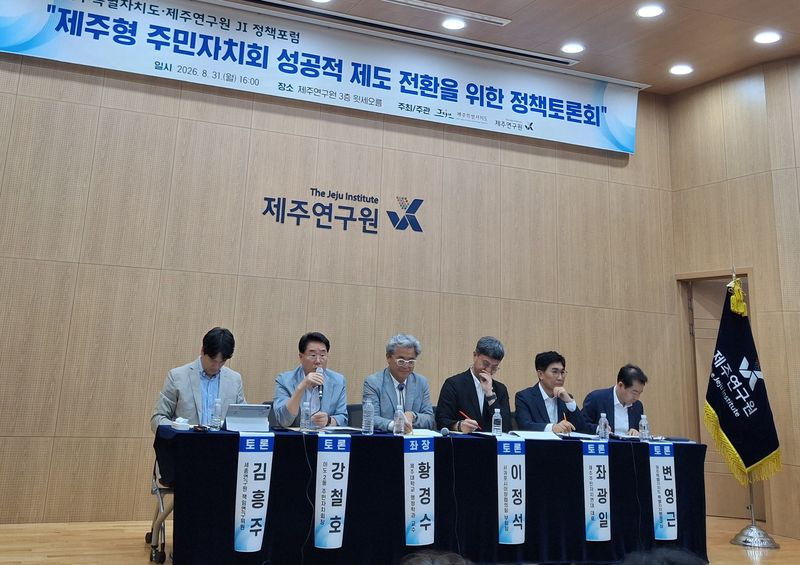
The discussion on the institutional transition has already entered the public debate stage. On Aug. 31, Jeju Special Self-Governing Province and the Jeju Research Institute held the policy forum on the successful institutional transition of the Jeju-style Residents’ Autonomy Council at the Jeju Research Institute and gathered opinions from local autonomy officials and experts.
Jeju Island will run the working group through October. After discussions on policy tasks and expert consultations, it plans to flesh out the basic direction of the ordinance on the establishment and operation of residents' autonomy councils and the Jeju-style operating model. Once a draft system design is completed, the province will not finalize it immediately. Instead, it plans to gather feedback again from residents and existing autonomy committee members through regional briefing sessions and the Residents’ Autonomy Academy.
Byun Young-geun, director of the Special Self-Governing Administration Bureau of Jeju Island, said, "This is the first step toward designing a Jeju-style residents' autonomy system together with resident representatives, experts and officials." He added, "Rather than focusing on the speed of the transition, we will prioritize helping it take root stably in the local community and reflect field opinions in the system design."
[email protected] Jung Yong-bok Reporter