Samsung Electronics Pushes Ahead With Advanced 'CUBE' Strategy to Break Through Memory Limits
- Input
- 2026-09-01 16:19:49
- Updated
- 2026-09-01 16:19:49
[Financial News] Samsung Electronics has unveiled its 'CUBE' strategy to push past the limits of memory technology by increasing memory capacity and bandwidth while also improving power and heat efficiency.
The company said the strategy reflects its vision to strengthen its leadership in memory technology through advances in capacity, utilization, bandwidth, and power and thermal efficiency. It also aims to achieve further advancement beyond the limited footprint of printed circuit boards (PCBs).
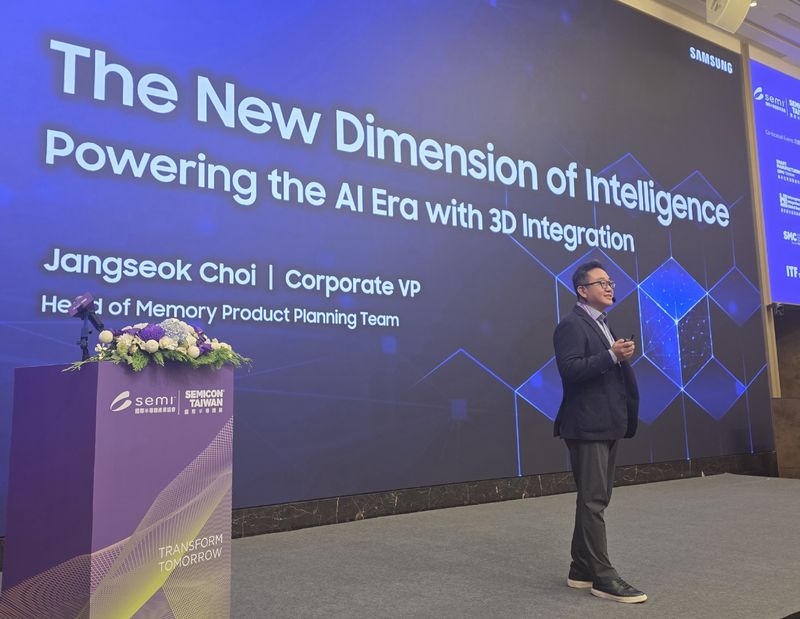
Samsung Electronics said on the 1st that it took part in the Memory Executive Summit at SEMICON Taiwan 2026, Asia's largest semiconductor exhibition, held in Taipei, Taiwan.
At the event, Choi Jang-seok, head of product planning at Samsung Electronics' Memory Business in the Device Solutions Division, introduced the 'CUBE' strategy in a keynote speech. Speaking about capacity, he said, "Memory will no longer be constrained by PCB area. We will expand vertically to increase memory capacity without enlarging the board footprint."
On optimization, Choi said, "3D is not just about stacking layers. The key is how each layer is utilized," adding that Samsung is optimizing logic and memory placement to eliminate data processing delays. On bandwidth, he noted, "By dramatically shortening the distance between dies, we can create a vertical highway and significantly improve bandwidth." Regarding power and thermal efficiency, he explained, "The ultimate goal of 3D is to reduce the energy needed to move a single bit of data, and Samsung Electronics is maximizing performance per watt by improving structural efficiency."
As the amount of data required for artificial intelligence (AI) computing surges worldwide, memory capacity must also expand. That has made it a challenge to increase capacity steadily through methods other than simply enlarging the physical area of chips and substrates.
Samsung Electronics is accelerating development by strengthening capacity, bandwidth, power efficiency, and thermal management technologies across generations, including 7th-generation high bandwidth memory (HBM4E) and 8th-generation HBM5.
The company is currently developing HBM5 and aims to deliver twice the performance of HBM4E, a 20% improvement in performance per watt, and a 20% reduction in thermal resistance.
Samsung Electronics is also developing its next-generation memory technology, 'zHBM,' with targets of eight times the performance of HBM4E, a threefold improvement in performance per watt, and a 75% to 90% reduction in thermal resistance.
Its high-performance NAND flash solution, 'zNAND-O,' offers 10 times the bit density of DRAM, supporting the large-scale capacity needed for large language models (LLMs). Samsung Electronics plans to begin sampling in 2028.
Samsung Electronics said it plans to continue expanding its leadership in the global memory market by responding quickly to demand across the board, from general-purpose DRAM and NAND to high-value-added AI memory such as HBM, based on its technological leadership and large-scale production infrastructure.
[email protected] Kim Hak-jae Reporter