Korea Customs Service sets 2027 budget at 728.4 billion won, all-out push to block drugs and accelerate AI transformation
- Input
- 2026-09-01 15:40:49
- Updated
- 2026-09-01 15:40:49
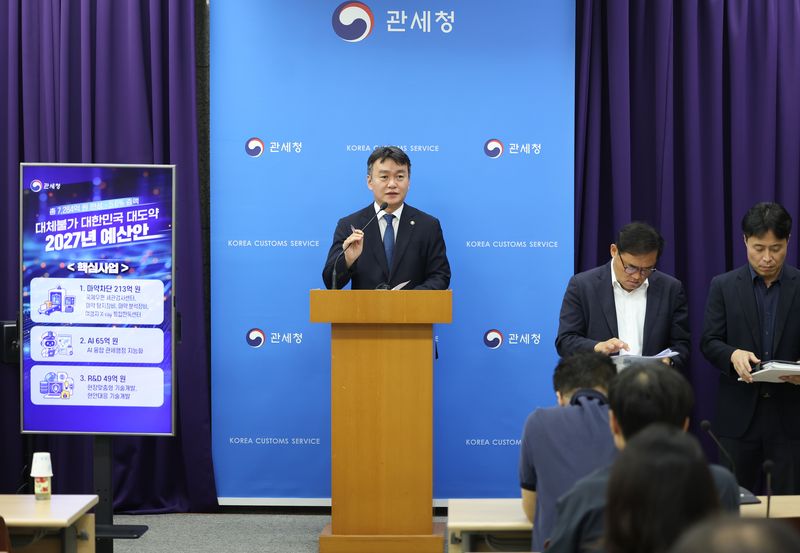
The record-high budget proposal for next year consists of 407.6 billion won for personnel costs, 284.1 billion won for major projects and 36.7 billion won for operating expenses. The agency identified three key priorities: building a drug border defense network, innovating work processes with AI, and supporting field-tailored R&D.
First, 21.3 billion won will be invested in building a drug enforcement network, the top priority. The agency will establish an "X-ray Integrated Multi-Reading Center" worth 5.2 billion won by combining the reading centers at Incheon International Airport Terminal 1 and Terminal 2. The new system will allow two officers to inspect suspicious cargo at the same time. It will also spend 4.6 billion won on advanced equipment, including 3D X-ray scanners, and 2.1 billion won on precision analysis tools. The aging "International Mail Customs Inspection Center" will be rebuilt with 9.4 billion won and equipped with automated facilities and a dedicated drug testing lab.
A further 6.5 billion won has been allocated for the AI transformation of customs administration. To block harmful items purchased through overseas direct shopping, the agency will upgrade its "AI model for screening illegal goods" with 1.8 billion won. It will also build an AI integrated analysis system for investigating illegal foreign exchange transactions, worth 2.6 billion won, and an AI monitoring system for checking the distribution process of imported goods, worth 1.4 billion won. The plan also includes 700 million won to enhance the Korea Customs Service mobile app and revisions to the Customs Act to improve information sharing on hazardous goods.
Under the field-oriented R&D program, worth 4.9 billion won, the agency will develop a system that uses AI to learn from 430,000 smuggling cases and automatically identify contraband, with 1.2 billion won earmarked for the project. Another 900 million won will go toward standardizing X-ray reading data. The budget also includes 700 million won for a portable test kit that can detect drugs without opening packages, as well as 2.1 billion won for short-term R&D.
The large-scale budget push to block drugs and other harmful goods comes as air travel demand has recovered and parcel volumes from overseas direct shopping have surged, leading to more diversified and sophisticated smuggling attempts. In particular, more cases have emerged in which new types of drugs, such as jelly, candy and liquid e-cigarette forms, are disguised as everyday products. Critics have long said that the existing one-by-one inspection system and manpower-based monitoring are reaching their limits.
Commissioner Lee said, "We concentrated resources secured through aggressive spending restructuring on key projects such as blocking drugs and driving AI innovation." He added, "Once the budget is finalized after parliamentary review, we will do our utmost to deliver results that the public can feel."
[email protected] Kim Won-joon Reporter