Automating Stem Training for Greenhouse Cucumbers Cuts Work Time by 58%
- Input
- 2026-09-01 15:21:07
- Updated
- 2026-09-01 15:21:07
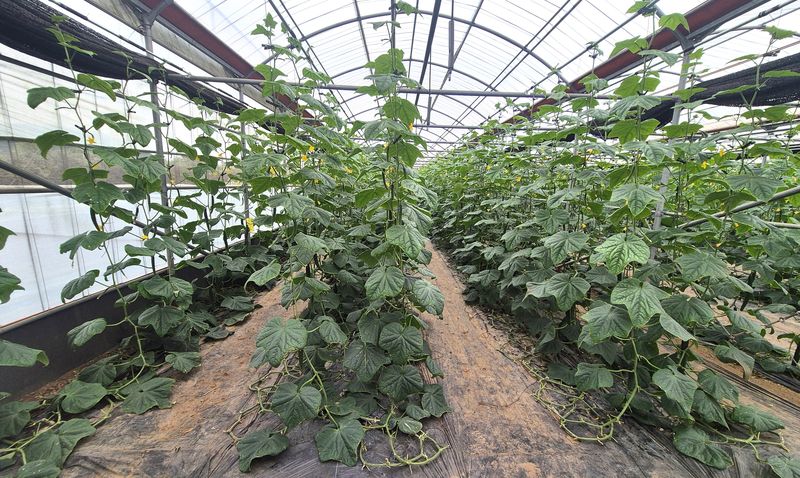
[Financial News Jeju = Reporter Jung Yong-bok] In greenhouse cucumber cultivation, applying a device that automatically lowers the stems cut the most labor-intensive stem training work time by 58.1% compared with conventional cultivation. The technology is drawing attention as a way to reduce repetitive work and the labor burden inside greenhouses during hot weather, but Jeju Province plans to conduct additional analysis through the fall crop to verify the results again.
According to the Jeju Agricultural Technology Center of the Jeju Special Self-Governing Province Agricultural Research and Extension Services on the 1st, the center is carrying out a demonstration project for greenhouse fruit and vegetable stem-training labor-saving technology for cucumber growers.
The project, which runs from March to December this year, focuses on reducing work time and labor through the introduction of automated vine-training equipment.
Greenhouse cucumbers grow quickly, so their stems must be continuously guided and their height adjusted as they develop. Shoots are also removed and harvested repeatedly. In summer, the work becomes especially demanding because it must be done inside greenhouses with high temperatures.
The vine-training device used by the Jeju Agricultural Technology Center adjusts the height of the training line with a drive unit. Unlike the conventional method, which moves cucumber stems sideways, it applies a 'vertical lowering cultivation' method that winds the stems in place and lowers them downward.
Its key advantage is that workers can reduce the distance they need to move along the stems and also adjust their working height.
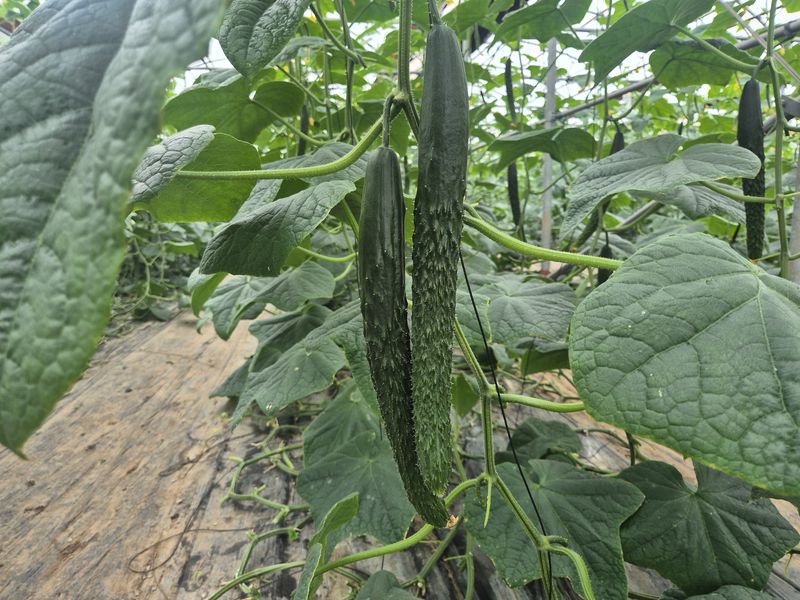
From May to July, the center compared work time, productivity and product quality between conventional six-row cultivation and five-row cultivation using the automated device in the spring crop.
As a result, stem training time in five-row cultivation fell by 58.1% from conventional six-row cultivation. Shoot management time dropped by 51.9%, and harvesting time by 32.3%. Even though the number of cultivation rows was reduced from six to five, total shipments remained at a similar level.
Differences also appeared in quality indicators. The share of premium-grade produce was 93.8% in five-row cultivation with the automation technology, compared with 78.1% in conventional six-row cultivation. However, the latest results are based on a field analysis that compared conditions in which the number of cultivation rows changed from six to five, along with whether the automated device was used. Additional verification is needed before attributing the difference in premium-grade share solely to the automation device.
That is why the Jeju Agricultural Technology Center plans to analyze work time and productivity again in the fall crop starting in October. It aims to determine whether similar labor-saving effects appear even under different seasonal and growing conditions, and to assess the technology's potential for field application.
The technology is also significant as a labor-saving solution in response to labor shortages and an aging rural population. Labor-saving technology refers to methods that use machinery and automation equipment to reduce the amount of work and labor time people must perform directly.
In particular, reducing repetitive tasks that continue throughout the cultivation period, such as stem training, could lower both the labor force required by farms and the time needed for work. If the time spent inside greenhouses during hot weather is also shortened, it could help reduce workers' exposure to heat.
Heo Young-gil, head of the Jeju Agricultural Technology Center, said, "In the spring crop analysis, we confirmed a high share of premium-grade produce while cutting stem training and shoot management time by more than half." He added, "We will further improve field applicability through additional analysis of the fall crop and expand the distribution of labor-saving technologies for greenhouse fruit and vegetables."
[email protected] Reporter Jung Yong-bok Reporter