The 'Big Spender' Effect From Chinese Tourists: Can It Spark a Rebound for Department Store Stocks?
- Input
- 2026-09-01 16:21:50
- Updated
- 2026-09-01 16:21:50
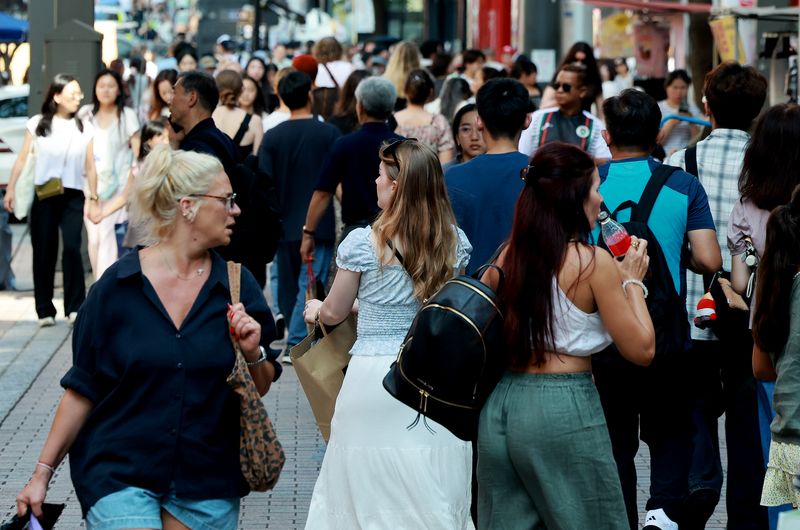
[Financial News] The recent decline in department store stocks, which have fallen by around 40% in just two months, is being seen as excessive. As sales from foreign big spenders rise and earnings improve, some investors say the recent drop is a buying opportunity.
1 According to the Korea Exchange, Shinsegae's share price fell 43.4% in two months, from 776,000 won on July 1 to 439,000 won on this day. Over the same period, Hyundai Department Store dropped 49.1% from 194,000 won to 98,700 won, while Lotte Shopping fell 38.8% from 185,000 won to 113,200 won.
Despite the stock price trend, earnings forecasts for the third and fourth quarters remain solid. Shinyoung Securities projected Shinsegae's operating profit at 142.3 billion won, up 42.7% from a year earlier, and Hyundai Department Store's at 88.6 billion won, up 21.9%. Daishin Securities forecast Lotte Shopping's operating profit at 174 billion won, up 33.3%.
Foreign spending is the key factor supporting those earnings outlooks. Foreigners still account for less than 10% of total department store sales, but the pace of growth is fast, and the impact on same-store sales growth is becoming larger. Shinyoung Securities estimated that foreign sales accounted for 7% to 8% in the first half. Researcher Seo Jeong-yeon of Shinyoung Securities explained that "foreign spending has become significant enough to influence about 2 percentage points of same-store sales growth."
At Shinsegae Department Store, sales to Chinese customers from January to July this year jumped 198.1% from a year earlier, and average spending per Chinese customer at the main store rose by more than 70%. The number of Chinese VIP customers among foreign shoppers also nearly doubled. By category, sales of luxury goods rose 266%, luxury jewelry 223%, beauty products 243%, and fashion items 109%. At the main branch of Lotte Department Store, sales growth from Chinese customers who bought overseas luxury goods, watches, and jewelry between Jan. 1 and Aug. 25 was about 25 percentage points higher than that of all foreign customers, and average spending per transaction was more than 10% higher.
According to Shinyoung Securities, the 12-month forward price-to-earnings ratio for domestic department store stocks is 8 times, far below the 15 to 25 times range for major Japanese peers. The view is that if foreign consumption becomes a new growth engine, the discount applied to domestic demand stocks could also narrow.
Shinyoung Securities kept its target prices for Shinsegae and Hyundai Department Store at 500,000 won and 140,000 won, respectively, while Daishin Securities set a target price of 200,000 won for Lotte Shopping. Compared with the closing prices on the day, the upside potential is 13.9% for Shinsegae, 41.8% for Hyundai Department Store, and 76.7% for Lotte Shopping.
However, if foreign spending is concentrated in luxury goods, which carry low commission rates, the contribution to profits may be limited. Regarding Shinsegae, Seo said that "its long-term fundamentals remain solid, as it has proven its ability to attract foreign demand and operate premium department stores," adding that "the recent short-term stock correction is a good opportunity to buy at a low point."
[email protected] Reporter Lee Jeong-hwa Reporter