The Cruel Morning Commute Left Behind by Punishment and Train Bypasses: What the Suspension of the Disability Rights Protest Means
- Input
- 2026-09-01 15:58:12
- Updated
- 2026-09-01 15:58:12
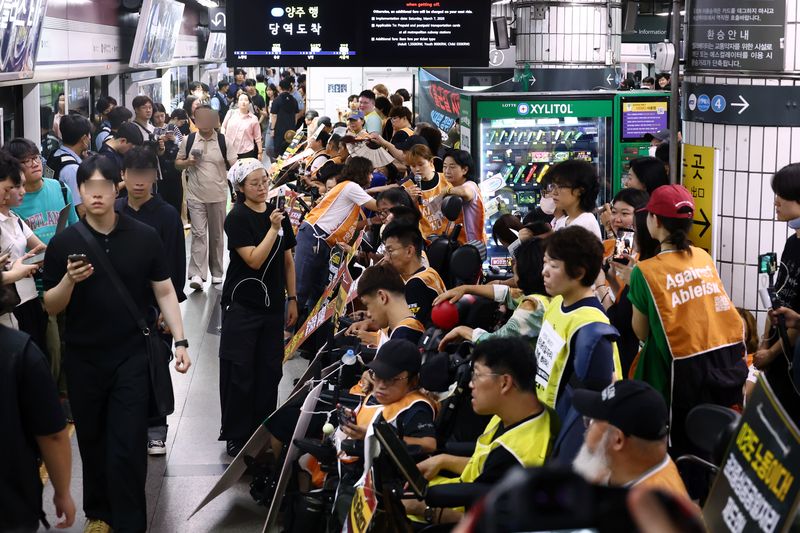
National Solidarity for the Elimination of Discrimination against the Disabled Suspends Protest as Ordinance to Promote Mobility Rights Is Pursued
According to the group on the 1st, the National Solidarity for the Elimination of Discrimination against the Disabled recently announced a declaration of a "social grand bargain for guaranteeing the rights of persons with disabilities" with the Democratic Party of Korea (DPK) in the Seoul Metropolitan Council and the DPK's Seoul chapter, and fully halted the subway boarding protests it had continued since December 2021. The move came after the council's DPK faction promised to push through, as a party line, an ordinance centered on promoting mobility rights for persons with disabilities and guaranteeing labor rights based on rights.The shift toward dialogue appears to reflect a recognition that the situation could not be managed through hard-line responses alone. Police, the Seoul Metropolitan Government, and Seoul Metro had all maintained strong blocking measures and legal action, but critics said those steps only deepened the confrontation rather than resolving the conflict at its root. The city and the transit operator responded by deploying staff to major stations and immediately ordering trains to bypass stations whenever delays occurred.
In addition, lawsuits seeking damages worth hundreds of millions of won, along with immediate arrests and forced removals at protest sites, were used as pressure tactics. Even so, the protests continued for years, prolonging public inconvenience and the standoff between the two sides. In the end, physical obstruction backed by state power could not fundamentally resolve the clash between the right to move and the right to pass through.
The prolonged confrontation has been attributed to the extreme clash between different legal interests and to the failure of the government and politicians to manage the dispute. The disability group argued that mobility rights are a prerequisite for exercising all basic rights, including education and labor. Authorities and ordinary citizens, however, pushed back, saying their constitutional rights, including the right to pursue happiness under Article 10 of the Constitution and the freedom of residence and movement under Article 14, were being infringed. A human rights group official said, "Rather than presenting fundamental solutions such as budget support and institutional reform, the government and local governments allowed the confrontation with citizens to continue and relied only on judicial punishment, which drove the conflict to an extreme."
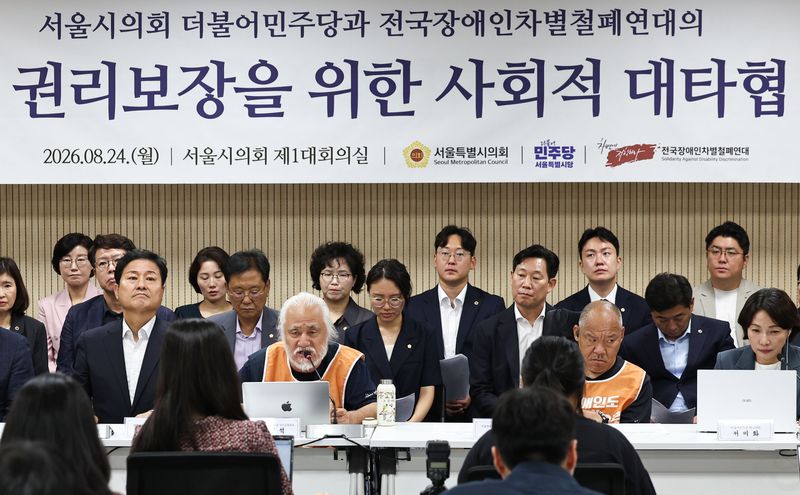
Need for a Permanent Consultative Body to Prevent Clashes Between Basic Rights
The problem is that while the authorities relied only on criminal punishment and the use of public force, the damage was ultimately passed on to both ordinary citizens and people with mobility difficulties. Advanced countries have, after long periods of social turmoil, revised related laws and absorbed such conflicts institutionally. In the United States, the enactment of the Americans with Disabilities Act (ADA) in 1990 was spurred by forceful actions such as bus occupations by the disability group ADAPT, and the law later made wheelchair accessibility on public transportation a legal obligation, reducing friction. The United Kingdom also introduced the Disability Discrimination Act (DDA) and the Equality Act 2010 in stages, clearly defining the right to use public transportation and embedding detailed implementation standards in law. By contrast, in South Korea, repeated judicial punishment and hard-line standoffs only piled up public inconvenience, while the institutional channel for dialogue that could have led the conflict toward an exit failed to function properly. Infrastructure issues such as expanding low-floor buses and securing elevator access routes were buried under lawsuits and direct action, preventing them from easing tensions.Experts say that beyond a simple declaration to suspend protests, substantive legislation, mandatory budget spending, and a permanent consultative body are essential. They argue that relying only on judicial punishment cannot fundamentally resolve structural conflicts over welfare budgets or clashes between basic rights. A lawyer specializing in criminal law said, "It is difficult to resolve structural clashes between basic rights with only judicial standards such as criminal punishment or fines," adding, "Only when an official consultative body involving the government and local governments ensures that legally defined rights are actually implemented on the ground can everyday peace and rights protection coexist."
[email protected] Seo Ji-yoon Reporter