'Six Months Since the Yellow Envelope Act,' Direct Bargaining with Parent Companies Has Opened, but 'Negotiations After Work and Limits on Agenda Remain'
- Input
- 2026-09-01 15:39:22
- Updated
- 2026-09-01 15:39:22
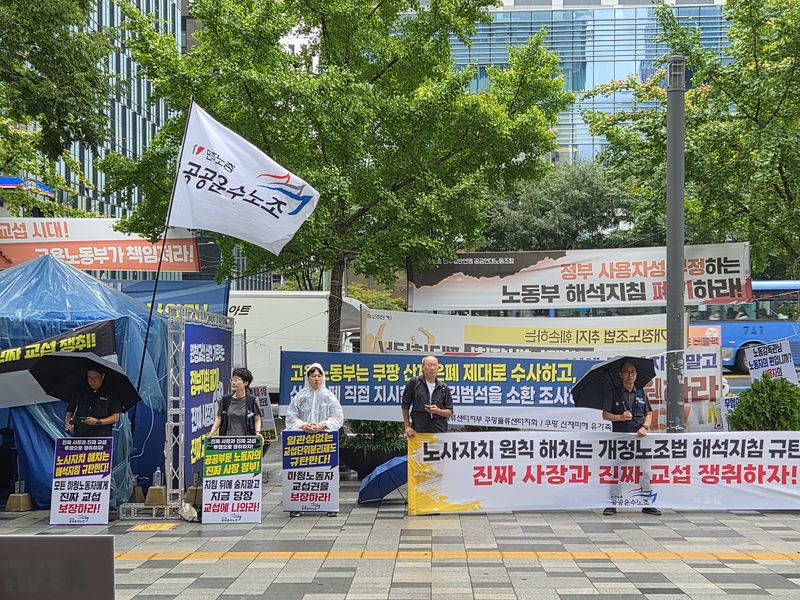
[Financial News] Although six months remain before the Yellow Envelope Act, or the revised Trade Union Act, takes effect, subcontracted workers in the field are still facing restrictions on bargaining hours and agenda items. They are even negotiating with parent companies after work. The door to direct talks has opened, but critics say institutional support for meaningful bargaining remains insufficient.
The Korean Public Service and Transport Workers' Union (KPTU) held a rally in front of the Seoul Regional Employment and Labor Office in Jung-gu, Seoul, on the 1st and urged the government to guarantee genuine bargaining with parent companies.
At the rally, the case of workers who collect and transport household waste in Hwaseong-si, Gyeonggi-do, was introduced. They said they had begun bargaining with Hwaseong City, the parent entity, but were not being given bargaining time during working hours.
According to the union, Hwaseong City sent a written request to subcontractors asking them to help ensure bargaining time. But because it was not binding, workers have been negotiating after finishing work, such as at 6:30 p.m. on weekdays and 1:30 p.m. on Saturdays.
At Handong Global University in Pohang, North Gyeongsang Province, disagreements continue over the bargaining agenda. The union said Handong Global University is taking part in direct bargaining, but maintains that it is difficult to discuss items that were not previously recognized as management-related issues by the Labor Relations Commission.
The union said the same problem is repeated during the dispute mediation process, limiting the scope of substantive bargaining topics. Even when the parent company comes to the table, it must again receive a ruling from the Labor Relations Commission on what issues can be negotiated, reducing the effectiveness of the talks, the union explained.
The union pointed to the Ministry of Employment and Labor's procedure for determining management status as the background to these problems. It argued that although the law has expanded the scope of parent-company responsibility, bargaining in the field is still being conducted around management status and agenda items recognized by the Labor Relations Commission, which can delay or restrict direct bargaining with parent companies.
According to MOEL, from March to June, 1,161 subcontractor unions demanded bargaining with 439 parent companies. Of those, 141 parent companies went through Labor Relations Commission procedures, and management status was recognized for only 103. Based on the total number of parent companies that received bargaining requests, the figure falls short of even one in four.
Park Byung-yeon, head of the union's organizing and operations department, said, "Even if a parent company sits at the bargaining table, issues not recognized in advance by the Labor Relations Commission are excluded from negotiations, and it is difficult to take collective action." He added, "It is no different from tying workers' hands and feet and then telling them to bargain with the parent company."
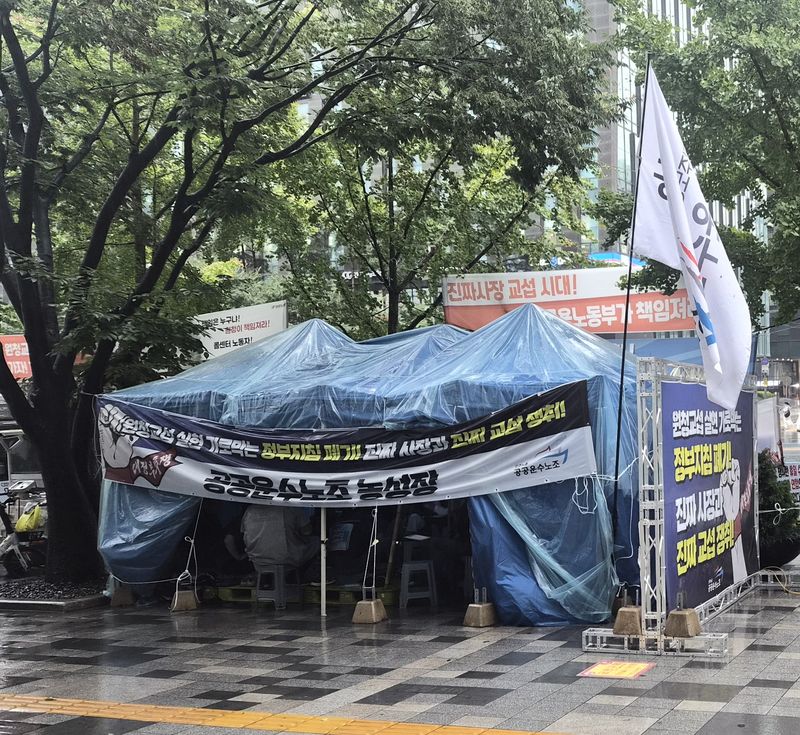
Meanwhile, the Korean Public Service and Transport Workers' Union has continued its sit-in in front of the Seoul Regional Employment and Labor Office for nine days and is demanding a meeting with the Minister of Employment and Labor and improvements to the direct bargaining system.
[email protected] Lee Dong-hyeok Reporter