"Attracting overseas startups alone is not enough... localization and follow-on investment are key"
- Input
- 2026-09-01 15:44:04
- Updated
- 2026-09-01 15:44:04
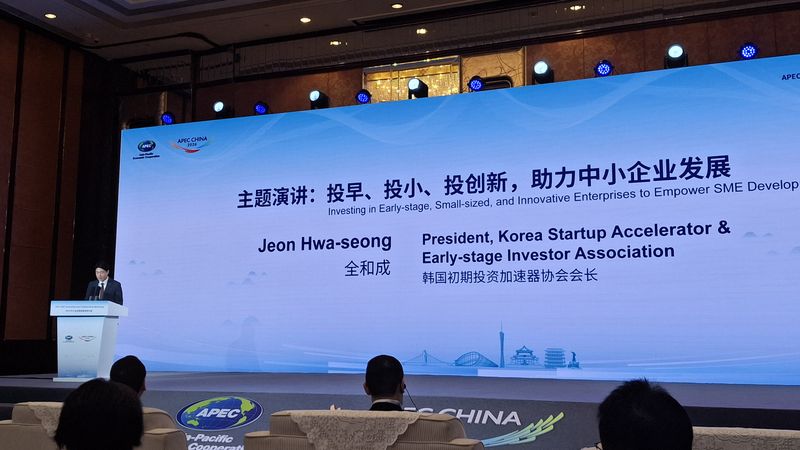
Jeon Hwa-seong, chairman of the Korea Startup Accelerators and Early Stage Investors Association, said at the APEC SME Innovation and Cooperation Workshop in Guangzhou, China, on the 1st, "What APEC needs is not a single integrated ecosystem, but interconnected startup ecosystems," and outlined the proposal.
The workshop was held as part of APEC China 2026 to discuss innovation among small and medium-sized enterprises in APEC member economies, as well as cross-border investment and cooperation. Jeon participated as a speaker in a session on investment in early-stage and small innovative companies and ways to foster SME growth, alongside an official from the China Small and Medium Enterprise Development Fund.
Jeon identified fragmented entrepreneurship and investment ecosystems by country as the biggest obstacle to global scale-up for startups. He explained that startups face structural barriers when entering overseas markets, including regulations and licensing, a lack of local information, the absence of follow-on investors, the local nature of distribution and large-company networks, and a lack of continuity after short-term support programs end.
He emphasized, "The harder task than attracting overseas startups is helping them secure local customers, understand business practices, work with local companies, and attract follow-on investment." He added, "Cross-border acceleration should not end at the startup attraction stage. It must be designed as a continuous process of 'attraction, localization, and scale-up.'"
As a framework for this, Jeon proposed the "APEC Startup Bridge." The idea is for APEC member economies not merely to run global acceleration programs individually, but to connect accelerators that meet certain standards as growth hubs across countries.
Specifically, he suggested designating hub accelerators in five to seven member economies and introducing a "Common Startup Passport" that standardizes company information and regulatory compliance data. He also proposed operating joint proof-of-concept projects and cross-border demo days among member economies, while building a public-private co-investment pipeline.
When a startup enters another member economy, a local accelerator would support market validation, regulatory guidance, and connections to companies and distribution networks. If the company proves its business performance locally, investors from multiple member economies would jointly participate in follow-on funding. He also suggested expanding the model later into industry-specific cross-border growth channels, such as for artificial intelligence.
Jeon also argued that the role of accelerators should expand beyond simple education and mentoring to become growth infrastructure that connects capital, markets, and technology. "Accelerators sit at the intersection that connects government policy, investor capital, large companies' market access, and founders," he said.
[email protected] Lee Jumi Reporter