Death Toll in Nepal-China Massive Floods Tops 1,000
- Input
- 2026-09-01 15:44:26
- Updated
- 2026-09-01 15:44:26
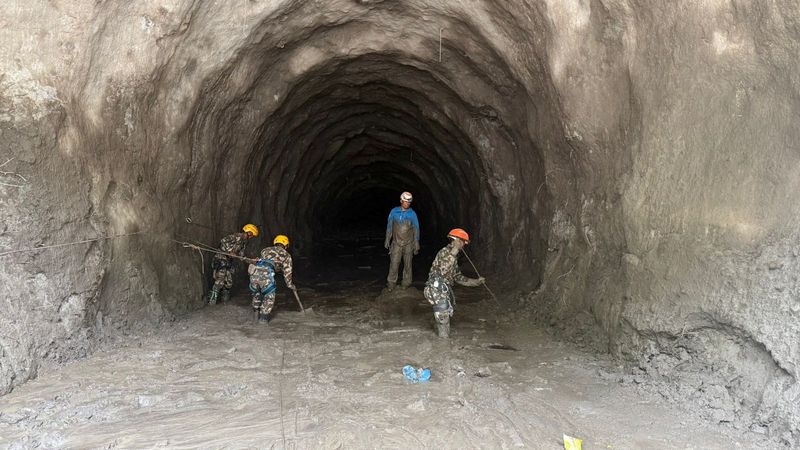
[Financial News] One week after a massive flood struck the Himalayan region along the Nepal-China border, Nepalese authorities were locked in a race against time on the 1st local time to rescue more than 900 missing people trapped inside tunnels at hydropower sites in the hardest-hit areas.
Nepal's disaster management authority said it was concentrating its efforts on rescuing workers stranded inside tunnels at six hydropower sites. Rescue operations are under way to enter the tunnels at these facilities, including the Trishuli 3A and 3B hydropower projects in Bagmati Province.
At the Trishuli 3A project, rescuers succeeded in reaching the tunnel interior after drilling four holes into the top of the tunnel the previous day. They are now working to determine the location and condition of those trapped inside. As mud and rocks are being dug out and cleared away, rescue workers are entering pits in search of a way into the tunnel, Nepalese authorities said.
Raja Ram Basnet, a spokesperson for the Nepal Army, said, "There is an enormous amount of debris, so we are having difficulty opening the tunnel," adding, "Our top priority is to open the tunnel first."
Narendra Pariyar, the administrative chief of Rasuwa, the hardest-hit area, said rescue work had picked up speed after the weather improved in the morning. However, rain began again in the evening, raising fears of secondary disasters such as additional landslides. In particular, there are concerns that a large glacial lake formed by a glacier collapse could burst again.
At the tunnel of the Upper Trishuli-1 Hydropower Project, where nine missing South Korean nationals had been working, rescuers recovered one body the previous day. Search and rescue operations by the Nepal Army are also continuing there.
Mohan Kumar Dangi, chairman of the Independent Power Producers' Association of Nepal, told the Associated Press that 576 people had lost contact at the Upper Trishuli-1 project, and that about 300 of them are believed to be trapped inside the tunnel.
Nepal's disaster management authority said the death toll from flooding in Nepal had risen to at least 987. Combined with 16 deaths on the Chinese side, the total death toll from the floods has reached 1,003, surpassing the 1,000 mark. The number of missing people has risen to 4,462, including 3,916 in Nepal and 546 in China.
Authorities in Uttar Pradesh in northern India said they had recovered 17 bodies believed to be flood victims from rivers and watersheds connected to Nepal.
Meanwhile, Nepalese Prime Minister Balendra Shah urged the international community to respond to climate change. In a social media post late the previous night, Shah said, "Now is the time to strongly raise before the international community the disaster we are facing as a result of climate change," adding that this incident was "not simply a flood, but a disaster."
He added, "It has shown that the risks facing the Himalayan region are growing along with climate change," and stressed, "This region must remain on constant alert." According to the United Nations, the rate of glacier loss in the Himalayas from 2010 to 2020 was 65% faster than in the previous decade. The risk of glacial lake outburst floods across the Himalayas, Karakoram, and Hindu Kush ranges is projected to nearly triple by the end of the 21st century.
[email protected] Reporter Lee Seok-woo Reporter