Daegu Metropolitan City’s First Supplemental Budget Under the 9th Popularly Elected Administration Focuses on Economic Recovery
- Input
- 2026-09-01 14:49:41
- Updated
- 2026-09-01 14:49:41
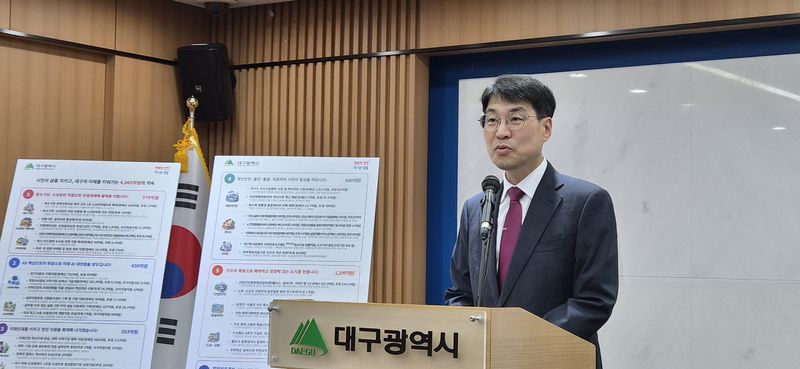
[Financial News, Daegu = Kim Jang-wook] Daegu Metropolitan City has drawn up and submitted its first supplemental budget under the 9th popularly elected administration to the Daegu Metropolitan Council, placing priority on economic recovery and building a foundation for future growth.
According to Daegu Metropolitan City, the city has prepared the '2026 2nd Supplemental Budget Bill' worth 12.6053 trillion won, up 406.5 billion won, or 3.3%, from the original budget of 12.1988 trillion won.
This supplemental budget is the first to turn the 9th administration’s city policy vision of 'Change and Growth, a Better Tomorrow' into concrete projects and spending. Despite difficult fiscal conditions, the city focused resources on key areas such as economic recovery, future industries, youth and talent development, disaster safety and welfare, and industrial complexes and transportation. The goal is to deliver changes that citizens can feel and lay the groundwork for Daegu’s next stage of growth.
Mayor Choo Kyung-ho said, "As this is the first supplemental budget of the 9th popularly elected administration, we focused on economic recovery that citizens can feel and on building a new growth foundation for Daegu." He added, "We will ease the difficulties faced by small business owners and SMEs, carefully address citizens’ lives in areas such as youth and welfare, and make concentrated investments in future industries such as Artificial Intelligence (AI) and robots, as well as key infrastructure, to create new growth engines for Daegu."
He also said, "We will execute this supplemental budget swiftly and responsibly so that it leads to results that citizens and businesses can actually feel, and we will allocate limited resources efficiently to the areas that need them most."
The budget bill is expected to be finalized on the 16th after review at the 328th regular session of the Daegu Metropolitan Council.
The supplemental budget will be financed through 119.2 billion won in surplus funds carried over from previous years, 49.1 billion won in grants including national subsidies, 58.4 billion won in non-tax revenue, and 109 billion won in local bonds.
First, the city allocated a total of 37.9 billion won to ease management burdens on SMEs and small business owners and to inject vitality into the local economy.
In addition, it set aside a total of 43 billion won to strengthen the competitiveness of future industries such as AI, robots, and Future Mobility, and to accelerate AI transformation across the industrial sector by expanding core AX infrastructure.
A total of 20.3 billion won was allocated to nurture future talent and support youth entrepreneurship, employment, and settlement in the region. Another 54 billion won was set aside to provide more detailed support for citizens’ safety, childbirth, care, and medical services.
To enhance the competitiveness of industrial complexes and strengthen the city’s future foundation in areas such as transportation and waterfront spaces, the city allocated 119.5 billion won. It also set aside 131.8 billion won for essential projects directly tied to daily life, including legally required and mandatory expenditures.
In particular, the supplemental budget prioritizes normalizing essential projects that could not be reflected in the main budget due to difficult fiscal conditions, such as legally required and mandatory expenditures and projects matched with national funds. At the same time, it aims to push ahead with key projects in a timely manner to support economic recovery and secure future growth engines.
Meanwhile, the city plans to issue 109 billion won in local bonds to carry out both the normalization of essential projects and future growth investment. It also intends to cut unnecessary spending, improve fiscal efficiency and accountability, and focus limited resources on improving citizens’ lives and preparing for Daegu’s future.
[email protected] Kim Jang-wook Reporter