"The exact partner for Lee's mega projects" ... Ruling party signals a dual leadership structure for growth policy
- Input
- 2026-09-01 13:45:20
- Updated
- 2026-09-01 13:45:20
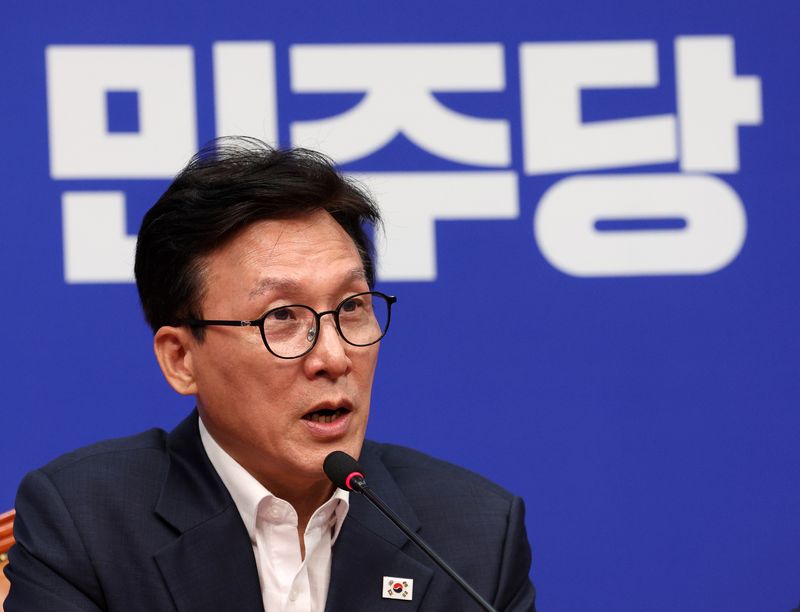
[Financial News] The Democratic Party of Korea is launching a separate internal mechanism to support the Lee Jae-myung administration's large-scale growth projects. Kim Min-seok, who heads the party's Mega Growth Special Committee, described it as the government's "exact partner" for mega projects. Attention is now on whether a ruling party-government "two-top" system will take shape, with the government planning and executing growth projects and the party backing them through policy and legislation.
Kim appeared on the first broadcast of Democratic Party TV's "Minti07" on the 1st and introduced the party's key driving body, "Mega Ten." He said the special committee is "the exact partner of the body the president said would plan and execute things over the next four years."
He went a step further than the previous day's announcement of the committee's launch and appointments, directly explaining its relationship with the government's growth strategy. Kim himself will chair the committee, while lawmaker Lee Kwang-jae will serve as senior vice chair. Heavyweights including former South Gyeongsang Province Governor Kim Kyung-soo and former lawmaker Kim Doo-kwan are also taking part.
Kim presented the special committee as the final destination of the Democratic Party's "Mega Ten" initiative. He said the party would pursue public livelihoods, party reform, and youth policy on the basis of broad unity, and that these efforts would "bloom into the most important mega growth." He added, "We are bringing in strong figures in each area, and the flower we ultimately want to grow is a major national transformation centered on unity, party reform, young people, and public livelihoods."
In particular, the committee is drawing attention for the possibility that it may go beyond a simple internal policy advisory body and take on a role in the government's mega-project drive. The key question is whether the government will plan and select large-scale growth projects while the party supports them through legislation and budgeting, or whether the party will identify new projects and propose them to the government. It remains to be seen how deeply the committee will be involved in future official consultation channels with the Presidential Office and the government, as well as in project selection and budget allocation.
Kim also stressed speed as the standard for judging the performance of Mega Ten. He said, "The party's key capabilities are starting to run in all directions at a frightening pace," adding, "The first success will be when people feel that the Democratic Party has changed and that it is running like a ruling party, like a giant aircraft carrier that has started moving."
He also suggested that he would personally oversee the progress of the various bodies, including the special committee. Kim said, "The job of the party leader or the leadership is to manage the process," adding, "I am quite confident in handling and managing work that is moving simultaneously on multiple fronts. Results will probably keep coming."
The Democratic Party plans to use the special committee to flesh out ways to connect the government's mega projects with the party's growth policies. Depending on whether the committee limits itself to supporting government policy or becomes a party-level policy platform that proactively identifies new growth projects, the party's role in the Lee Jae-myung administration's later-stage growth strategy is expected to change.
[email protected] Kim Kyung-min Reporter