Semiconductor Share Hits Record High at 47.5% as August Exports Reach $98.3 Billion
- Input
- 2026-09-01 13:38:18
- Updated
- 2026-09-01 13:38:18
[Financial News]
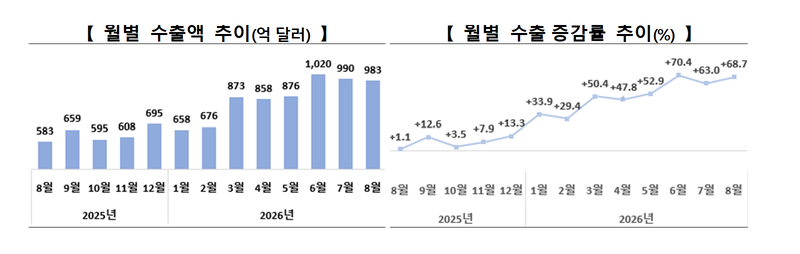
August exports topped $90 billion for the third straight month, raising hopes that annual exports could reach $1 trillion. Semiconductor exports also hit an all-time high, driven by expanded investment in Artificial Intelligence (AI), and their share of total exports surged to a record 47.5%. The government said the strong semiconductor performance is likely to continue until early next year.
According to the Ministry of Trade and Industry's 'August Export and Import Trends' released on the 1st, exports last month came to $98.25 billion, up 68.7% from a year earlier. Average daily exports also rose 72.5% to $4.47 billion, marking the second-highest level on record.
Semiconductors led the export growth. Semiconductor exports jumped 209% to $46.65 billion, setting a new record. The increase reflected stronger memory demand and higher prices as Big Tech expanded AI infrastructure investment. Computer exports also soared 419.5% to $6.24 billion, helped by rising demand for enterprise SSDs for AI servers.
Semiconductors accounted for 47.5% of total exports, the highest share ever recorded. With a single item making up nearly half of all exports, concerns have emerged over excessive dependence on semiconductors. Kang Gam-chan, director of trade and investment at the Ministry of Trade and Industry, said, "By the numbers, it is fair to say exports are concentrated in semiconductors, and it is true that the share is high." He added, "But exports of other items are also holding up well, so I do not see a problem with the current situation." Exports excluding semiconductors still rose about 20% from a year earlier, and even when both semiconductors and computers are excluded, exports increased by about 8%.
The semiconductor boom also boosted exports to the United States. August exports to the United States reached $16.5 billion, up 89.3% from a year earlier. The government believes the annual trade surplus with the United States could exceed $100 billion this year.
By contrast, automobile exports fell 29.8% to $3.85 billion, while ship exports dropped 45.9% to $1.69 billion. In automobiles, the decline was affected by a shift in the summer vacation period and production disruptions caused by strikes. Ship exports were hit by a decrease in scheduled deliveries. The government views both declines as temporary and expects a recovery after September.
Steel exports rose 7.9% to $2.11 billion. Exports to the European Union fell after the bloc introduced a TRQ system for steel, but this was offset by increased shipments of steel products and plates tied to expanded AI data center construction in the United States.
Meanwhile, imports in August increased 22.5% to $63.51 billion. The trade balance posted a surplus of $34.75 billion, staying above $30 billion for the third consecutive month.
Kim Jung-kwan, Minister of Trade, Industry and Energy, said, "Trade uncertainty is high because of the United States' tariff policy and the European Union's TRQ system." He added, "We will not be complacent about the export rebound and will closely examine how changes in the trade environment affect corporate exports."
[email protected] Park Ji-young Reporter