KRICT Marks 50th Anniversary, Unveils Vision to "Respond to the World Through Chemistry"
- Input
- 2026-09-01 13:18:52
- Updated
- 2026-09-01 13:18:52
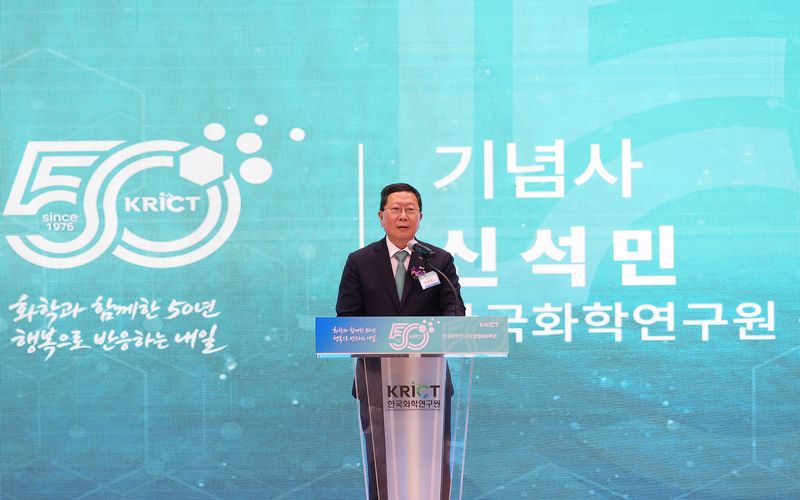
[Financial News] Korea Research Institute of Chemical Technology (KRICT), a government-funded research institute representing the chemical sector, marked its 50th anniversary on the 1st by unveiling its "2040 Vision" and announcing the slogan, "When the world cannot find an answer, we answer with chemistry (Chemistry, Find Ways Beyond Now)."
KRICT held its 50th anniversary ceremony on the 1st at its headquarters in Daejeon, with guests and current and former employees in attendance. At the event, the institute presented its vision along with "FIND," an acronym formed from its four core values: Foresight, Intelligence, Network, and Dedication. The blueprint calls for proactively addressing future challenges facing the nation and industry, redefining research methods with AI and data, building a convergence platform that connects industry, academia, and research at home and abroad, and fulfilling a public mission and long-term research commitment to the nation and its people.
In his commemorative address, Shin said, "The history of KRICT is the result of the long breath of all members who worked quietly and diligently, and the 50th anniversary is a day of celebration for everyone who devoted their time and passion." He added, "Going forward, we will continue to find answers through chemistry when the world cannot, and lead a major transformation in South Korea's chemical industry."
KRICT began as a privately led institute established with the support of industry. After the 1973 declaration of industrialization in heavy and chemical industries, demand for technology rose rapidly. At a time when much of the needed technology and materials still depended on foreign sources, 17 companies representing 136 firms formed the founding general meeting in 1976 and officially launched the Korea Research Institute of Chemical Technology. Its founding goal was self-reliance in chemical technology. Research began in 1978 in just four buildings, starting with Building No. 1, now known as Seongjwagyeong Hall, driven by the dream of developing the chemical technologies needed for industrial growth with limited staff and equipment.
KRICT then boldly took on fine chemicals in the 1980s, developing an oxygen-based bleaching agent in 1984 and localizing key materials and process technologies such as the polybutene manufacturing process in 1994 and high-performance polyimide materials in 2005. In pharmaceuticals and agrochemicals, it produced new substances including Korea's first homegrown new pesticide, "Sunbong," in 1996, the world's first imipenem generic antibiotic, "Preepenem," in 2004, and the AIDS treatment drug "Inoverin" in 2021.
It has also played a role in responding to national and social crises. During the 2019 Japanese export restrictions, it transferred fluorine-based material (PVDF) manufacturing process technology to companies, helping stabilize the materials supply chain. In 2020, when the world was suffering from COVID-19, it took the lead in infectious disease response by developing rapid diagnostic kits. In the era of carbon neutrality, its biodegradable plastic technology led to the completion of a 70,000-ton-per-year plant in Vietnam at the end of 2025, while its dry reforming technology for carbon dioxide and methane resulted in the world's first 8,000-ton-per-year production facility. Its perovskite solar cell technology continues to break world records for efficiency.
In addition, KRICT operates national research infrastructure such as the Korea Chemical Bank, supporting the broader chemical research ecosystem in South Korea. It also serves as the lead institution in two areas, rechargeable batteries and Carbon Capture and Utilization (CCU), under the Global TOP Strategic Research Group, helping bring together the nation's research capabilities. This year, the recipient of the "KRICT Person of the Year" award developed a treatment for terminal rare blood cancer and has advanced to global Phase 2 clinical trials.
[email protected] Yejian Yeon Reporter