"AI Policy to Focus on Execution, Not Strategy...We Will Deliver Results People Can Feel"
- Input
- 2026-09-01 12:38:13
- Updated
- 2026-09-01 12:38:13
He also presented concrete performance goals: delivering tangible results through cross-ministerial policy coordination, regulatory reform and diversification of the AI supply chain, while realizing a top-three position in AI as a country with influence in the global AI supply chain. The goal is to strengthen the influence of Korean-style AI (K-AI) with frontier AI and domestically produced AI chips that are not dependent on specific overseas technologies in the AI supply chain, including graphics processing units (GPU), power and data.
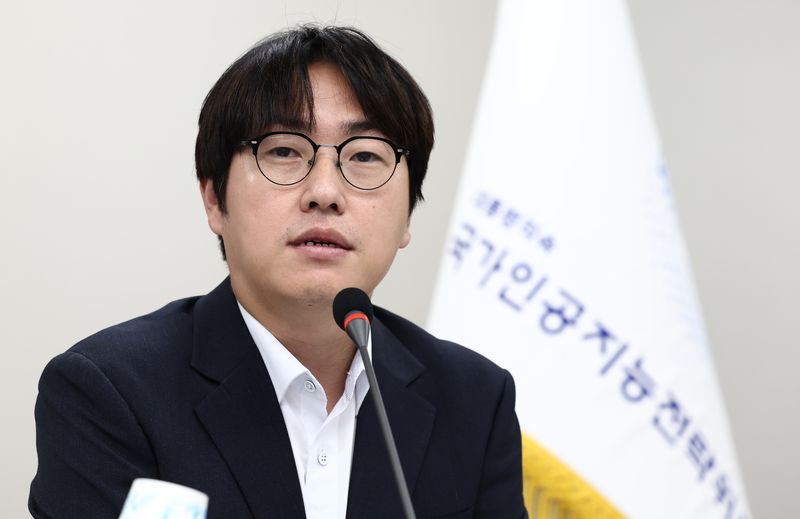
On Aug. 31, his first day in office, Ha, the new vice chairperson of the National AI Strategy Committee, held a press briefing at the committee's office in Jung District, Seoul. "If the AI Strategy Committee focused on major strategies and direction in its first year last year, we will now upgrade those strategies to fit the times and focus on delivering results that the public can feel through fast-paced execution," he said. "We will make sure the committee creates results by focusing on policy coordination, mediation, advice and technical support."
Ha defined the national policy goal of becoming one of the top three AI powers as securing influence as a country with a core supply chain in the AI era. "South Korea is already the strongest in memory chips and is also building capabilities in AI models," he said. "For developing countries seeking AI sovereignty, South Korea can become a horizontal cooperation partner, and that is another way to build influence through the supply chain."
"Urgent need to resolve regulations on data use and AI data center permits"
Ha identified the most urgent regulatory issues the committee must address as the difficulty of using data, which is one of the most important pillars of AI; regulations in the process of turning AI technology into business; and the difficulty of obtaining permits for AI data centers.
He said, "We want to examine these regulations in a qualitative way so they can be truly helpful." In particular, he noted, "In supply chain areas such as power and GPU, we have made a lot of efforts to expand supply, but it is still not enough." He added, "For GPUs, we need to diversify the supply chain and strengthen the use of domestic NPUs." He also said, "For power, we are drafting the Basic Electricity Plan, including transmission and distribution, so we will look into practical alternatives."
"Strengthen the committee's role as a control tower...Use CAIO policy consultations"
Ha stressed his intention to strengthen the committee's role as the government's control tower for AI policy across ministries. Starting this year, the committee's AI policy evaluations will be reflected in each ministry's performance review. The committee will also review the importance and necessity of AI policies during the budget planning process for each ministry.
He said, "Because the committee's evaluations are reflected in ministry assessments and budget planning, we already have a strong function to lead policy coordination." He added, "Beyond the annual evaluations and budgets, we will coordinate policies on an ongoing basis through the CAIO council, which is made up of vice ministers from each ministry." He explained that most sharp disagreements are already being adjusted through the CAIO council.
"We will examine whether the K-LLM direction is still valid"
Regarding the Ministry of Science and ICT's selection policy for the independent foundation model project, Ha said, "We will examine whether it is being carried out properly in line with the project's fundamental purpose, whether the direction of K-LLM is still valid, and what needs to be added to lead frontier AI." He added, "We also need to find ways to address past shortcomings by having experts participate in the next evaluation."
He explained, "This is not about whether a particular company is selected or excluded. It is about determining which direction we should take from here to build powerful AI."
Meanwhile, Ha responded to criticism from some quarters that he is a "revolving door" appointment, saying, "It may be criticized as a revolving door appointment, but I think it will not be a problem if we deliver results." He added, "I will ease concerns by contributing to AI development and producing results."
[email protected] Lee Gu-soon Reporter