Why Does Industrial City Ulsan Need the IBK Headquarters So Badly?
- Input
- 2026-09-01 13:03:20
- Updated
- 2026-09-01 13:03:20
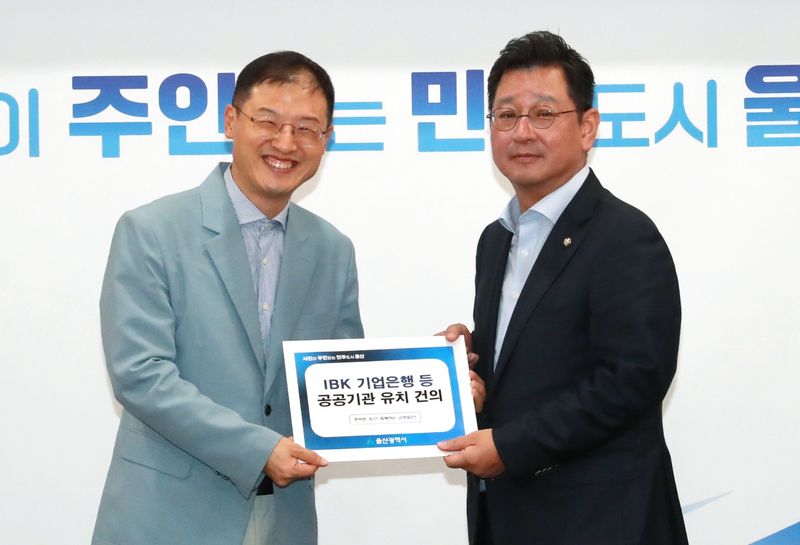
[Financial News Ulsan = Reporter Choi Soo-sang] Ahead of the second relocation of public institutions, Ulsan Metropolitan City is drawing attention as it sets its sights on attracting the headquarters of the Industrial Bank of Korea (IBK). It is not easy to immediately understand why a leading industrial city would seek a bank headquarters. Still, Ulsan is mounting an aggressive campaign. Why does Ulsan need the IBK headquarters so badly?
■ Ulsan is a place where demand for policy finance is overflowing
Ulsan says its main reason for the bid is to combine finance and industry by attracting the IBK headquarters and to help form a broader economic bloc in the southeastern region. This is closely tied to the city’s future industries. In other words, Ulsan wants to bring the IBK headquarters to the heart of Korea’s manufacturing sector, directly connect on-site policy finance with real-world manufacturing, and use that link to provide timely funding for small and mid-sized companies undergoing green and AI transformation.
In the Ulsan area, demand for funds from small partner firms in shipbuilding and auto parts is rising sharply as the shipbuilding industry booms, investment in core industries expands, and AI transformation accelerates.
Ulsan has 2,504 companies clustered across 33 industrial complexes, with manufacturing sales reaching 274 trillion won, or 76.9 percent of the total. In short, it is a place where demand for policy finance is abundant.
In addition, financing needs for equipment investment, business restructuring, and AI transformation among partner companies are expected to rise as the government pushes major projects in the Yeongnam region, including next-generation batteries and GW-scale AI data centers.
Ulsan emphasizes that linking IBK’s lending policy and product design capabilities with manufacturing sites would allow policy finance to be deployed in a way that reflects real industrial demand.
A city official said, "As new financing demand expands with future industry investment, on-site financial support is needed to spread the benefits of large-scale anchor investments to partner small and mid-sized companies through investment and growth."
■ Ulsan is the only metropolitan city without a bank headquarters
Ulsan also stresses that it is the only metropolitan city without even a headquarters of a commercial bank, let alone a state-run bank. The city argues that since Daegu has Daegu Bank, Busan has Busan Bank, and Gyeongnam has Kyongnam Bank, relocating the IBK headquarters to Ulsan would be reasonable from the standpoint of regional balance.
It also says that if the IBK headquarters is brought to Ulsan, where small businesses are densely concentrated, a virtuous cycle can be created between industrial finance and the real economy, which would also align with the government’s policy finance goals.
This could serve as a chance to help build a broader economic bloc in the southeastern region by linking Busan’s financial infrastructure with the manufacturing industries of Ulsan and Gyeongnam. A broader financial system connecting capital markets in Busan, policy finance in Ulsan, and manufacturing in Ulsan and Gyeongnam could create functional division and synergy across the region.
It could also be expanded into a model for financial support at each stage of corporate growth by linking national funding, policy finance, and regulatory exemptions to Busan–Ulsan–Gyeongnam cooperative projects, as part of broader interregional cooperation initiatives.
Mayor Kim Sang-wook said he plans to offer exceptional relocation incentives, recognizing that Ulsan entered the competition relatively late. While he did not disclose specifics, he said the city would create living and working conditions in welfare, culture, and education that would leave IBK employees with no reason to feel dissatisfied.
[email protected] Choi Soo-sang Reporter