Hyundai Motor Company Reaches Wage Settlement... Five Automakers Intensify Battle to Defend the Home Market in the Second Half
- Input
- 2026-09-07 16:23:05
- Updated
- 2026-09-07 16:23:05
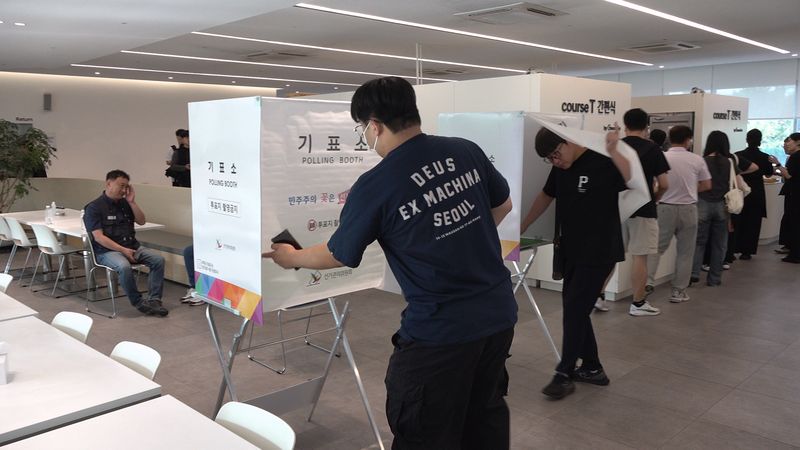
■ Hyundai Motor Company Ends Negotiations Among Five Automakers with Vote
The core of the agreement concerns wages. The monthly base salary will increase by 100,000 won, including the seniority-based increase, and performance bonuses will be paid at 400% plus 12.7 million won. In addition, labor and management agreed to hire 500 new technical (production) workers from the second half of next year through 2028 and to extend the retirement age without expanding the wage-peak system if the relevant laws change.
Kia Corporation held a signing ceremony for the wage and collective bargaining agreement at Gwangmyeong Autoland. The agreement includes a base salary increase of 100,000 won and performance incentives worth 400% plus 12.7 million won, including a management performance bonus of 300% plus 4 million won, a quality improvement incentive of 100% plus 4.7 million won, and a 4 million won incentive commemorating the 2026 Autocar Awards.
Renault Korea Co., Ltd. also held a general meeting of employees on the 26th of last month and passed a tentative wage and collective bargaining agreement that includes a 51,000-won base salary increase and lump-sum payments totaling 2.5 million won. Earlier, GM Korea Company and KG Mobility Corporation (KGM) also concluded their respective wage and collective bargaining agreements in July.
■ Defending Profits in the Second Half with Hybrids and New Models
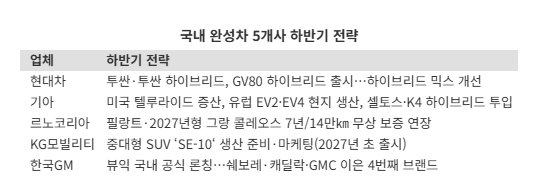
As labor-management risks subside, the automotive industry’s focus is shifting to the sales battle in the second half of the year. The key factors are new models and hybrids.Hyundai Motor Company will successively launch its best-selling Hyundai Tucson and Tucson Hybrid, as well as Genesis’s first hybrid vehicle, the GV80 Hybrid, in the second half of the year. This strategy aims to recover profitability by improving the product mix centered on hybrids, as operating profit in the first half fell 25.8% from the same period last year. Hyundai Motor Company’s hybrid sales in the first half of this year reached 363,000 units, up 18% from the same period last year. The push to bring forward fourth-quarter sales is also a variable, as the individual consumption tax reduction for hybrid vehicles, worth up to 700,000 won per vehicle, will end with vehicles delivered at the end of this year.
At the CEO Investor Day on the 26th of last month, Hyundai Motor Company CEO José Muñoz said, "Considering current regulations and customer demand, hybrids represent the greatest opportunity," adding, "The simplest way to enhance business capabilities is to increase production capacity and launch hybrid models." Hyundai Motor Company presented medium- to long-term goals of 5.55 million global sales and an operating profit margin of more than 9% by 2030, along with plans to introduce more than 100 new models.
Kia Corporation, which recorded its highest-ever first-half sales performance on strong sales of electric and hybrid vehicles, is continuing its upward trend by differentiating powertrains according to regional demand. In the second half of the year, it plans to increase Kia Telluride production capacity in the United States and expand sales in Europe through local production of the Kia EV2 and the EV4, as well as the launch of the Kia Seltos Hybrid and Kia K4 Hybrid.
■ Renault Korea Co., Ltd. Bets on Warranties, KG Mobility Corporation (KGM) on Its Next Model, and GM Korea Company on a New Brand
The three mid-sized companies are seeking breakthroughs in the second half of the year with different strategies. First, Renault Korea Co., Ltd. has placed its bet on warranties and pricing instead of new cars. For individual and sole-proprietor customers taking delivery of the Renault Filante or the 2027 Grand Koleos after September, the free warranty period will be extended to a maximum of seven years or 140,000 km. This expands the existing three-year/60,000-km warranty for the body and general parts and the five-year/100,000-km warranty for the engine and major powertrain components. The benefits remain valid if customers receive a 12-item free inspection and a paid engine-oil change once a year at an official service network.KG Mobility Corporation (KGM) is focusing on preparing its next model. Following the launch of the 2027 models of the KGM Torres and KGM Actyon last May, the company plans to focus in the second half of the year on production preparations and marketing activities for the successful launch of the mid- to large-size SUV SE-10, scheduled for release in early 2027.
GM Korea Company will officially launch the global brand Buick in the domestic market in the second half of the year. With a heritage spanning more than 120 years, Buick is a brand known for distinctive design, intuitive technology, and a comfortable driving experience. It will become the fourth brand after Chevrolet, Cadillac, and GMC. The company plans to intensify its market presence by introducing new products alongside the official domestic launch.
"Through Buick’s entry into the Korean market, we plan to further strengthen our multibrand strategy and provide customers with a wider range of brand and product choices," a GM Korea Company official said. "Going forward, we will continue to review a diverse product portfolio in consideration of the Korean market and customer demand."
[email protected] Kim Dong-chan Reporter