Free education and care expanded to children as young as 3 and a half; first education grant budget under new formula reaches 78.9 trillion won [2027 budget proposal]
- Input
- 2026-09-01 12:59:51
- Updated
- 2026-09-01 12:59:51
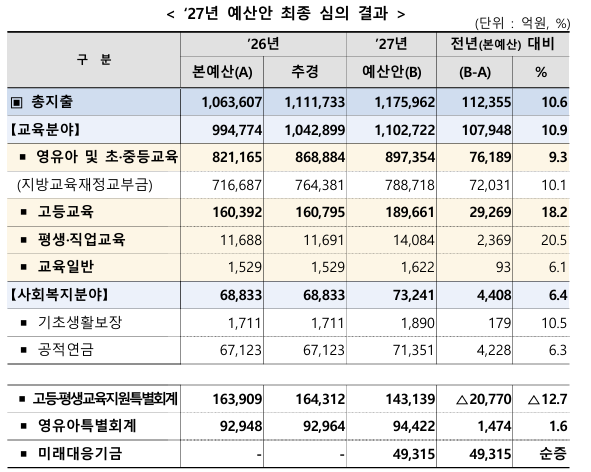
[Financial News] Starting next year, the government will expand free education and care support for young children from the current ages of 4 and 5 to children as young as 3 and a half. It will also allocate 213 billion won to fully cover tuition for about 60,000 freshmen at regional national universities. In addition, the number of recipients of regional talent scholarships at private universities will rise from 4,000 to 10,000. The Local Education Subsidy Grants, a key source of funding for elementary and secondary education, will be set at 78.8718 trillion won under a new formula that reflects economic growth and changes in the school-age population, replacing the previous automatic link to 20.79% of national tax revenue. Including this, the Ministry of Education's budget for next year will total 117.5962 trillion won, up 11.2355 trillion won from this year.
The Ministry of Education announced the 2027 budget proposal on the 1st. By sector, it allocated 89.7354 trillion won to early childhood and elementary and secondary education, 18.9661 trillion won to higher education, and 1.4084 trillion won to lifelong and vocational education. The higher education budget will rise by 2.9269 trillion won, or 18.2%, from this year, while lifelong and vocational education will increase by 239.6 billion won, or 20.5%.
■First grant under new formula reaches 78.8718 trillion won
The Local Education Subsidy Grants, the backbone of elementary and secondary education finance, will increase by 7.2031 trillion won, or 10.1%, from 71.6687 trillion won this year to 78.8718 trillion won next year.
Instead of setting the grant as 20.79% of national tax revenue, the government will apply a new formula that reflects the previous year's grant, the average nominal growth rate over the past three years, and changes in the school-age population. The school-age population change rate will be weighted at 35%. Next year's grant is the first amount prepared under the new formula.
The Ministry of Education expects the grant to rise to 84.3 trillion won in 2028, 90.1 trillion won in 2029, and 92.7 trillion won in 2030. The revised Local Education Subsidy Grants Act will also include a safeguard to prevent the total grant amount from falling below the previous year.
The higher education budget will rise by 2.9269 trillion won, from 16.0392 trillion won this year to 18.9661 trillion won next year. The increase rate of 18.2% is higher than the ministry's overall budget growth rate of 10.6%.
■New 465 billion won program to support first career experience for 60,000 college students
A total of 4.4655 trillion won will be invested in projects related to regional development and youth support.
The regional balanced development scholarship program will be expanded to 328 billion won. Of that, 213 billion won will go toward tuition support for 60,000 freshmen entering regional national universities. Another 115 billion won will be spent on private universities to increase the number of recipients of regional talent scholarships from 4,000 to 10,000.
Financial support for regional national universities themselves will also be newly introduced. The government will provide 691 billion won in 'Future Talent Growth Funds' to 21 regional national universities, including Flagship Korean National Universities. The funding will be provided as a lump sum so universities can invest autonomously in strengthening education and research competitiveness under their medium- to long-term development plans. On average, Flagship Korean National Universities will receive 50 billion won each, while other regional national universities will receive 20 billion won each.
The budget for innovation projects at Flagship Korean National Universities will also rise by 145.7 billion won, from 648.7 billion won this year to 794.4 billion won next year. Of that, support for package programs in growth engines and artificial intelligence for three flagship universities will increase from 70 billion won to 80 billion won per university.
The government will newly allocate 465 billion won for the 'College Student First Career Project,' which is designed to help students gain work experience before employment. The program will support 60,000 students at four-year universities and junior colleges in participating in semester-long practical training. The monthly training stipend, set at about 2.3 million won, will be split equally between the government and companies.
Investment in university facilities linked to regional strategic industries will also expand. The government will newly spend 600 billion won to build experimental, practical training, and research facilities at about 40 private universities and about 10 junior colleges with science and engineering departments.
■Free education and care expanded to children as young as 3 and a half...642.9 billion won
Support for early childhood education and care will also increase. Free education and care support will be expanded from children aged 4 and 5 to those as young as 3 and a half. Related spending will rise by 172.6 billion won, from 470.3 billion won this year to 642.9 billion won next year.
The government will spend 526.9 billion won to improve the child-to-teacher ratio at daycare centers, up 200.7 billion won from this year. Support will be expanded from classes for 0-year-olds to classes for 1-year-olds, and incentives will be introduced to help public and state-run facilities open additional classes for children aged 0 to 1.
The budget for childcare subsidies for infants and toddlers aged 0 to 2 will rise by 132.4 billion won from this year to 3.7959 trillion won. The subsidy rate will be increased by 3%.
■Future Response Fund education account reaches 4.9316 trillion won
The way education finances are organized will also change. The Ministry of Education has set aside a total of 4.9316 trillion won for projects funded through the new education and talent account under the Future Response Fund, which will be introduced next year.
Of that amount, 526.9 billion won is allocated to early childhood programs, 2.3489 trillion won to regional and youth support, and 2.0558 trillion won to cultivating future talent in AI. The package includes the Future Talent Growth Fund for regional national universities, the College Student First Career Project, private university science and engineering infrastructure, and AI Rebound Universities.
Education Minister Choi Kyo-jin said, "Now that the education and talent account under the Future Response Fund has been created, we will work to bring about clear, tangible changes on the ground, from the starting line in early childhood to higher and lifelong education."
[email protected] Lee Bo-mi Reporter