Busan and North Gyeongsang Province designated for the first time as the New Marine Leisure Wide-Area Linked Free Regulatory Zone
- Input
- 2026-09-01 10:23:15
- Updated
- 2026-09-01 10:23:15
A free regulatory zone is a system that, upon application by a local government and consultation with the relevant regulatory ministries, allows regulatory exemptions for new technologies and new industries to be applied within a designated area for a set period of time while demonstration projects are carried out.
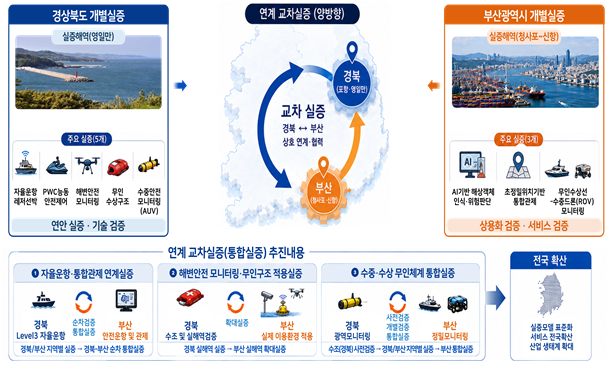
The New Marine Leisure zone covers a total area of 682.23 square kilometers, including the waters off Pohang, North Gyeongsang Province, and the Cheongsapo to Busan Newport area in Busan. The designation runs from today through December 31, 2030.
Within the zone, technologies related to new marine leisure will be tested in real sea conditions, including autonomous leisure vessels, AI-based marine safety control, unmanned water rescue robots, underwater drones, and unmanned surface vessels. A total of four demonstration exemptions under the jurisdiction of the Ministry of Oceans and Fisheries (MOF) and the Korea Coast Guard (KCG) will be applied.
Busan will use its shipbuilding, marine, and marine ICT industrial base, along with real-world marine service environments such as ports, marinas, and beaches, to demonstrate AI-based maritime object recognition and risk assessment, integrated coastal and port safety control based on ultra-precise location data, and marine environment and safety monitoring using underwater drones and unmanned surface vessels. The city will also verify the technologies' practicality in the field and their commercial viability.
North Gyeongsang Province will take charge of developing core technologies such as autonomous operation and underwater robots, manufacturing equipment, and verifying basic performance and safety, drawing on research institutes in the robotics and marine mobility sectors as well as offshore and natural sea areas.
By carrying out cross-demonstrations in different sea areas, the project is expected to improve the reliability and safety of the technologies. It is also likely to help establish standard models and safety guidelines for future autonomous operation, unmanned rescue, and smart marine safety sectors.
The zone is also expected to boost the growth and commercialization of Busan's marine industry.
According to the Korea Maritime Institute (KMI), Busan's marine tourism market consumption reached 6.3796 trillion won in 2024, the largest in the country. The city also has around 30,000 marine industry businesses and more than 160,000 workers concentrated there.
Based on this industrial and market foundation, the city plans to apply autonomous operation, AI, and underwater robot technologies demonstrated in the zone to real-world sites such as ports, marinas, and beaches, in order to accelerate companies' commercialization efforts and market expansion.
Chun Jae-soo said, "This designation will serve as a starting point for creating a new market for the future marine leisure industry by linking Busan's marine industry and port infrastructure with North Gyeongsang Province's research and development capabilities." He added, "We will combine autonomous operation, AI, and robotics technologies with Busan's shipbuilding and marine industries to develop Busan into a leading global marine mobility city."
[email protected] Kwon Byung-seok Reporter