AI Diagnosis for Pancreatic and Lung Cancer, from Detection to Recurrence Prediction, to Be Developed as a National Project
- Input
- 2026-09-01 08:37:12
- Updated
- 2026-09-01 08:37:12
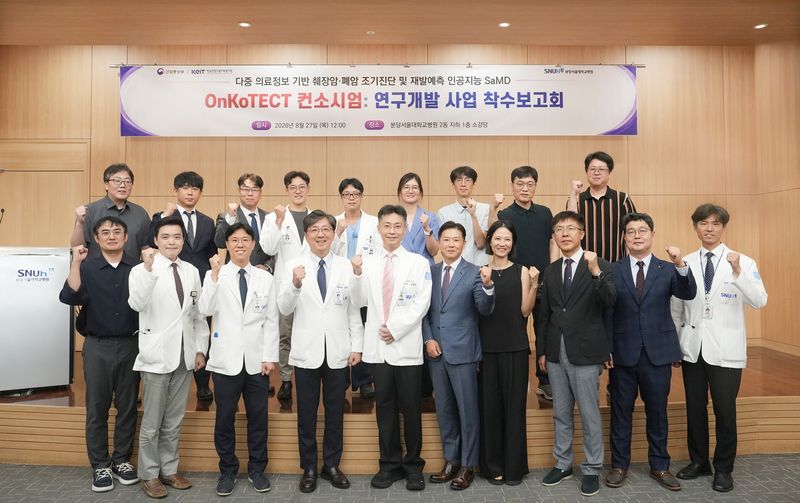
[Financial News] To overcome the limits of medical AI development, where data has piled up but has not led to real products, Seoul National University Bundang Hospital is joining hands with major hospitals and IT companies to develop AI for diagnosing pancreatic and lung cancer.
Seoul National University Bundang Hospital was selected as the lead institution for a national project in the digital healthcare field under the Ministry of Trade and Industry's "Bio Industry Technology Development" program. The hospital will lead the OnKoTECT consortium, which aims to develop and commercialize AI that can detect pancreatic and lung cancer early and even predict recurrence. OnKoTECT is a compound word formed from Oncology, On Korea, DeTECT, and ProTECT.
The project will run from July 2026 to December 2030 and receive a total of 15.5 billion won in research funding over four years and six months.
Kim Chae-Yong, head of the Biomedical Research Institute at Seoul National University Bundang Hospital, will serve as the overall principal investigator. The project is designed to combine the hospital's clinical capabilities with the technology of industry partners, creating a structure that spans AI software development, clinical validation, and regulatory approval.
Kim said, "The core of this study is to develop diagnostic and predictive tools that can be used in real clinical settings based on multicenter data," adding, "We will work with industry partners to ensure the process is completed through regulatory approval and commercialization."
The consortium includes major hospitals in Korea, such as teams led by Professors Lee Jong-chan and Kim Yeon Wook at Seoul National University Bundang Hospital, Professor Park Joo Kyung Sophie at Samsung Seoul Hospital, Professor Woo Sang-myeong at National Cancer Center (NCC), Professor Oh Hyeong-ju at Chonnam National University Hwasun Hospital, Professor Yoon Seung-bae at The Catholic University of Korea Eunpyeong St. Mary's Hospital, and Professor Eom Joong-seop at Pusan National University Hospital. IT and medical companies A&T Solution, ACRYL, and Hecto will also participate.
Existing medical data projects have succeeded in building data dams that collect large-scale datasets, but cases in which those data were turned into actual AI products and commercialized have been rare. That is because data accumulated, but the technology and systems needed to organize it and turn it into real services were lacking.
To solve this problem, the OnKoTECT consortium is relying on two proven technologies. A&T Solution's data integration platform, "AnTHEM," standardizes medical data scattered across multiple hospitals and connects them into one system. ACRYL's AI operations system, "Jonathan," which has already been commercialized, will be responsible for safely applying and operating the developed AI in real clinical settings.
Lee Jong-chan, head of the Big Data Center at Seoul National University Bundang Hospital and professor of gastroenterology, who is in charge of the overall planning for the project, said, "The biggest strength of this consortium is that it brings together doctors with both clinical experience in pancreatic and lung cancer and expertise in digital health technology." He added, "We will strategically build multimodal cancer data and use both centralized learning and federated learning to create a scalable data storage system."
Kim Yeon Wook, a professor in the Department of Pulmonology at Seoul National University Bundang Hospital who is responsible for the lung cancer field in the consortium, said, "AI technology that detects lung cancer early using images alone has already been developed in many places." He added, "This consortium will develop technology that uses multimodal data from six categories, including imaging, genomics, and pathology, to predict early diagnosis as well as recurrence after surgery."
[email protected] Medical Reporter Jung Myung-jin Reporter