"Even with 500 million won, There Is No Home to Rent" — Seoul Housing Lease Crisis Has Already Gone Beyond a Full-Blown Emergency
- Input
- 2026-09-01 07:59:37
- Updated
- 2026-09-01 07:59:37
[Financial News] Seoul's housing lease market is showing signs of severe strain, regardless of whether the property is an apartment or a villa. In many areas, lease prices have already broken past the previous peak seen during the last rental crisis. The average housing lease price has also climbed to nearly 500 million won, setting an all-time high.
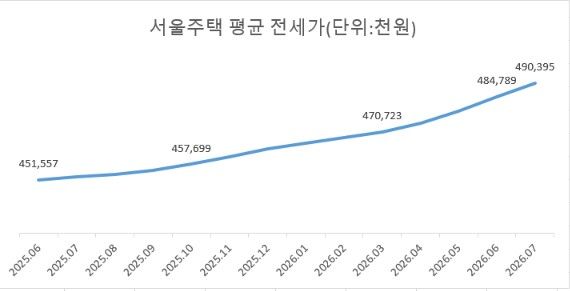
According to monthly data released by the Korea Real Estate Board (KREB) on the 1st, the average housing lease price in Seoul stood at 490.39 million won in July. The figure includes apartments, villas, and detached houses. It is the highest level on record. Even during the previous rental crisis, the average lease price was in the 480 million won range. The data show that Seoul's average housing lease price reached a record high in July.
These areas are concentrated mainly in the northern part of the city. Specifically, they include Jongno District, Yongsan District, Seongdong District, Gwangjin District, Dongdaemun District, and Mapo District. In the southern part of Seoul, the housing lease price indices in Yeongdeungpo District, Songpa District, and Gangdong District have also moved above their previous peaks.
The previous peak in lease prices came in late 2021 and early 2022. At the time, the housing market was hit hard by a lease shortage, as various regulations and the implementation of the two rental laws took effect.
Housing sale price indices have already surpassed their previous highs, with only some outer areas of Seoul left behind. Now, lease price indices are also beginning to break past their former peaks in earnest as of July.
The cumulative rise in lease prices is also striking. Seoul's housing lease prices have risen 5.04% from January to July this year. That already exceeds the increases recorded over the same period in 2020, at 1.26%, and 2021, at 2.63%. Based on the January-to-July period, this is the sharpest rise in 15 years, since 2011, when the increase reached 6.11%. In addition, as of July, the lease supply-demand index for apartments in Seoul is nearing its previous peak, while the housing lease supply-demand index has already set a new record.
Professor Ko Jun-seok of Yonsei University said, "It takes at least a year, and often longer, for housing supply measures, including apartments and non-apartments, to show results." He added, "As government policies continue to reduce the volume of jeonse and monthly rental listings, instability in the rental market is likely to persist."
[email protected] Lee Jong-bae Reporter