Bessent Says U.S. Can Squeeze Iran Without China, Pushes Back on Treasury Market Concerns
- Input
- 2026-09-01 01:29:52
- Updated
- 2026-09-01 01:29:52
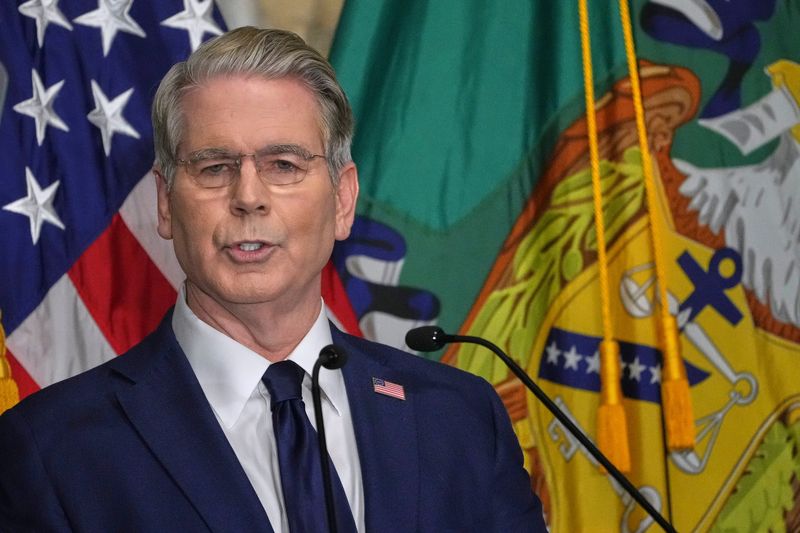
【Financial News, New York = Lee Byung-chulScott Bessent, the U.S. Treasury Secretary, said the United States can still make its sanctions strategy against Iran work even without China’s cooperation. He also pushed back against concerns that the Iran crisis and rising artificial intelligence investment are driving up long-term U.S. Treasury yields, saying the U.S. bond market remains the strongest in the world.
Speaking to reporters at the Group of Twenty (G20) meeting in Asheville, North Carolina, on the 31st local time, Bessent said the strategy of cutting off Iran’s funding could work even if China, Iran’s largest trading partner and oil buyer, does not join U.S. sanctions. "There is a false narrative spreading through the media that we cannot do this without China, and I do not agree," he said. "We can do it without China."
Bessent pointed to the fact that only 30 million barrels of Iranian crude remain at sea because of U.S. restrictions. He argued that even if Iran receives payments from China, its oil supply will eventually run out. In other words, if pressure on Iranian oil exports continues, foreign currency inflows to Tehran can be limited even if China keeps buying Iranian crude.
China has openly opposed U.S. sanctions on Iran. The Chinese government has said it opposes "illegal unilateral sanctions that have no basis in international law."
Bessent, however, said the United States and China actually share significant common ground on the issue. "We agree with China on more things than we disagree on when it comes to Iran," he said. "China also agrees that Iran should not have nuclear weapons, and it agrees that the Strait of Hormuz must remain open for free and fair shipping."
Bessent also disclosed that he met with Pan Gongsheng, governor of the People's Bank of China (PBC), on Sunday. He did not provide details on whether the two discussed Iran or financial sanctions in depth.
"The U.S. Treasury market is the strongest" ... Defends against long-term rate concerns
In an interview with CNBC, Bessent also strongly rejected concerns that the prolonged Iran crisis and the surge in AI investment are putting upward pressure on long-term U.S. interest rates.
"The U.S. bond market is the most resilient market in the world," he said. "This month, the U.S. bond market has performed better than any other major market." He added, "The 30-year yield is down, and the 10-year yield is flat. You cannot say that about other major bond markets."
He repeatedly stressed that the 10-year U.S. Treasury yield has essentially been unchanged since President Donald Trump took office. "If there were a problem in the U.S. bond market, investors would be selling U.S. Treasuries and buying bonds from other countries," Bessent said, arguing that the recent rise in long-term yields reflects global bond market movements rather than a U.S.-specific issue.
He also drew a line against interpretations that the Treasury Department's expanded long-term bond buybacks are an intervention designed to artificially push market rates lower.
"I never said I was trying to change the direction of interest rates," Bessent said. "I do not think I can change the market’s equilibrium price." He explained that his role is to provide fact-based information so the market does not move too far in one direction.
When asked about criticism that the Treasury Department's expanded buyback plan is still putting upward pressure on yields, he replied, "Consider the opposite. What would have happened if I had not done that?" He added, "We have not actually bought anything yet."
"The Iran war will pass, and AI will raise productivity"
Bessent also emphasized that the factors currently pressuring long-term yields are not permanent.
"We will eventually move past this Iran conflict," he said, suggesting that financial market pressure could ease once the situation stabilizes.
He also rejected claims that the race to invest in AI is creating a crowding-out effect, as Big Tech companies raise more funds and compete with U.S. Treasuries and private companies for investor money.
"I keep hearing that financing for AI infrastructure is creating a crowding-out problem," Bessent said. "But what it is actually creating is a productivity boom."
"Whether it is three months from now or six months from now, we are generating productivity," he said. "I believe that productivity gain will be disinflationary." His argument is that while expanded AI investment may absorb huge amounts of capital in the short term and push bond yields higher, it could improve productivity over the medium to long term, ease inflationary pressure, and eventually put downward pressure on rates.
He declined to comment directly on the possibility of a rate hike by the Federal Reserve System (Fed) in September. "I will not speculate on what the Fed will or will not do," Bessent said, while describing current inflationary pressure as a supply shock.
[email protected] Lee Byung-chul Reporter