[Editorial] Performance-based bonuses may lift growth, but their impact on investment should not be overlooked
- Input
- 2026-08-31 18:33:00
- Updated
- 2026-08-31 18:33:00
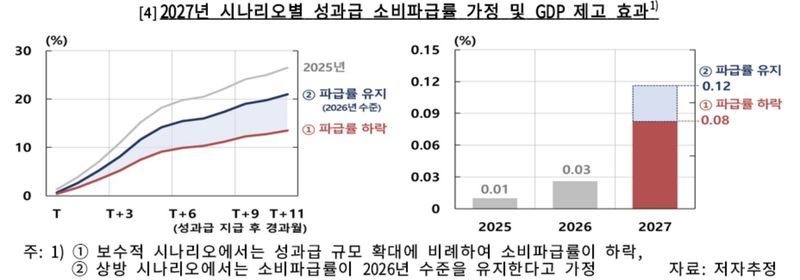
On the 31st, BOK released a report saying that higher consumption driven by expanded performance-based bonuses could raise next year's real gross domestic product (GDP) growth rate by 0.06 to 0.09 percentage points. The central bank said the semiconductor industry boom and bonus payments are having a positive effect on domestic consumption. Reflecting this analysis, BOK recently raised its growth forecasts for this year and next year to 3.3 percent and 2.9 percent, respectively.
Of course, BOK's analysis looks only at the consumption side. If wages, including bonuses, go up, consumption will naturally increase. Consumption boosts production and drives growth. Spending is what keeps the economy moving and growing. Consumption is a prerequisite for growth, so it is clear that performance-based bonuses should not be viewed unconditionally in a negative light when considering their effect on spending.
However, it should not be overlooked that excessive performance-based bonuses or wages can also have negative effects, such as discouraging corporate investment. This aspect is, of course, missing from BOK's analysis. If companies pay out most of their profits as wages, that may be good for consumption, but it leaves them with no money to invest in the future. It weakens their ability to develop further. Research should also be produced showing that large bonus payouts hurt investment and, over time, lead to negative consequences for economic growth.
In that sense, the bonus disputes at companies other than semiconductor firms, which are flush with cash thanks to a boom, are worrying. The conflict is spreading from the semiconductor industry to the IT industry and now to the shipbuilding industry. Following Hyundai Motor Company's 8-hour strike, which caused 230 billion won in losses, summer labor unrest at major conglomerates is intensifying.
The union at HD Hyundai Heavy Industries approved industrial action in a vote on the 27th. Its key demand is for performance-based bonuses equal to 30 percent of operating profit. HD Hyundai Heavy Industries posted 1.9453 trillion won in operating profit in the first half of this year, and if the trend continues, the bonus demand could reach the 1 trillion won range.
The shipbuilding industry, after years of prolonged weakness, has only recently begun to recover as orders have increased since last year. Now, however, its docks are at risk of coming to a standstill. The industry is in a boom period comparable to the semiconductor industry. The operating rates of Korea's three shipbuilders are close to 100 percent, and if a strike breaks out, losses would follow immediately, just as they did at Hyundai Motor Company.
If companies make strong profits, wages should rise. But a demand for a 30 percent bonus is excessive. From a company's perspective, when profits are high, it should spend more on things it could not afford during losses, such as facility investment. Once 1 trillion won is spent on bonuses, that much room for maneuver disappears. Moreover, if U.S.-Korea shipbuilding cooperation moves into full swing, companies will also need to make investments in the United States.
The union at POSCO, which has been hit by weak results amid the downturn in the steel industry, is demanding a 7.1 percent increase in base pay and a 600 percent incentive payment. This reflects a mindset that says workers should live well regardless of whether the company earns a lot or a little. This is not only a problem in the shipbuilding and steel industries. Conflicts related to the Yellow Envelope Act are also adding to companies' difficulties. A company must survive for a union to exist, and with demands this excessive, it will be difficult to achieve labor-management coexistence and mutual growth.