"Cash Rewards Lose Their Incentive Effect the Moment They Are Received": KEF Calls for a Redesign of the Total Rewards Paradigm
- Input
- 2026-09-01 11:00:00
- Updated
- 2026-09-01 11:00:00
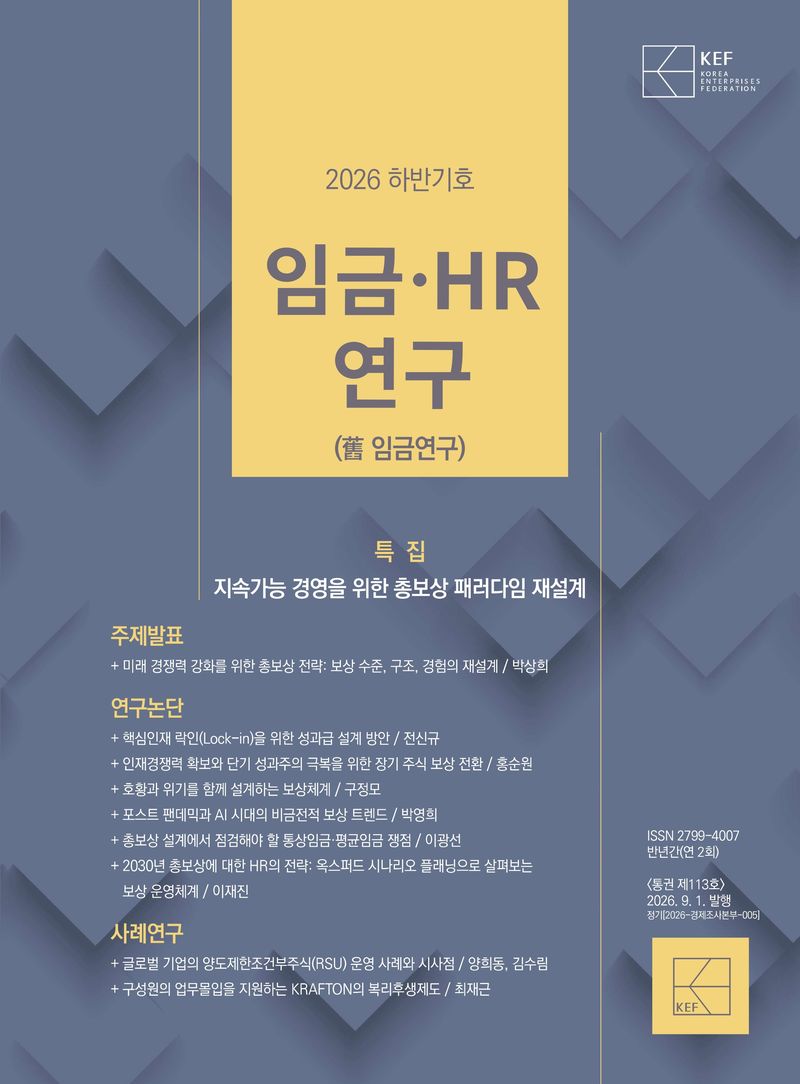
On the 1st, KEF said it had published the second-half 2026 issue of its regular journal, Wage & HR Research, under the theme "Redesigning the Total Rewards Paradigm for Sustainable Management."
In this issue, Sanghee Park, a professor at Hanyang University’s College of Business, said that "the talent and capabilities companies need are changing, workforce structures and employment periods are also shifting, and employees are evaluating compensation by increasingly diverse standards." She added that "companies need to redesign their overall total rewards strategy so it can support their management and talent strategies in line with these changes."
Park also said that "the starting point of a total rewards strategy is base pay." She suggested that "base pay should be determined by the value of the work currently assigned, rather than years of service, and differences in skill and sustained contribution should be reflected within the same job."
Jeon Singyu, managing director at Korn Ferry, pointed out that "a system that distributes bonuses at a uniform rate to all employees based on company-wide performance can deepen free-riding, drive out key talent, weaken motivation among younger employees, and create inefficiencies in labor costs." He explained that "general-purpose talent should receive appropriate compensation, while rewards resources should be concentrated on key talent and critical roles to secure top-tier market competitiveness in pay."
Professor Gu Jeong-mo of Mokwon University emphasized that "performance bonuses should be designed not only to share gains during high-performance periods, but also to set adjustment standards for variable pay during low-performance or crisis periods and principles for normalization during recovery." He added that "a sustainable compensation system can function only when standards are established that can be applied consistently in both boom times and crises."
Hong Soon-won, managing director at Human Consulting Group, stressed that "because long-term incentives are missing from the total rewards portfolios of many domestic companies, they should use long-term stock compensation to strengthen mid- to long-term value sharing and retention of key talent." Hong also noted that "cash loses its incentive effect as compensation the moment it is received, and no matter how large a bonus is, it cannot guarantee continued service after payment; in fact, a lump-sum payout can become the seed money for a job change or early retirement."
The case study section covered real-world examples such as Apple and NVIDIA’s stock compensation practices, as well as Krafton’s organizational culture-based welfare system.
Ha Sang-woo, a director at KEF, said that "as the business environment is changing more rapidly and dramatically due to AI and digital transformation, companies also need to move away from seniority-based and uniform compensation systems and shift in line with the changing landscape."
He added that "companies need to build a sustainable total rewards system that concentrates compensation on key talent and roles directly linked to future competitiveness, while using long-term rewards and non-monetary rewards alongside short-term cash compensation." He also emphasized that "within such a system, performance bonuses should be designed and operated rationally, taking into account the company’s long-term competitiveness and investment capacity."
Meanwhile, Wage & HR Research is a regular publication issued twice a year that selects major issues related to human resources, organization, and wage systems at domestic and overseas companies as special topics and presents views from academics and field experts, along with case studies from leading companies.
[email protected] Kim Dong-chan Reporter