Samsung Biologics' 3 Trillion Won Rights Offering Leaves the Market Skeptical [fn Market Watch]
- Input
- 2026-08-31 17:06:53
- Updated
- 2026-08-31 17:06:53
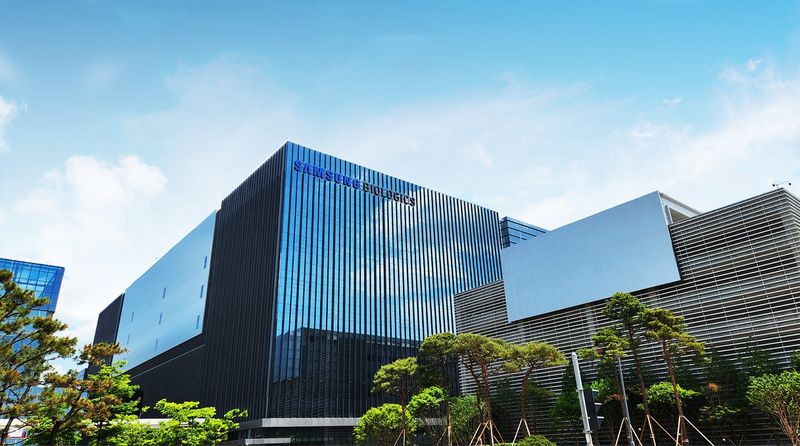
[Financial News] Samsung Biologics has unveiled a 3 trillion won rights offering as its sole funding option, but critics say the company has asked shareholders for money first without winning market agreement on its business progress or mid- to long-term growth roadmap. While the purpose of the fundraising is clear, the case for the 15.4 trillion won investment plan it will support is still seen as unproven.
The market says, "Samsung Biologics' decision to choose a rights offering as its only funding option is highly disappointing."
According to the investment banking industry on the 31st, Samsung Biologics held a board meeting on the 28th and approved a 3 trillion won rights offering, issuing 2.27 million common shares at 1.322 million won per share. Of the proceeds, 270 billion won will be used to acquire Swiss peptide contract development and manufacturing organization PolyPeptide Group, while about 295 billion won will go toward facility investment. The new shares will amount to about 4.9% of the company’s existing shares outstanding.
Shin Young-kyung, a researcher at Shinyoung Securities, said, "It is very disappointing that the company chose a rights offering alone as a financing method to minimize its burden," adding that "the key will be to prove the 1.54 trillion won mid- to long-term CAPEX plan one step at a time."
What is making the market uncomfortable is the gap between this move and the company’s explanation a month earlier.
When Samsung Biologics announced the PPG acquisition in July, it said it would consider borrowing, bonds and a rights offering, but that a capital increase would be a lower priority. In the end, however, it decided to raise the full 3 trillion won through equity. The company cited a weak corporate bond market, a higher debt ratio if it relied entirely on borrowing, and the fact that major investments are concentrated in the early stages.
The key issue is the visibility of the mid- to long-term investment plan, which totals 15.4 trillion won. Large-scale investments are planned for the PPG acquisition, Plants 6 and 7, the third bio campus and the Rockville factory in the United States. However, details such as orders and utilization rates at Plant 5 and the U.S. plant, ADC order performance and the timing of construction for Plant 6 have not been disclosed. That is why the market is focusing more on future investment results than on the rights offering itself.
Intensifying global CDMO competition and labor issues are also variables. As Lonza, Fujifilm BI New Zealand branch and WuXi Biologics expand their production capacity and process development capabilities, Samsung Biologics' labor union staged its first full strike in the company’s history in May.
One industry source said, "Because CDMO is a business where stable supply is essential, the market’s ultimate assessment of this 3 trillion won rights offering will depend on whether future large-scale CAPEX actually leads to orders and results."
PPG's strength is also under scrutiny, and its relatively weak profitability raises questions about whether the valuation can be justified.
The acquisition target, PPG, is also seen as needing validation. PolyPeptide Group is a peptide CDMO with six production sites in Europe, the United States and India. Last year, it posted revenue of 389.3 million euros and EBITDA of 46.8 million euros. Revenue rose by more than 15%, but profitability is lower than Samsung Biologics'. The acquisition price carries a premium of about 40% to the share price before rumors of the deal emerged. The key questions are how the company will offset the lower profitability of PPG with the stronger margins it has built through the biosimilar spin-off, and what synergies it can create with Samsung Epis Holdings.
Another variable is the participation of the largest shareholder. Based on the planned issue price, Samsung C&T and Samsung Electronics are expected to be allocated about 100 billion won and 75 billion won, respectively. Since the stake held by related parties exceeds 74%, participation is likely, but whether they subscribe in full is expected to influence investor sentiment.
The credit rating industry viewed positively the fact that the company will fund the 270 billion won acquisition with equity rather than debt. By contrast, opinions in the securities industry were mixed, with Daol Investment & Securities maintaining its target price at 2.1 million won, while DS Investment & Securities lowered its target to 1.85 million won.
The company must also clear tougher scrutiny from the financial authorities on rights offerings. As the FSS is closely examining the interests of general shareholders and the purpose of the funds, Samsung Biologics will likely need to justify the necessity of the PPG acquisition and how it will enhance shareholder value.
Shin Young-kyung of Shinyoung Securities said, "The dilution is only around 5%, so the short-term impact is limited," but added that "the company needs to fully explain and substantiate its investment plans, including modality expansion and development of the third campus."
Samsung Biologics has ruled out any additional rights offerings. In the end, just as it demonstrated results through large-scale expansion after its 320 billion won capital increase in 2022, the key task this time is to prove the value of the 270 billion won it will put into PPG through growth and profitability.
[email protected] Kang Gu-gwi Reporter