Jeju exports nearly 1.8 times last year's total in just seven months... Governor Wi Seong-gon seeks solutions for quarantine, sales channels and talent
- Input
- 2026-08-31 16:19:14
- Updated
- 2026-08-31 16:19:14
[Financial News, Jeju = Jung Yong-bok] Jeju Province's exports in just seven months this year have reached about 1.8 times last year's annual total, posting the nation's highest growth rate. But with semiconductors accounting for 69.6% of exports, local exporters said quarantine, overseas sales channels, logistics and labor shortages are becoming bottlenecks to further growth.
According to Jeju Special Self-Governing Province and the Korea Customs Service on July 31, Jeju's exports from January to July this year totaled $609.98 million, or about 835.2 billion won, up 280.3% from the same period last year. That was the highest growth rate among all metropolitan local governments nationwide.
That figure is also about 79% higher than last year's full-year export total of $340.42 million, or about 466.1 billion won. In just seven months, this year's exports have already far surpassed last year's annual performance.
While the overall export volume has grown rapidly, concentration in a few items has also deepened. Semiconductors accounted for 69.6% of Jeju's exports from January to July. Their export value reached about $400 million, or about 547.7 billion won, up 366.3% from a year earlier.
Exports excluding semiconductors also rose 167.5% from a year earlier, showing growth in other categories as well. Still, Jeju accounted for just 0.1% of the country's total exports, leaving a wide gap between the pace of growth and the absolute scale.
In July alone, the concentration in a few items was even more pronounced. Jeju's exports for the month reached $167.68 million, or about 229.6 billion won, a monthly record. That was up 417.3% from a year earlier and 88.3% from the previous month.
Semiconductors accounted for 53.9% of the total, while aircraft made up 39.7%. Together, the two items represented 93.6% of monthly exports.
This record growth has raised a new policy challenge for Jeju: how to spread the benefits beyond a few strong-performing items and across the broader local business base.
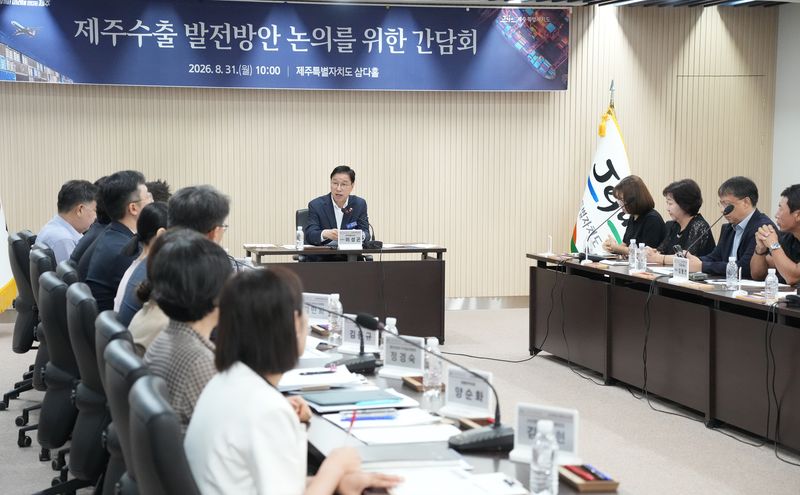
Jeju Province held a meeting on the morning of July 31 at Samdahol in the provincial office, chaired by Governor Wi Seong-gon, to discuss measures for developing Jeju exports.
Seven export companies in semiconductors, cosmetics, food and agricultural, marine and livestock products attended the meeting, including Jeju Semiconductor, Jeju Indi, Eco J Food, Korea Mu Export, Jeju Flatfish, Jeju Changhae Fisheries and Hondi Livestock.
Export support organizations also took part, including the Jeju Economic and Trade Promotion Agency, aT's Jeju regional headquarters, KOTRA's Jeju office and the Jeju branch of the Korea International Trade Association.
The difficulties raised on site were not reflected in export figures, but they were real problems of time and cost.
Han Yong-ok, head of Jeju Flatfish, explained, "To quarantine live fish exported from Jeju, we have to send them to other regions such as Busan, which takes about four nights and five days in business days." He asked for conditions that would allow quarantine to be carried out in Jeju so that urgent orders can be handled.
Jeju Province said it would work with local lawmakers and aT to propose institutional reforms to the Ministry of Oceans and Fisheries and the Ministry of the Interior and Safety.
There were also calls to shift overseas sales from one-off promotions to year-round distribution. Kang Geum-ran, head of Korea Mu Export, proposed permanent overseas sales spaces where Jeju products could be sold throughout the year, along with a system that would let companies choose the support programs they need directly.
Kang Chun-il, head of Jeju Indi, cited the company's July launch of products in 100 offline stores in Japan. He said sales can continue only if local promotion and support for consultations with buyers in Europe and North America follow the initial store placement.
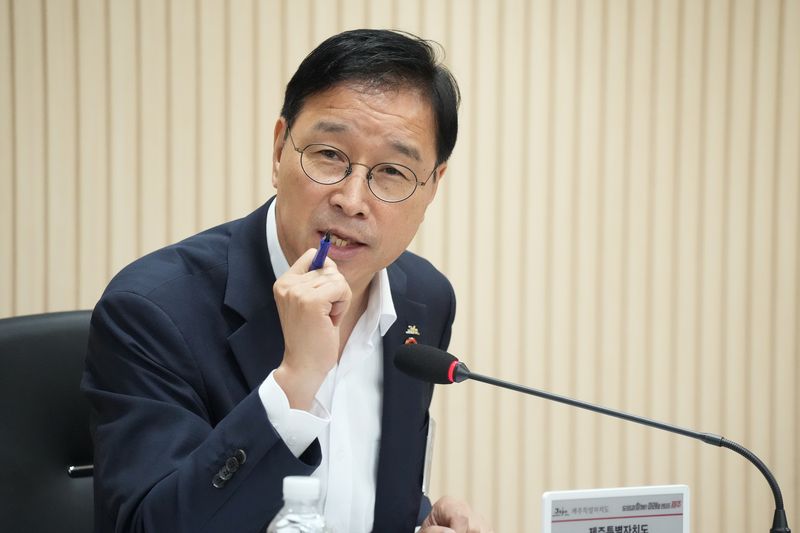
Governor Wi said the province would review ways to unify export support channels so companies do not have to visit multiple agencies for each project. He also said officials would look into operating overseas sales spaces jointly with other regions.
In the semiconductor sector, which has driven Jeju's export growth, securing talent emerged as a key issue. Sanghun Kim, executive vice president of Jeju Semiconductor, said 64% of the workforce at the company's Jeju headquarters are local residents. He proposed incentives for companies that hire local talent and support for workers recruited from outside the province to settle in Jeju.
Jeju Province plans to look for support measures it can link with the Ministry of Trade and Industry, while also considering ways to attract other semiconductor design companies to Jeju and connect them with workforce support.
Industry-specific issues were also raised, including livestock price volatility, professional interpretation for export consultations and responses to U.S. import regulations on seafood.
The key challenge ahead is to turn the surge in exports into a broader expansion of Jeju's export industry. While semiconductors and aircraft have driven overall performance sharply higher, the sustainability of export growth will depend on how much the province can reduce quarantine, logistics and sales barriers faced by agricultural, marine, livestock, food and cosmetics companies.
Wi said, "We need a single window where companies can receive support at once without having to go from one place to another," adding, "We will connect the proposals raised on site to support that companies can actually feel."
[email protected] Jung Yong-bok Reporter