Can Kim Min-seok's Mega-Growth and Youth Policies Help Reverse President Lee's Approval Rating?
- Input
- 2026-08-31 16:01:24
- Updated
- 2026-08-31 16:01:24
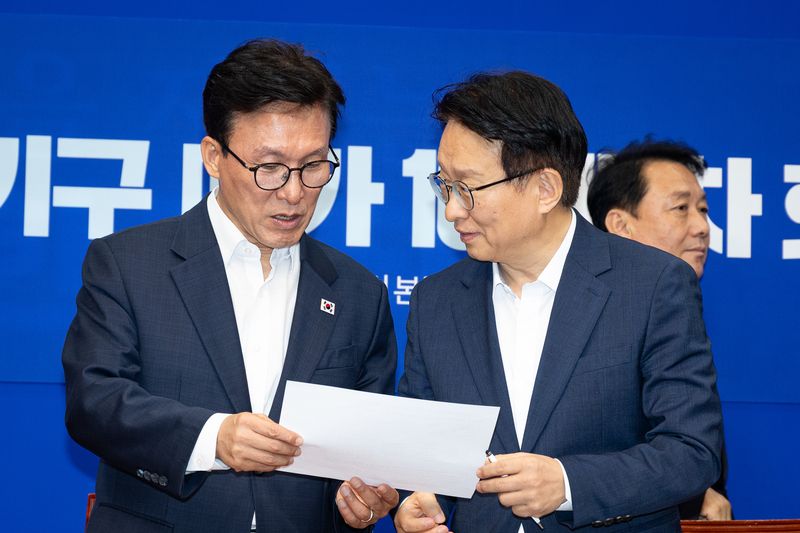
At the National Assembly, Kim said the Mega Growth Special Committee, which held its first meeting that day, is "the most important body for our party's direction as well as for the nation and the government," adding that "from now on, we will directly plan and take responsibility" at the party level. The committee, which expands and integrates the existing special committees supporting the three major mega-projects and national balanced growth, will develop regional growth strategies centered on semiconductors, physical AI and AI data centers. Lee Kwang-jae, chair of the Special Committee on Budget and Accounts of the National Assembly, will serve as senior vice chair, while former Kim Kyung-soo, former head of the Presidential Committee for Local Era, and Kwon Chil-seung, a former minister of SMEs and Startups and current head of the Democratic Party of Korea's Policy Committee, will serve as standing vice chairs.
The party also stepped up policy efforts aimed at young people. The Democratic Party of Korea plans to identify policies directly tied to the lives of young people, including housing, finance and jobs, while broadening contact with young party members in an effort to regain support from a demographic where it is relatively weak. Kim Han-kyu, who heads the 1030 Youth Policy Team, cited a Realmeter poll released that day showing the party's approval rating at 20-something percent among people in their 20s and 30-something percent among those in their 30s. "As the ruling party, we must take this as a very painful and serious result," he said. "Rather than grand slogans, we will first focus on policies directly connected to young people's lives." Kim Min-seok also promised to make the Democratic Party of Korea more youth-oriented, saying that even when approval ratings were much higher, young people's satisfaction with state affairs remained relatively low.
This policy drive is drawing attention as President Lee's approval rating continues to slide. According to a survey conducted by Realmeter at the request of Energy Economy Newspaper from July 24 to 28 among 2,509 adults aged 18 and older nationwide, positive evaluations of President Lee's performance fell 1.3 percentage points from the previous week to 38.9%. It marked the seventh consecutive weekly decline and the first time the figure had dropped into the 30% range since he took office. Negative evaluations rose 1.8 percentage points to 58.7%. In particular, positive ratings among moderates also fell 3.2 percentage points to 41.4%.
The Democratic Party of Korea plans to support President Lee's major policy goals, including mega growth, youth policy, the AI transition economy and livelihoods, at the party level, while also accelerating related legislation and budget support. As Kim has made clear that the party will take an active role from the policy planning stage, the key question is whether the 'Mega Ten' can produce policy outcomes that people can feel in their daily lives and create a turning point for a rebound in the government's approval rating.
The cited poll on the president's job approval was conducted by automated phone response using mobile numbers. The margin of error was plus or minus 2.0 percentage points at the 95% confidence level, and the response rate was 3.9%. For more details, see the website of the Central Election Poll Deliberation Commission.
[email protected] Song Ji-won Reporter