Over the Next Two Years, 425,412 Households Are Expected to Move In Nationwide; Gyeonggi Province Leads with 151,343
- Input
- 2026-08-31 15:48:14
- Updated
- 2026-08-31 15:48:14
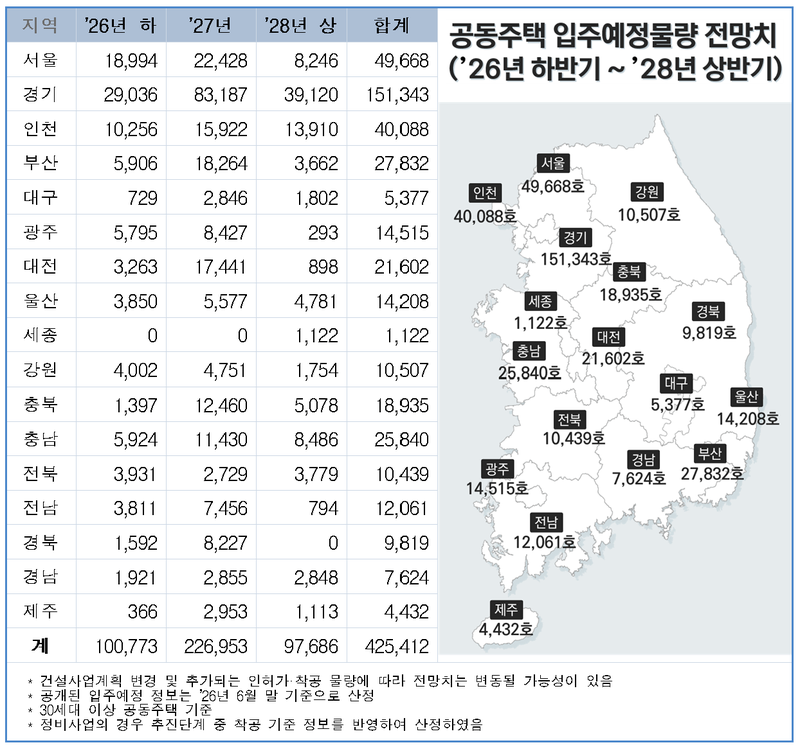
According to the 'Apartment Move-in Volume Information' jointly released on the 31st by KREB and Real Estate 114, 100,773 households are expected to move in during the second half of 2026. The figure is estimated at 226,953 households in 2027 and 97,686 households in the first half of 2028.
The Capital Region accounts for 241,099 of the expected move-ins, or about 56.7% of the total. That includes 151,343 households in Gyeonggi Province, 49,668 in Seoul, and 40,088 in Incheon.
By period, the Capital Region supply is estimated at 58,286 households in the second half of 2026, 121,537 in 2027, and 61,276 in the first half of 2028.
In particular, the 2027 outlook for the Capital Region has risen to around 122,000 households, up about 5% from the 116,000 announced in February. The increase reflects changes in move-in schedules for individual complexes and the addition of 5,000 households at Banpo THE H Class in Seoul, which is being sold after construction.
Outside the Capital Region, Busan had the largest expected volume at 27,832 households. It was followed by South Chungcheong Province with 25,840, Daejeon with 21,602, North Chungcheong Province with 18,935, Gwangju with 14,515, and Ulsan Metropolitan City with 14,208.
The forecast was calculated as of the end of June 2026 by combining housing construction records, move-in application notices, redevelopment project progress data, and other materials held by KREB and Real Estate 114. It covers apartment complexes with at least 30 households, and for redevelopment projects, it reflects construction-start information among the project stages.
However, because it does not reflect construction plan changes, move-in schedule adjustments, or additional after-construction sales that occurred after the reference date, actual move-in volumes may differ from this forecast.
Detailed regional and period-specific data can be found on KREB's R-ONE Real Estate Statistics Information System, Cheongyak Home, and the Public Data Portal.
[email protected] Choi Ga-young Reporter