"CPTPP trade larger than with the U.S. or China" ... Korea emerges as a solution to the new trade order
- Input
- 2026-08-31 16:06:17
- Updated
- 2026-08-31 16:06:17
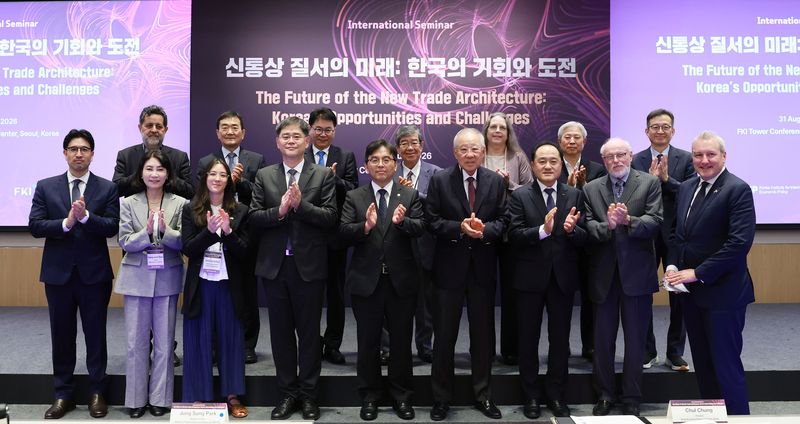
[Financial News] As protectionism spreads and global supply chains are reshaped, weakening the existing multilateral trade order, South Korea should actively make use of "open plurilateral cooperation," including the Comprehensive and Progressive Agreement for Trans-Pacific Partnership (CPTPP), experts said.
The argument is that trade between South Korea and CPTPP member countries exceeds trade with the United States or China, respectively. As a result, existing trade ties should be brought together under a single institutional framework to stabilize supply chains and secure leadership in global trade rules.
The Federation of Korean Industries (FKI) said on the 31st that it had co-hosted the international seminar "The Future of the New Trade Order: Korea's Opportunities and Challenges" with the Korea Institute for International Economic Policy (KIEP) at the conference center of FKI Tower in Yeouido, Seoul. The seminar was organized to examine Korea's trade strategy options amid the weakening multilateral trading system, the restructuring of global supply chains, and the spread of protectionism. In particular, the role of "open plurilateral cooperation" among like-minded countries, such as the CPTPP, was discussed in depth.
In his welcome remarks, FKI Chairman Ryu Jin said, "Companies urgently need stable markets, reliable supply chains and a predictable framework of rules," adding, "The business community is paying close attention to the CPTPP, a new trade cooperation system based on openness and rules."
The first session was held under the theme, "Can open plurilateral cooperation shape the future of global trade?" In her keynote speech, Deborah Elms, head of trade policy at the Hinrich Foundation, said the recent trend toward economic integration faces a fundamental rupture. Still, she described it as "a transition from globalization to a more regionalized and fragmented form."
Elms presented three options for mid-sized trading nations: waiting and maintaining the status quo, aligning with a major power, or pursuing selective partnerships. She said, "Rather than creating a new organization, the most realistic option is 'selective partnership' that makes use of cooperation structures that are already functioning, such as the CPTPP or FIT-P."
In the second session, Jeffrey Schott, senior fellow at the Peterson Institute for International Economics (PIIE), delivered the keynote address and analyzed Korea's trade situation under the theme, "Korea's strategic choices in the emerging trade order." As of last year, trade between South Korea and CPTPP member countries stood at about $341 billion, or 25% of total goods trade. That figure exceeds trade with China, at about $273 billion or 20%, and with the United States, at about $196 billion or 15%.
Schott said, "Korea has signed bilateral agreements with 10 of the 12 CPTPP members, but the scope of those rules varies, and there are no agreements with Japan or Mexico," adding, "Since substantial trade ties already exist, an institutional framework is needed to govern them comprehensively." He also said participation in the CPTPP would not only help ease supply chain risks involving critical minerals and machinery, but also allow Korea to take part in setting new global rules on data, labor and the environment.
[email protected] Im Subin Reporter